
A blistering assessment of government appointments has exposed widespread favouritism across both major political parties. The long-suppressed findings reveal how political connections have regularly trumped merit in board selections.
Finance Minister Katy Gallagher released the explosive review on 2 December 2025, more than two years after former public service commissioner Lynelle Briggs handed it to her. The timing raises questions about why Labor kept the findings hidden for so long.
The report’s central finding couldn’t be clearer: appointment processes across federal government have “let down the Australian people” and damaged public sector integrity.
What the Review Found
Briggs didn’t mince words in her assessment titled “No Favourites.” She identified systemic problems with how both Coalition and Labor governments fill board positions.
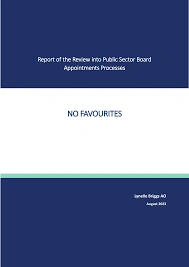
Report of the Review into Public Sector Board Appointments Processes
The review found appointments are often made to reward political loyalty rather than identify the best candidates. This practice has created a perception among Australians that board appointments function as a “closed shop” accessible only to political insiders.
Key findings include:
- Between 6-7% of all board appointments can be described as overtly political
- Up to 50% of appointments in some portfolios are direct ministerial appointments with no formal process
- Public perception holds that all ministerial appointments are political, regardless of actual process
- Pre-election appointment “bequests” to departing governments are described as “shameless”
“Too often the practice in recent years has been to appoint friends of the Government to boards, either as a reward for past loyalty or to ensure alignment with government priorities,” the review states.
Briggs argued these appointments have created the appearance of patronage and nepotism, eroding trust in government institutions. The Westminster system depends on public confidence in government integrity, she noted.
The Recommendations Labor Rejected
The Briggs review proposed 30 recommendations designed to create distance between ministers and appointment decisions. Most have been ignored.
The key recommendation called for legislating a standard 10-step appointment process. This would include public advertising of positions and full selection panel systems for all government board roles.
Other major proposals included:
- Former politicians and staffers banned from appointments for six months after leaving government
- Ministers and their staff facing an 18-month ban
- No direct ministerial appointments in the six months before an election
- Standard four-year terms for all board positions
- Individuals limited to serving on no more than two paid boards simultaneously
The government response? A seven-point framework that maintains ministerial flexibility and requires no legislative backing.
Government’s Alternative Framework Falls Short
Rather than implement Briggs’ systematic reforms, the Albanese government has released what it calls the Australian Government Appointments Framework. The document replaces the 2008 Merit and Transparency Policy but lacks enforcement mechanisms.
The framework states ministers should “always seek to make the best possible appointments on the basis of merit.” However, it adds that ministers retain “flexibility to implement selection processes suitable for sourcing the best candidates.”
Independent assessment panels need only be used “when appropriate and proportionate.” No formal justification for hand-picked appointments is required, though ministers should be “prepared to publicly justify” their choices.
Senator Gallagher defended the approach during a heated parliamentary hearing, claiming legislation wouldn’t add value. She said the framework provides necessary flexibility given the breadth of government appointments.

Katy Gallagher, Minister for Government Services
The framework takes effect in February 2026.
Political Reactions Expose Deep Divisions
Independent Senator David Pocock expressed disappointment with the government’s response. He described Labor’s rejection of Briggs’ recommendations as evidence of why Australians have lost trust in politicians.
“It is very disappointing that the Albanese Government has refused to accept the full suite of recommendations from the Briggs Review designed to stop the rampant appointment culture that exists in federal politics,” Pocock said.
He added it was “clear why the government was hiding it” for over two years.
Industry Minister Tim Ayres defended Labor’s appointment record during ABC Radio National interviews. He insisted all Labor appointments followed proper processes and served the national interest.
“We have made appointments in the national interest,” Ayres said. “These are good appointments, they’ve been made in the national interest.”
Greens Senator Barbara Pocock challenged this assertion during a Senate hearing. She highlighted that the new framework contains no repercussions for ministers who fail to follow its guidelines.
Why This Matters for Australian Democracy
The broader significance extends beyond any single government’s actions. Trust in democratic institutions requires transparency and merit-based decision-making.
When Australians believe government positions go to political mates rather than qualified candidates, it undermines confidence in public administration. This erosion of trust affects government effectiveness and policy implementation.
The Westminster system Australia inherited depends on clear separations between political considerations and public service. Appointments that appear political blur these boundaries.
Briggs argued in her review that current arrangements expose ministers to unnecessary risk while failing to deliver the best candidates. She proposed reforms to ensure “the chance to do meaningful work that contributes to our country will no longer be seen as a closed shop accessible only by the chosen few.”
The question now is whether Labor’s weaker framework will address these concerns or simply maintain the status quo with different packaging.
The Two-Year Delay and Senate Pressure
The government commissioned the review in 2023 after Labor spent the 2022 election campaign criticising Coalition appointment practices. Senator Gallagher specifically accused the previous government of overseeing a culture of political favouritism.
Briggs completed her work in August 2023. Yet the government sat on the findings for more than two years.
Senator Gallagher repeatedly claimed she couldn’t release the report because it remained under cabinet consideration. This explanation drew criticism given other government-commissioned reviews have been released without formal responses.
Senate Question Time descended into chaos in recent weeks over Labor’s refusal to table the document. The Senate eventually forced the government’s hand through a formal order requiring release before the end of 2025.
The delayed release has fuelled speculation about whether the report’s findings embarrassed the current government as much as its predecessor.
What Happens Next
Implementation of the new framework begins in February 2026. Government departments will need to adjust their processes to meet the stated principles, though without legislative backing or enforcement mechanisms.
Independent observers will likely monitor subsequent appointments closely to determine whether practices actually change. The framework’s effectiveness will ultimately be judged by whether Australians see appointments that look more merit-based and less political.
The political opposition now has ammunition to challenge future Labor appointments that appear to favour party allies. Each board selection will face scrutiny over whether proper processes were followed.
For the Australian public service, the episode reinforces concerns about political interference in what should be independent functions. Whether the new framework addresses these concerns remains to be seen.
The Briggs review offered a roadmap for fundamental reform. The government chose a different path. Only time will reveal whether Labor’s approach restores public confidence or simply papers over systemic problems.
Also Read: Greens Attack Labor’s AI Strategy as Government Dodges Dedicated Regulation
Frequently Asked Questions
Q: What is the Briggs review about?
A: The Briggs review examined how federal government appointments to public sector boards are made. It found widespread evidence of political favouritism and recommended independent, merit-based selection processes.
Q: Why did the government delay releasing the report?
A: Finance Minister Katy Gallagher claimed the report was under cabinet consideration. Critics argue the delay was to avoid embarrassment over findings that implicate the current Labor government as well as the previous Coalition.
Q: What recommendations were rejected?
A: Major rejected recommendations include legislating a mandatory appointment process, banning former politicians from board roles for six months, and preventing ministerial appointments six months before elections.
Q: What is the new appointments framework?
A: The government’s alternative framework provides principles for appointments but lacks legislative backing or enforcement mechanisms. It maintains ministerial flexibility rather than imposing independent selection requirements.
Q: How will this affect future government appointments?
A: The framework takes effect in February 2026. Its impact depends on whether ministers actually follow the guidelines without legal requirement to do so. Public and political scrutiny of appointments will likely increase.


