Most investors chasing the AI revolution pile into Nvidia, Microsoft, and other tech giants. They’re missing something critical hiding in plain sight.
Every data centre built to power ChatGPT, every semiconductor fab churning out AI chips, and every server rack processing machine learning workloads shares a common dependency. Antimony.
This strategic metalloid doesn’t grab headlines like rare earths or lithium. Yet without it, the entire AI infrastructure buildout grinding to a halt remains a distinct possibility.
United States Antimony Corporation (NYSE: UAMY) sits at the centre of this supply squeeze. The company is America’s only fully integrated antimony producer at a time when China controls 70% of global supply and recently weaponised export restrictions.
Data Centres Can’t Function Without Flame Retardants
AI data centres face an uncomfortable truth. The massive computing power required to train large language models generates extraordinary heat. More servers packed into confined spaces mean higher fire risk.
Antimony trioxide serves as the primary flame retardant synergist in electronics housings, wiring systems, and roofing materials. When combined with halogenated compounds, it creates a powerful fire suppression effect that far exceeds what either component achieves independently.
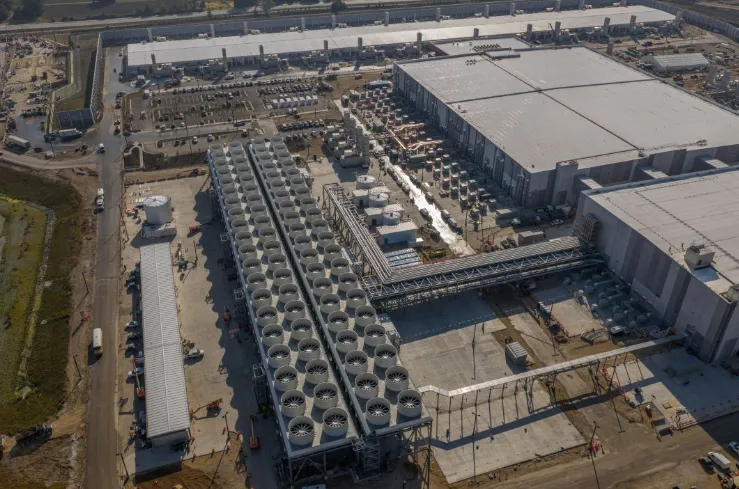
Aerial view of Microsoft’s new AI datacenter campus in Mt Pleasant, Wisconsin.
According to industry executives, all new AI data centres require antimony-based flame retardants on their roofs and throughout their wiring systems. The roofing chemical alone represents a massive addressable market.
United States Antimony secured a $104 million contract just weeks ago for fire retardants in roofing materials. That’s not military ordnance. That’s commercial construction driven by the data centre boom.
The semiconductor manufacturing process adds another layer of demand. Materials like gallium, germanium, antimony, tungsten, and others remain vital for semiconductor production, creating bottlenecks that affect AI chip availability.
From $20 Million to $1.1 Billion in Two Years
United States Antimony Corporation’s market capitalisation has exploded. The company went from a $20 million valuation to $1.1 billion in just two and a half years.
Revenue projections tell the growth story. The company expects to jump from $40-$43 million this year to $125-$150 million next year. That’s not incremental growth. That’s transformation.
Recent contract wins demonstrate the strategic shift:
- $245 million with the Defense Logistics Agency after China’s export ban
- $104 million for industrial flame retardants
- Multiple government agreements totalling over $350 million
The Montana refinery expansion aims to increase output fivefold. Processing capacity becomes the new constraint as demand outstrips supply.
Also Read: Resolution Minerals strengthens North American expansion strategy
China’s Export Ban Creates a Strategic Opening
December 2024 marked a turning point. China banned exports of antimony and germanium to the United States in retaliation for semiconductor restrictions.
The U.S. military holds the lowest antimony supply since World War II. Years of supplying the Ukrainian and Israeli conflicts depleted stockpiles while depending on Chinese imports.
This geopolitical reality transformed antimony from industrial commodity to national security imperative. The U.S. imports over 80% of its antimony Center for Strategic and International Studies, with no current domestic primary production outside UAMY’s operations.
Market prices reflect the supply crisis. Antimony trioxide costs surged 400% in the past year alone, with recent reports indicating prices reaching $51,500 per ton in early 2025.
The Brookings Institution confirms antimony sits among critical minerals like gallium, germanium, tungsten, and molybdenum vital for semiconductor manufacturing Brookings but not readily available from domestic sources.
Australia and the U.S. are reshaping rare earths supply chains to reduce Chinese dependence, creating parallel opportunities in antimony markets.
Trump Administration Backs Critical Minerals Renaissance
President Trump’s March 2025 executive order “Immediate Measures to Increase American Mineral Production” changed the regulatory landscape overnight.
The order explicitly designates antimony among critical minerals receiving fast-track permitting and federal investment support. Within months, the administration deployed over $1 billion in equity stakes across mining companies.
Key policy mechanisms include:
- Export-Import Bank authorised for domestic critical minerals financing
- Defense Production Act authorities streamlined
- International Development Finance Corporation pivoted to domestic projects
- 10-day deadlines for compiling pending mineral projects
The administration’s $400 million equity investment in MP Materials demonstrates the scale of federal commitment. Similar support for antimony producers appears inevitable given defence priorities.
The White House confirmed plans for financing, loans, and investment support for new mineral production projects through a dedicated critical minerals fund.
Semiconductor Supercycle Demands More Than Silicon
The AI chip boom created what industry analysts call a “giga cycle” in semiconductors. Global semiconductor revenue could pass the trillion-dollar threshold before the decade closes.
This growth requires more than advanced lithography. Supply chain constraints across multiple materials threaten to slow the entire buildout.
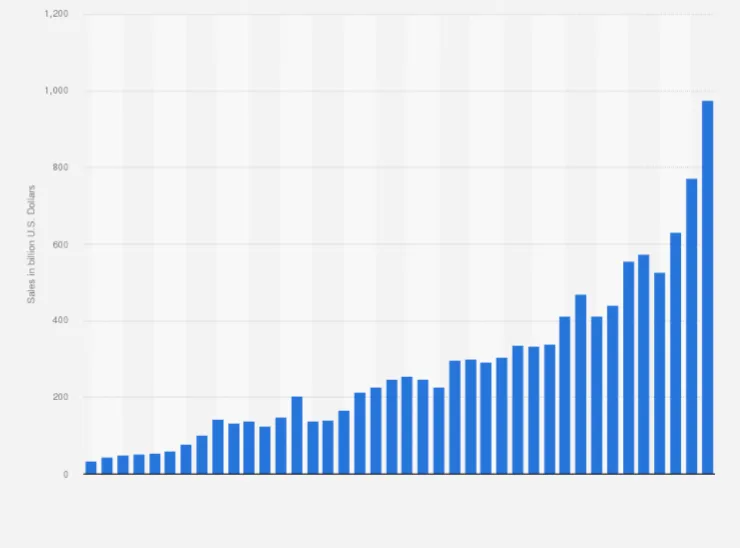
Semiconductor market size 2026
Memory shortages already impact consumer electronics. DRAM prices are expected to rise 30% in Q4 this year and another 20% in early 2026 due to AI infrastructure demand.
Data centre semiconductor markets are projected to grow from $209 billion in 2024 to $492 billion by 2030. Every layer of this expansion requires flame-retardant materials meeting stringent safety standards.
Antimony oxide’s role extends beyond flame retardants. The material functions as a stabiliser in plastics, a catalyst in polymerisation, and a component in specialty glass and ceramics used throughout electronics manufacturing.
Black Cat Syndicate’s antimony project advances demonstrate growing interest across Australian mining companies in this critical mineral.
Stock Performance Reflects Strategic Positioning
As of 29 December 2025, UAMY trades at $6.17 per share within a 52-week range of $19.71 – $1.21. The stock hit an all-time high of $19.71 on 14 October 2025.
Recent performance shows volatility but strong underlying momentum:
- 1 Month: Mixed performance with significant swings
- 2025 YTD: Substantial gains from year-start levels
- 1 Year: +421% from December 2024 lows
Market capitalisation stands at approximately $883.6 million with 140 million shares outstanding. Trading volume averages nearly 15 million shares daily, indicating strong institutional interest.
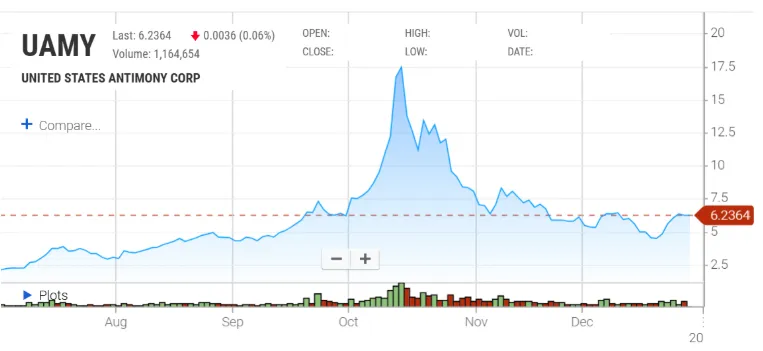
United States Antimony Corporation Common Stock (UAMY) Charts
H.C. Wainwright raised the price target to $10.25, citing strategic growth and expansion driving the buy rating. Analyst consensus points to significant upside from current levels.
The company’s forward P/E ratio of 23.5 suggests markets are pricing in substantial earnings growth despite current losses. This reflects confidence in the revenue ramp from major contract wins.
Financial challenges persist. Q3 2025 showed a loss of $0.04 per share against expectations. Revenue guidance of $40-$43 million for 2025 missed the $46.4 million consensus.
Yet investors appear willing to look past near-term struggles to the strategic positioning ahead.
The Geopolitical Premium in Critical Minerals
China’s dominance across critical mineral processing creates systemic vulnerability. Beijing controls over 70% of rare earth processing globally and similar percentages in antimony refining.
The U.S. government recognises this exposure. Korea Zinc’s recent $7.4 billion Tennessee refinery project received 40% Defense Department ownership in the joint venture. This demonstrates Washington’s willingness to take direct equity stakes securing mineral supply chains.
United States Antimony benefits from being the domestic exception. The company mines, processes, and refines antimony entirely within American borders. That vertical integration becomes increasingly valuable as trade restrictions proliferate.
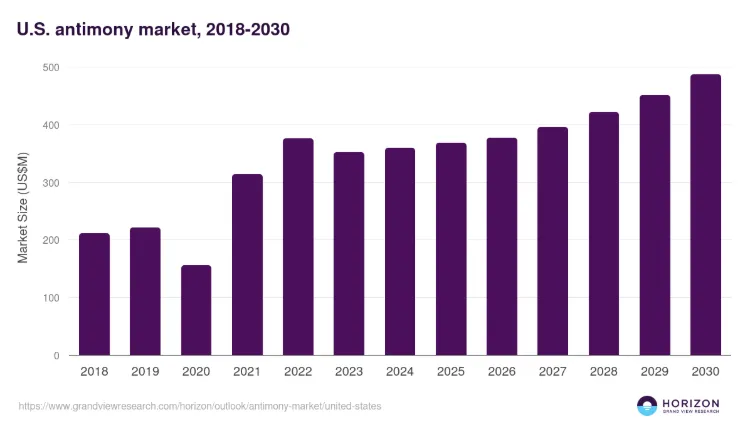
The United States Antimony Market Size & Outlook, 2030
Europe faces similar dependencies. Osmond Resources advances its Orion project in Spain to provide EU-based critical minerals including titanium and rare earths.
The U.S. antimony market is projected to grow from $2.45 billion in 2025 to $4.38 billion by 2035, reflecting a 6.0% compound annual growth rate driven by flame retardants and battery manufacturing.
Beyond AI: Antimony’s Expanding Applications
Flame retardants represent approximately 55% of global antimony consumption. The remaining 45% spans applications that also benefit from current trends.
Lead-acid batteries still dominate automotive starting systems, representing 75% of the rechargeable battery market in this sector. Antimony enhances battery performance and longevity.
Defense applications remain critical. Antimony trisulfide serves as a primer in ammunition. The metal itself goes into bearings, storage batteries, and ordnance.
Specialty applications include:
- Catalysts in polyester and PET production
- Colorants and opacifiers in glass and ceramics
- Semiconductors and thermoelectric materials
- Friction materials and rubber formulations
United States Antimony’s diversified revenue streams provide some insulation from single-market dependence. The company produces antimony oxide, trisulfide, and metal products alongside zeolite and precious metals recovery.
Risk Factors Investors Must Consider
No investment thesis comes without caveats. Several factors could derail the antimony opportunity.
Operational Challenges
The Montana facility faces labour constraints. Management noted border patrol arrests of five Peruvian workers with fraudulent documents disrupted operations. Recruiting to rural Montana proves difficult.
Production ramps take time. The company targets 300 tons monthly by March 2025 and 500 tons shortly after. Execution risks remain if these timelines slip.
Alternative Materials Development
Phosphorus-based flame retardants offer halogen-free alternatives. Companies like Clariant promote solutions that eliminate antimony trioxide dependency, though these require formulation adjustments and aren’t direct drop-in replacements.
Organic compounds and hydrated aluminum oxide can substitute for antimony in certain flame retardant applications. Technological shifts could reduce demand over time.
Market Volatility
Antimony prices surged 400% but could reverse if Chinese export restrictions ease. Political changes in Washington might reduce federal support for domestic mining.
The stock’s 52-week range from $1.21 to $19.71 illustrates extreme volatility. Investors seeking stable returns should look elsewhere.
Financial Performance
Current losses and missed revenue guidance raise execution concerns. The company needs to convert contracts into profitable operations. Cash burn remains a risk if production ramps disappoint.
What This Means for Portfolio Strategy
United States Antimony Corporation represents a pure play on critical mineral supply chain reshoring. Few public companies offer comparable exposure.
The investment case rests on several premises:
- AI infrastructure buildout continues requiring massive fire safety investments
- China maintains export restrictions on strategic minerals
- U.S. government support for domestic production persists
- The company successfully ramps Montana refinery output
- Major contract wins translate into profitable operations
If these hold true, current valuations could prove conservative. The company trades at roughly 7x projected 2026 revenues of $125-$150 million.
Comparable mining companies in similar growth phases often command 10-15x revenue multiples. Apply that to UAMY’s upper guidance, and $2+ billion market caps become plausible.
But this remains a speculative position. Small-cap mining stocks face operational risks, financing needs, and market volatility that can destroy shareholder value quickly.
Position sizing matters. This belongs in the high-risk, high-potential-return bucket alongside other critical mineral plays, not as a core holding.
Also Read: Weebit Nano Lands Blockbuster Deal with Texas Instruments in Memory Tech Breakthrough
FAQs: United States Antimony Corporation and AI
Q: How does antimony relate to artificial intelligence?
A: Antimony serves as the primary flame retardant synergist in AI data centre infrastructure, including roofing materials, electronics housings, and wiring systems. The massive heat generation from AI computing requires robust fire safety measures.
Q: Why did China ban antimony exports to the United States?
A: China imposed export restrictions in December 2024 as retaliation for U.S. semiconductor sanctions. Beijing controls 70% of global antimony production and recognised its strategic leverage in critical minerals.
Q: Is United States Antimony Corporation profitable?
A: No. The company reported a loss of $0.04 per share in Q3 2025. However, major contract wins totalling over $350 million are expected to drive revenue from $40-$43 million this year to $125-$150 million in 2026, potentially turning profitable.
Q: What is UAMY’s stock price target?
A: Analysts at H.C. Wainwright set a price target of $10.25 per share, suggesting approximately 62% upside from current levels around $6.31. The 52-week high reached $19.71 in October 2025.
Q: Are there alternatives to antimony in flame retardants?
A: Yes. Phosphorus-based and halogen-free flame retardants exist, though they require formulation changes and aren’t direct replacements. Antimony trioxide remains the industry standard for electronics applications due to its effectiveness and established supply chains.
Q: How much antimony does the U.S. import?
A: The United States imports over 80% of its antimony requirements, with China historically supplying the majority. Domestic production has been negligible for decades until recent efforts to restart operations.