
Weebit Nano Limited (ASX: WBT) has scored a landmark agreement with one of the world’s largest semiconductor manufacturers. The Australian-Israeli memory technology developer announced on 29 December 2025 that Texas Instruments has licensed its resistive random access memory (ReRAM) technology.
The deal places Weebit at the centre of the semiconductor industry’s shift away from traditional flash memory.
Texas Instruments generated US$17.3 billion in revenue over the past 12 months. The agreement marks a watershed moment for Weebit, which has been working to commercialise its next-generation memory technology since 2015.
Why This Deal Matters
Texas Instruments (NASDAQ: TXN) ranks as the world’s largest analogue semiconductor manufacturer. The company produces tens of billions of chips annually for automotive, industrial, and embedded processing applications.
Under the agreement, Weebit’s ReRAM will be integrated into TI’s advanced process nodes for embedded processing semiconductors.

Sign at TI’s Dallas headquarters
The partnership covers:
- IP licensing and technology transfer
- Design qualification in TI’s process technologies
- Integration for automotive-grade operations at 150°C
Amichai Ron, Senior Vice President at TI Embedded Processing, said the collaboration would deliver “industry-leading NVM technology in performance, scale, and reliability.”
Second Major Deal This Year
Weebit signed a similar agreement with onsemi (NASDAQ: ON) in January 2025. That partnership generated more than $9 million in cash flow during the first nine months, according to analyst estimates from Pitt Street Research.
Texas Instruments is roughly twice the size of onsemi by revenue. Market observers expect the initial license fees to exceed those from the earlier deal.
Coby Hanoch, CEO of Weebit Nano, described the announcement as “another strong signal that the industry is moving towards ReRAM as the successor to flash memory in SoC designs.”
The company now holds IP licensing agreements with four fabrication facilities alongside several product companies.
Revenue Guidance Emerges
Following the Texas Instruments agreement, Weebit issued formal revenue guidance for the first time.
The company expects minimum revenues of A$10 million for FY26. Management had previously indicated a revenue goal exceeding $10 million at the November 2025 AGM but stopped short of making it official guidance.
With additional agreements secured since then, the company now has sufficient visibility to formalise its outlook.
Weebit maintains a lean cost structure with cash holdings of approximately A$1.17 million as of 30 June 2025 and no corporate debt.
ReRAM Technology Gains Traction
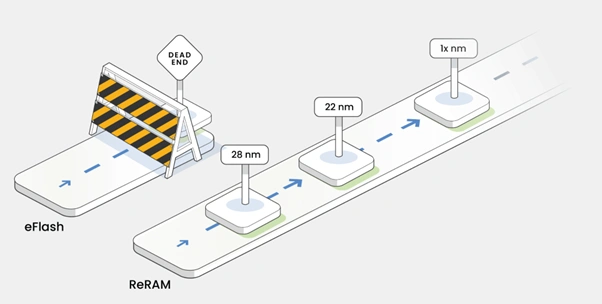
Resistive random access memory offers several advantages over conventional flash memory. The technology delivers faster read and write speeds, lower power consumption, and better performance at high temperatures.
Weebit’s ReRAM has been qualified for AEC-Q100 standards at 150°C operation. This makes it suitable for automotive applications where extreme conditions are common.
The technology uses fab-friendly materials based on silicon oxide. This allows chip manufacturers to integrate ReRAM without retooling existing production lines.
The global ReRAM market was valued at US$630 million in 2025 and is forecast to reach US$1.6 billion by 2030. That represents a compound annual growth rate of 20.49%, according to market research firm Mordor Intelligence.
Rising demand comes from applications in:
- Artificial intelligence and machine learning
- Internet of Things devices
- Autonomous vehicles
- Edge computing systems
- 5G communications infrastructure
Texas Instruments’ Embedded Processing Focus
Texas Instruments operates primarily through its Analogue and Embedded Processing divisions. The company generates most revenues from automotive and industrial sectors.
Both verticals are experiencing rapid growth driven by automation, electrification, and advanced driver assistance systems (ADAS).
TI’s most advanced processing node currently operates at 28 nanometres using planar CMOS technology. This is primarily deployed in high-end automotive system-on-chip applications.
The company sells more than 80,000 different chip types across its portfolio. This creates extensive opportunities for ReRAM integration beyond initial automotive applications.
Industry analysts believe the deal may accelerate commercial discussions with other analogue integrated device manufacturers including Infineon, STMicroelectronics, and Analog Devices.
Market Response
Weebit Nano shares have responded strongly to the company’s recent momentum. The stock closed at A$4.13 on 27 December 2025, within its 52-week range of A$1.38 to A$5.65.
Year-to-date performance shows gains exceeding 100% as the company transitions from development to commercialisation.
Market capitalisation stands at approximately A$865 million based on 209 million shares on issue.
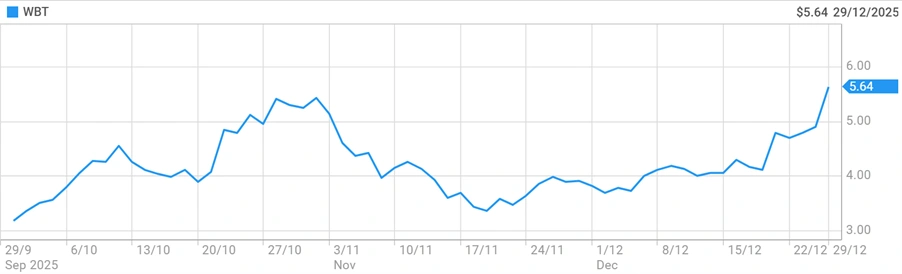
Trading volume has averaged more than one million shares daily over the past month as institutional interest builds.
The technology sector has experienced volatility recently amid global semiconductor demand uncertainty. However, critical memory technologies continue attracting strategic partnerships and investment.
Strategic Positioning
Weebit’s dual approach targets both embedded and discrete memory markets. The near-term focus remains on embedded applications where customers integrate the IP into system-on-chip designs.
Longer-term plans include expansion into discrete memory components. This market encompasses NOR flash replacement and emerging storage-class memory applications.
The company maintains development partnerships with CEA-Leti, a French research institute, and has taped out test chips at multiple production facilities.
Successful qualification at onsemi’s 300mm fab in New York earlier this year demonstrated manufacturing readiness. The Texas Instruments agreement builds on this foundation with a significantly larger partner.
Industry Context
Flash memory faces physical limitations as chip geometries shrink below 10 nanometres. The technology requires more than 10 additional masks in the manufacturing process and struggles with power efficiency at smaller nodes.
ReRAM addresses these challenges through a simpler architecture requiring only two additional masks. The technology also enables bit-level addressing rather than block-level operations used in flash.
This creates architectural advantages for embedded systems needing fast, random access to small amounts of data.
Applications in automotive and industrial equipment particularly benefit from ReRAM’s radiation tolerance and electromagnetic field resistance. These environments often exceed the operating parameters of conventional flash memory.
Next Steps
Weebit will now begin technology transfer and design qualification work with Texas Instruments. The timeline for first product integration has not been disclosed.
Additional commercial agreements remain possible as the semiconductor industry evaluates next-generation memory options. The company’s growing roster of manufacturing partners provides validation for its technical approach.
Investors will watch revenue recognition timing as Texas Instruments progresses through design and qualification milestones. The A$10 million FY26 guidance provides a baseline but leaves room for upside as additional deals materialise.
With two major integrated device manufacturers now on board, Weebit Nano has established itself as the leading independent supplier of ReRAM technology. The shift from development to revenue generation marks a critical transition for the decade-old company.