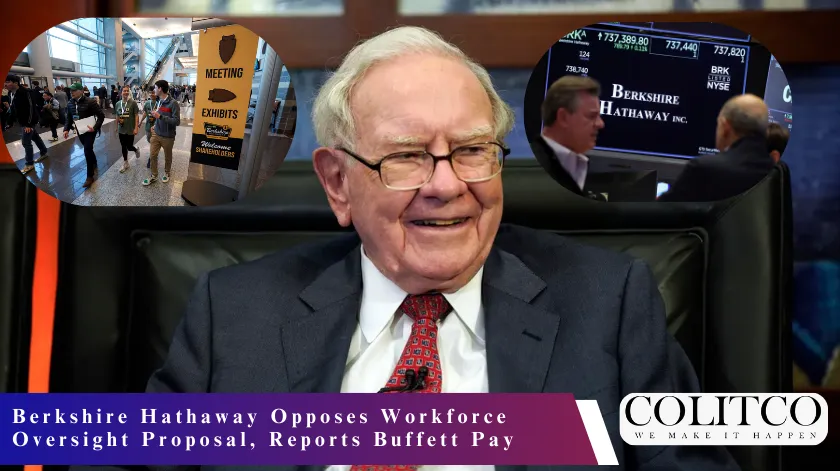
The compensation and corporate governance policies of Warren Buffett have been in the limelight after Berkshire Hathaway shot down a shareholder proposal regarding the management of the workforce.
The problem was revealed in the proxy statement of the Company prior to its yearly shareholder convention due on May 2 in Omaha, Nebraska. The filing revealed that Buffett received compensation in 2025, which amounted to $389,488, including his usual salary of 100,000, as well as security expenses.
The board also acted concurrently in asking investors to vote against a shareholder proposal that requested the Company to provide a comprehensive report on the workforce and human-capital management of its subsidiaries.
The firm indicated that such reporting was not necessary because the Company had a highly decentralised operating model. The proposal is a subset of the greater shareholder discussion of governance, transparency and labour controls in large multinational corporations.
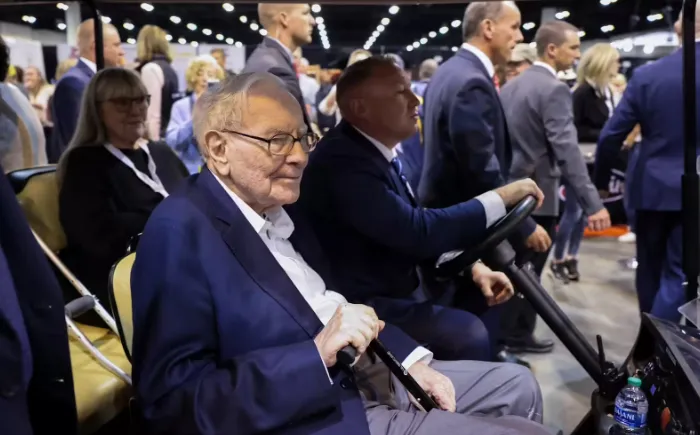
Warren Buffett attends Berkshire Hathaway’s annual shareholder meeting in Omaha. [Courtesy: ET Telecom]
Berkshire Hathaway Shareholder Proposal 2026 Sparks Governance Debate
The shareholder proposal 2026 of Berkshire Hathaway demanded that the Company provide a report on how it conducts supervisory workforce policies within the dozens of operating businesses within the Company.
The proponents claimed that such disclosure enhances transparency and assists investors to learn about labour risks and labour workforce practices. The proposal was unanimously voted down by the Berkshire board and advised shareholders to cast their votes against the proposal.
According to directors, the decentralised structure of the conglomerate gives subsidiaries the freedom to run their business and policies towards employees. The management believes that a centralised workforce overseer report would run counter to the long-standing management philosophy of the Company, according to the board.
This governance controversy points out a more general trend in which shareholders are agitating towards more disclosure concerning workforce practices, environmental factors and corporate responsibility.
Why Did Berkshire Reject Workforce Oversight Reporting?
The board of Berkshire justified this by saying that they have subsidiaries and that there is independent workforce decision-making in the subsidiaries. The conglomerate has an extensive variety of businesses, including insurance, railroads, energy companies, manufacturing operations and retail brands.
Due to this diversity, the board claimed that it would not be viable to apply one workforce oversight model. It was also noted by the directors that the management teams in the localities are in a better position to know their employees and their operational needs.
The firm reaffirmed its conventional governance strategy by saying subsidiaries are obliged to obey the law and do what is right. Such a position is characteristic of the old culture of Berkshire that values decentralised leadership and operational independence.

Berkshire Hathaway headquarters building in Omaha, Nebraska. [Courtesy: Shutterstock]
How Does Warren Buffett’s Compensation News Affect Investors?
Warren Buffett’s compensation news can shed some light on the leadership structure and executive pay transparency at Berkshire Hathaway.
Although Buffett has been running the Company for several decades, his salary is relatively small compared with those of other CEOs of companies of the same size. He is still being paid a token salary that is a token representation of his massive ownership stake in the organisation.
Buffett holds 13.7% of the Berkshire stock yet 30.2% of the voting power; hence has a lot of influence on voting with the shareholders. It is a form of voting in which any proposal that is against Buffett and the board has a great difficulty winning the majority in terms of votes.
Governance developments are thus being monitored by investors closely in an attempt to know how leadership decisions would affect the long-term strategy of Berkshire.
Greg Abel Pay Details Highlight Berkshire Leadership Transition
The proxy filing also showed the next generation of leadership of Berkshire in terms of compensation. In 2025, Chief Executive Greg Abel was paid 22 million, identical to the compensation of Vice Chairman Ajit Jain.
Abel was appointed as chief executive by Buffett on January 1, 2026, and had served as vice chairman of non-insurance operations since January 1, 2018.
The filing also revealed that Berkshire has just started back with share buybacks, spending over 200 million dollars in buying its own stock after almost two years of no buybacks.
The Company had cash and equivalents of $373 billion, which is roughly a third of its market value of one point six trillion at the end of the year. Analysts attribute such figures to a conservative capital allocation policy of Berkshire.
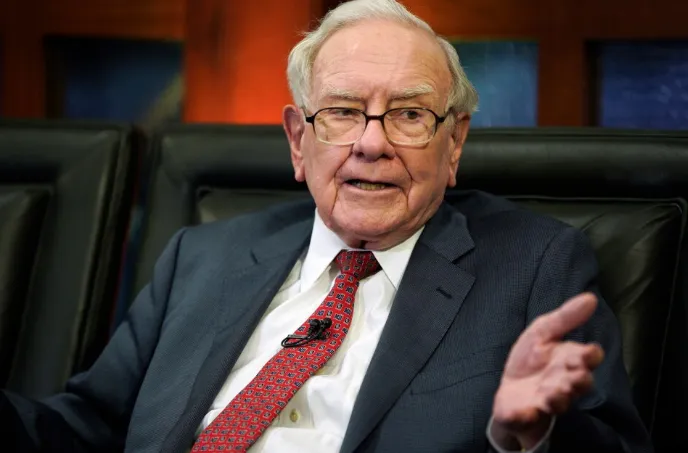
Greg Abel speaks during a Berkshire Hathaway investor event. [Courtesy: AP News]
Berkshire Hathaway Corporate Governance Update Signals Future Strategy
The recent update of the corporate governance of the Berkshire Hathaway firm indicates that the Company is unlikely to alter its traditional decentralised management despite growing activism of shareholders.
The board advocated the conduct of an advisory vote-on-pay vote within every three years, wherein the shareholders will be able to give their opinions regarding executive remuneration.
Nevertheless, it is also not responsive to the requests that it needs to report more in the areas of workforce management or operational policies. This transparency-operational freedom balance is at the core of the philosophy of governance of Berkshire.
To investors, the argument brings to the fore the manner in which big conglomerates have to manoeuvre the pressure towards increased disclosure without losing management flexibility.
The following shareholder meeting on May 2 will probably be of great interest to the investors because the governance concerns, the strategy of executive compensation, and capital allocation are still developing.
Also Read: Commonwealth Bank Commits A$90M to AI Workforce Upskilling Across 30,000 Staff
FAQs
Q1. What happened in the Berkshire Hathaway shareholder proposal 2026?
A1: Berkshire’s board urged investors to reject a proposal requesting a report on workforce oversight across subsidiaries.
Q2. How much did Warren Buffett earn in 2025?
A2: Buffett earned $389,488, including his usual $100,000 salary and security expenses.
Q3. Who succeeded Warren Buffett as CEO of Berkshire Hathaway?
A3: Greg Abel became CEO on January 1, 2026, after serving as vice chairman.
Q4. Why does Buffett still influence shareholder votes?
A4: Buffett owns 13.7% of the stock but controls 30.2% of the voting power, giving him strong influence.
Disclaimer:
This article is for informational purposes only and does not constitute financial, investment, or legal advice. Colitco presents news based on publicly available information and credible sources. Readers should conduct their own research or consult a qualified financial advisor before making investment decisions.
Sources
- Reuters– Berkshire awards CEO Abel $22 million for 2025, confirms it resumed stock buybacks
- Reuters– Berkshire shareholders reject diversity, AI proposals