
Venezuela holds the world’s largest proven oil reserves on paper, but actual production remains a fraction of that potential. In reality, the country produces less than a million barrels per day, a fraction of its former capacity.

Figure 1: The El Palito refinery in Puerto Cabello, Venezuela, operated by state-owned oil company PDVSA. [source: The Guardian]
The recent political developments have sparked speculation about a rapid recovery. However, experts warn that fixing the Venezuela oil sector requires far more than lifting sanctions.
Why Venezuela’s Oil Production Remains Low: The Structural Damage
The Venezuela oil sector decline began in 2007 with government expropriations. That year, authorities forced foreign operators into minority positions and seized assets when companies like ConocoPhillips and ExxonMobil rejected new terms.
The Orinoco Belt represents one of the world’s most technically demanding heavy oil regions. Sustaining production requires advanced reservoir management, steady diluent supply and multi-billion-dollar upgraders to make the crude usable.
When foreign operators left, they took critical capabilities with them. Future investment capital, technical expertise, operational discipline and project management systems all disappeared.

Figure 2: Oil production equipment at a Venezuelan drilling site. [source: Reuters]
Venezuela’s state-owned oil company PDVSA received the assets but not the knowledge to run them. Maintenance deteriorated, equipment failed, and skilled workers departed.
Production fell steadily years before oil sanctions arrived. This structural damage explains why Venezuela’s oil production remains low even when considering potential sanctions relief. The damage cannot be reversed quickly, even under stable political conditions.
Venezuela Oil Recovery Challenges: When Sanctions Accelerated the Fall
Sanctions hit Venezuela directly in January 2019. Earlier measures targeted individuals with little production impact, but the 2019 restrictions changed everything.
The United States cut off Venezuela’s largest customer, restricted payments, blocked diluent imports and complicated shipping and insurance. Heavy oil that could have been produced became commercially stranded almost overnight.
Without a diluent, crude oil could not move through pipelines. Without U.S. refiners, Venezuela lost its most natural market. Joint ventures struggled to operate without reliable payment channels.
By late 2025, tanker movements nearly halted after U.S. interdictions. Vortexa data showed a 36 per cent drop in December alone.
This portion of the decline could reverse faster than structural damage. Wells shut in for commercial reasons can restart, joint ventures can normalise operations, and diluent flows can resume.
However, this would not restore Venezuela to its former peak of 3 million barrels per day. It could produce a meaningful short-term increase of perhaps 500,000 additional barrels daily. Understanding Venezuela oil recovery challenges requires recognising that sanctions relief alone addresses only part of the problem.
Chevron’s Unique Position in Venezuela
Chevron stands apart from other Western oil companies. It is the only major U.S. firm that never fully exited Venezuela.
Through exemptions, Chevron retained its joint ventures, maintained personnel on the ground, and preserved operational continuity. The company currently produces around 200,000 barrels per day through its Venezuelan operations.
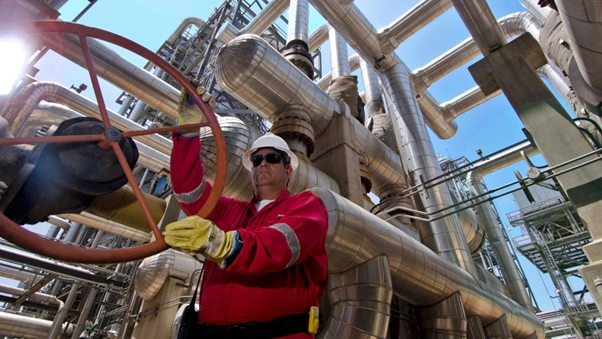
Figure 3: A Chevron employee operates equipment at a Venezuelan oil facility. [source: Chevron]
This continuity matters significantly. Chevron does not need to renegotiate entry terms or rebuild relationships from scratch. If sanctions ease, Chevron is positioned to scale operations faster than any other Western oil company.
The company understands Venezuela’s geology and operations. Employees remain on-site who could expand operations quickly with clearer commercial frameworks. This positions Chevron uniquely to address some Venezuela oil recovery challenges faster than competitors.
ConocoPhillips and the Compensation Question
ConocoPhillips occupies a very different position. The company was expropriated in 2007 and later won an US$8.7 billion arbitration award plus interest for seized investments.
The ongoing Citgo sale represents one pathway for recovery. If meaningful compensation is secured, a return to Venezuela becomes a viable option.
However, ConocoPhillips today is fundamentally different from 2007. After spinning off Phillips 66 in 2012, it became a pure exploration and production company rather than an integrated major.
The company redirected significant long-cycle heavy oil investment toward Canada after leaving Venezuela. It may have no interest in returning.
The Investment Required for Real Recovery
Existing oil fields and pipelines can be rehabilitated with relatively modest investment. Estimates range from US$10 billion to US$20 billion to add around 500,000 barrels per day.
This would bring total production to roughly 1.5 million barrels per day within a couple of years. Getting beyond that level requires developing new fields.
Raising production back to 3 million barrels per day needs substantially more capital. Some estimates suggest US$100 billion over ten years.

Figure 4: An aerial view of Venezuelan oil infrastructure with active gas flaring. [source: CNN]
Major U.S. firms possess the technical expertise and capital for such projects. They have played large roles in Venezuelan production before.
However, excluding PDVSA entirely from revitalisation could risk future backlash. Joint ventures where PDVSA takes minority stakes could align interests better. The sheer scale of investment needed highlights why Venezuela’s oil production remains low despite vast reserves.
Venezuela Oil Sector: The Technical Challenges
Venezuelan crude is very heavy and sour, meaning it has high sulphur content. It often needs mixing with lighter crude to move easily through pipelines.
This makes Venezuelan oil technically difficult to refine. It always trades at a discount compared to other crude grades.
U.S. Gulf Coast refiners were originally built to handle heavy, sour crude from Venezuela and Mexico. This currently works in America’s favour.
Venezuelan oil is also a conventional play. Once a well produces, it continues for a long time. The economics differ greatly from U.S. shale plays that generate higher upfront returns.
Big oil firms need clarity on Venezuela’s long-term political future before committing serious capital. Most returns on current investment would come long after current political leaders leave office. These technical and economic realities form a core part of Venezuela oil recovery challenges.
Final Thoughts
The Venezuela oil sector faces intertwined problems that sanctions relief alone cannot solve. Structural damage from mismanagement and lost expertise requires years of patient rebuilding.
Commercial disruption from sanctions could ease faster, potentially adding meaningful barrels in the near term. However, massive debt burdens and compensation claims create additional hurdles.
Chevron’s maintained presence gives it advantages, whilst other majors face longer paths back. The heavy, sour nature of Venezuelan crude and conventional production economics means this will never be the cheapest oil to produce.
Also Read: St George Mining Extends Araxá Footprint as High-Grade Niobium Discovery Opens Northwest Zone
FAQs
Q1. Why Venezuela’s oil production remains low despite large reserves?
Ans. The Venezuela oil sector suffers from structural damage dating to 2007 expropriations, loss of foreign technical expertise, deteriorated infrastructure and skilled worker departures, separate from sanctions impacts.
Q2. How much oil does Venezuela currently produce?
Ans. Venezuela currently produces around 800,000 barrels per day, compared to 3 million barrels daily twenty years ago and 2.5 million as recently as 2016.
Q3. What are the main Venezuela oil recovery challenges?
Ans. Key challenges include US$10 billion to US$20 billion needed for field rehabilitation, US$100 billion for new development, US$170 billion in external debt and need for political stability.
Q4. Which U.S. oil company is best positioned in Venezuela?
Ans. Chevron never fully exited Venezuela, maintaining joint ventures producing 200,000 barrels daily and keeping personnel on the ground with operational continuity.