Australia enforced a groundbreaking social media prohibition for users under 16 years old today, December 10, 2025. The government describes this pioneering policy as an effort to mitigate pressures and dangers that children face online. Social media platforms must now take reasonable measures to prevent minors from establishing accounts and deactivate existing accounts belonging to users younger than 16.
Legislative Framework and Government Intent
The Australian Government passed the Online Safety Amendment (Social Media Minimum Age) Bill 2024 on November 28, 2024. The law took effect today as scheduled, requiring age-restricted social media platforms to prevent Australian children under 16 from maintaining accounts on their services. Parents cannot grant consent to allow underage children to use these platforms. The government enacted this legislation to address design elements that encourage prolonged screen time while exposing users to content that may adversely affect their health and wellbeing.
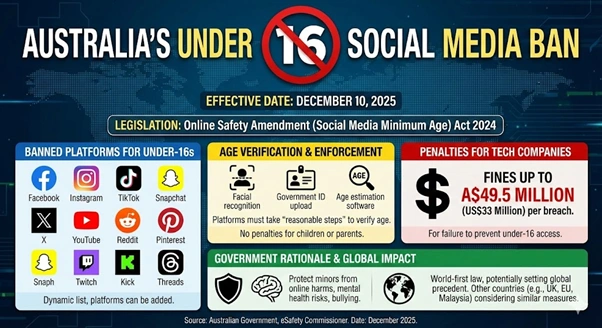
Everything about the ban
Affected Platforms and Scope
Ten major social media platforms fall under this ban today. The initial list includes Facebook, Instagram, TikTok, Snapchat, X, YouTube, Reddit, Twitch, Kick, and Threads. The government indicated that this list remains subject to change. Additional platforms could face inclusion if younger users migrate to them post-ban and they present similar concerns. Streaming services and online gaming platforms like Roblox and Discord have begun implementing age verification measures for certain features in anticipation of potential inclusion.
Enforcement Mechanisms and Penalties
The responsibility for upholding the ban lies with social media companies themselves, not with children or parents. Non-compliance carries substantial financial consequences. Companies face fines of up to $49.5 million for significant or repeated violations. The eSafety commissioner requires assurance that platforms have adopted reasonable measures to prevent underage users from maintaining accounts. The government stated that platforms cannot depend on users self-reporting their ages or parental confirmations.
Implementation Strategies Across Platforms
Meta, parent company of Facebook, Instagram, and Threads, began shutting down accounts for teens from December 4. Users mistakenly removed have the option to verify their age using government identification or by providing a video selfie. TikTok allows users to deactivate or delete their accounts and archive existing content. Users can submit an email for a reminder when they become eligible to log back in. Snapchat permits users to download their data while locking accounts until they verify their age. The platform implements a frozen state for accounts that platforms can reactivate upon reaching the appropriate age.
For Facebook and Instagram users, teenagers can download their photos and messages. They may place their accounts on hold until reaching 16 or choose to delete accounts permanently. Snapchat allows users to download photos and messages while locking accounts until age verification occurs.
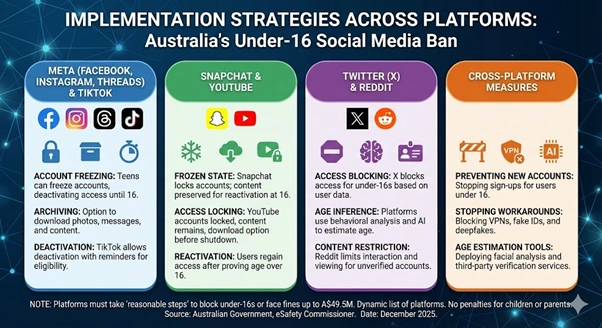
Implementation strategies across social media platforms
Age Verification Approaches
The Australian eSafety Commissioner Julie Inman Grant stated that platforms possess targeting technology capable of identifying users under 16 with remarkable precision. She emphasised that these platforms already hold adequate information to confirm whether a user exceeds 16 years old. The government encouraged platforms to adopt a variety of methods for age verification. Commissioner Inman Grant noted that blanket age verification for all users would prove unreasonable and impractical.
The government urged social media networks to employ minimally invasive techniques for verifying user ages. Methods include facial age estimation via video selfies, government identification submission, or bank card verification. Users over 16 who are incorrectly classified as underage can navigate appeals processes. Meta utilises facial verification through Yoti, requiring video selfies or government-issued identification. TikTok provides multiple appeal options including facial age estimation or government-approved identification submission.
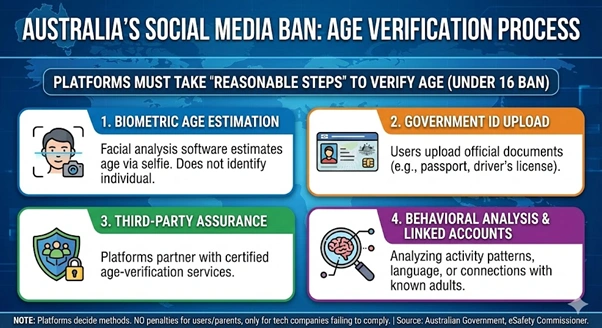
Age verification process
Initial Rollout and Realistic Expectations
The eSafety Commissioner clarified that the government does not expect all under-16 accounts to disappear overnight on December 10. Some platforms manage this transition more swiftly and effectively than others. Certain platforms require additional time to adjust their extensive systems. The Commissioner stated that enforcement will prioritise platforms with the highest percentages of underage users.
The rollout encountered initial challenges on implementation day. Guardian Australia received multiple reports indicating that some users under 16 successfully passed facial age verification tests. By Tuesday, all listed platforms except X had confirmed their intention to adhere to the ban. The eSafety Commissioner noted that discussions recently occurred with X regarding compliance. Bluesky, an alternative to X, declared that it would also prohibit under-16 users.
Also Read: Westpac Payment Systems Crash Leaves Thousands Stranded at Checkout During Christmas Shopping Peak
Impact on Young Australians
This ban is estimated to impact approximately 440,000 Australian users aged 13 to 15. In preceding weeks, children engaged in age verification checks and exchanged phone numbers in preparation for account deactivations. Parents of affected children expressed varying opinions about the new policy. Polling consistently reveals that approximately two-thirds of voters favour the minimum age requirement for social media use.
International Recognition and Global Interest
The ban has attracted significant international attention. Several countries indicated plans to implement similar restrictions, including Malaysia, Denmark, and Norway. The European Union has passed a resolution to introduce comparable measures. A spokesperson for the British government informed Reuters that the nation closely observes Australia’s approach to age restrictions.
Australia has established itself as the first nation globally to impose such comprehensive restrictions on younger users accessing social media platforms.