
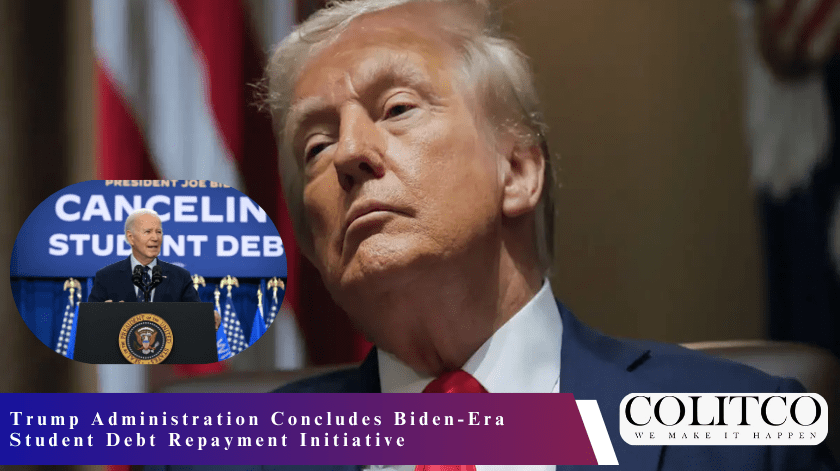
The Trump administration announced a joint legal settlement on Tuesday to terminate the Saving on a Valuable Education (SAVE) plan. This income-driven repayment programme faced sustained legal challenges from Republican-led states throughout the Biden presidency. The proposed agreement represents a significant shift in federal student loan policy direction.
Settlement Details and Implementation Strategy
Federal Education Department officials revealed that the settlement resolves ongoing litigation with Missouri and other red states. The agreement stipulates that the Education Department will cease enrolling new borrowers into SAVE immediately. Pending applications for programme participation will receive outright rejection from the department. Approximately 7 million current SAVE borrowers must transition into alternative repayment plans within a limited timeframe established by the agreement.
The 8th U.S. Circuit Court of Appeals blocked SAVE implementation in February following Missouri’s legal challenge. Republican states contended the programme exceeded Biden administration authority concerning debt relief mechanisms. The proposed settlement requires final court approval before implementation becomes effective across all borrower accounts.
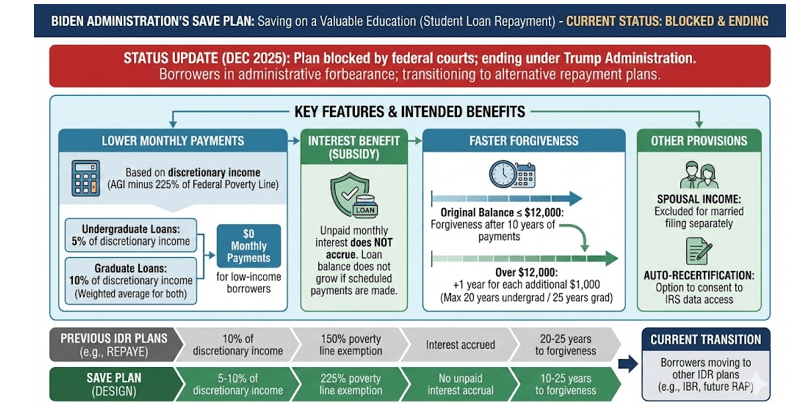
Biden’s SAVE plan
Impact on Millions of Student Loan Borrowers
Current SAVE borrowers have experienced administrative forbearance since June 2024, meaning they were not required to make monthly payments on their outstanding balances. Interest on their federal student loans resumed accruing in August 2025 despite the forbearance status. The Education Department stated that impacted borrowers can transition to other income-based repayment plans including Income Contingent Repayment and Pay As You Earn options.
Federal Student Aid website resources will help borrowers estimate their new monthly payment obligations under alternative repayment structures. The department will contact all affected SAVE borrowers in the coming weeks with specific transition instructions and deadlines. Consumer advocacy organisations characterised the settlement as a decisive reversal of Biden-era student loan relief policies and programmes.
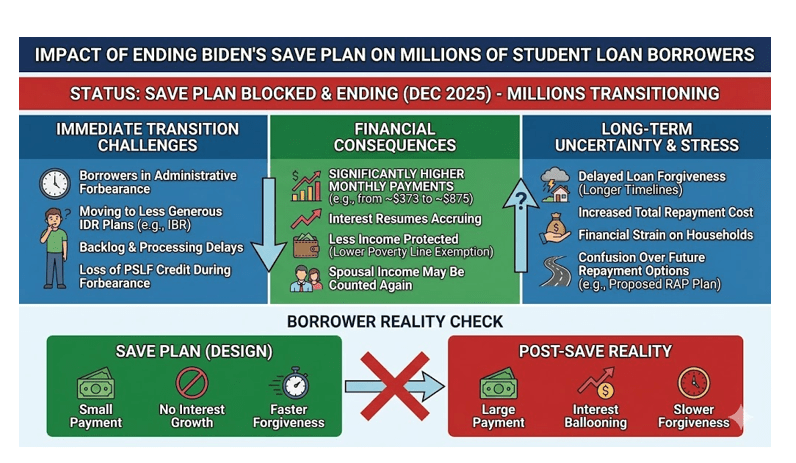
Impact on student loan borrowers
Trump Administration’s Rationale and Statement
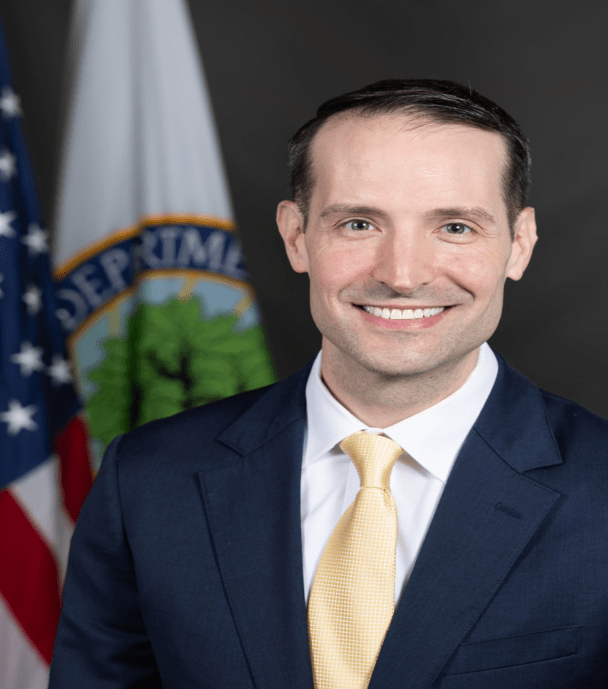
Nicholas Kent, undersecretary of education, issued a formal statement regarding the settlement. Kent stated that “For four years, the Biden Administration sought to unlawfully shift student loan debt onto American taxpayers, many of whom either never took out a loan to finance their postsecondary education or never even went to college themselves, simply for a political win to prop up a failing Administration.”
Kent continued: “The Trump administration is righting this wrong and bringing an end to this deceptive scheme. The law is clear: if you take out a loan, you must pay it back.” Administration officials characterised the SAVE programme as representing unlawful attempts to circumvent judicial restrictions on broader debt cancellation initiatives.
The settlement represents what Trump administration officials described as the “final nail in the coffin” for Biden’s student debt relief objectives. Biden’s original debt cancellation scheme would have provided nearly $200 billion in relief to over 5 million Americans carrying substantial debt burdens. Through SAVE specifically, the Biden administration approved approximately $5.5 billion in student loan discharges benefiting nearly half a million borrowers before legal challenges suspended operations.
SAVE Plan Characteristics and Previous Benefits
The SAVE programme was designed to address affordability concerns for millions of borrowers struggling with student loan obligations. Under the plan, borrowers calculated monthly payments based upon their individual incomes and family circumstances. Many borrowers saw monthly payments reduced to zero dollars based on their financial situations.
The programme also enabled faster debt forgiveness for lower-income borrowers carrying smaller loan balances compared to traditional repayment alternatives. Interest accumulation received caps under the SAVE framework, preventing balances from increasing beyond the original loan amounts for borrowers making regular payments.
The Biden administration promoted SAVE as the most affordable student loan repayment option available in American history. The programme represented a fallback mechanism after the Supreme Court struck down broader debt cancellation plans in June 2023, determining the executive branch had exceeded constitutional authority.
Opposition and Advocacy Group Responses
Protect Borrowers, a leading advocacy organisation representing individuals carrying student debt, condemned the settlement as a “back-room deal” amounting to capitulation. The organisation’s deputy executive director Persis Yu stated: “The real story here is the unrelenting, right-wing push to jack up costs on working people with student debt.”
Advocates emphasised that the settlement would deprive borrowers of the most affordable repayment option available through federal student loan programmes. The American Federation of Teachers previously challenged Trump administration efforts to obstruct loan forgiveness under income-driven plans, resulting in a separate court-supervised agreement accelerating relief processing.
Broader Context of Trump Student Loan Reforms
The SAVE termination occurs within the framework of comprehensive Trump administration reforms reshaping student loan policy. The “One Big Beautiful Bill” legislation established new borrowing caps for graduate and professional students effective after July 1, 2026. Graduate students now face annual borrowing limits of $20,500 with $100,000 lifetime maximums.
Current borrowers with loans issued before July 1, 2026, may retain temporary access to existing repayment plans. However, mandatory transitions to new repayment structures are scheduled by 2028. The administration has resumed wage garnishment and tax refund offsets for borrowers in default status, increasing compliance pressure.
The Congressional Research Service indicates that over 42 million Americans carry student loan debt totalling more than $1.6 trillion in aggregate balances. The Trump administration characterises its approach as establishing “real, long-term solutions” replacing what it describes as unlawful debt relief mechanisms implemented during the Biden presidency.