
Australia’s communications regulator, the Australian Communications and Media Authority (ACMA), published its final Telecommunications (Mobile Network Coverage Maps) Industry Standard 2026 on 31 March. Mobile operators must publish standardised 4G and 5G coverage maps by 30 June 2026, using one of four categories: good, moderate, basic, or no coverage.
The rule is meant to give consumers an apples-to-apples comparison between Telstra, Optus, and TPG. But Telstra says the fine print could mislead millions of customers, particularly those in regional Australia.
A Signal Threshold That Could Redraw the Map
The crux of the issue is a single technical number.
Under the new rules, areas with signal strengths below -115 dBm are declared as not having a usable service and cannot be shown on coverage maps. That threshold determines what counts as “coverage” and what gets labelled as nothing at all.
Telstra says the draft would wipe roughly a third of its landmass from its map, potentially erasing around one million square kilometres. The company argued for a lower cutoff of -122 dBm, which it says more accurately reflects where calls, texts, and data actually work.
Every month, more than 1.5 million Telstra customers use coverage that sits below that -115 dBm threshold. That includes people travelling through remote areas, not just those who live there.
What Telstra Says Its Network Actually Delivers
Telstra ran independent tests to back its position before the final standard was handed down.
In late 2025, a third party drove 60,000 kilometres across the country using a standard Samsung S25 smartphone with no external antenna. Results showed that more than 90% of the time, customers at -122 dBm could load web pages within seconds, start apps without excessive delay, and make clear voice calls.
The company also points to the volume of emergency calls made in areas that will now appear blank on the new maps. Around 57,000 emergency calls are made each year in those zones, along with 700,000 voice calls and 750,000 texts per day, plus 300TB of data.
Shailin Sehgal, Telstra’s Group Executive for Global Networks and Technology, put it plainly: “If a map says ‘no coverage’ but a customer can still call, text or get online nine out of ten times, there’s a very real risk of confusion.“
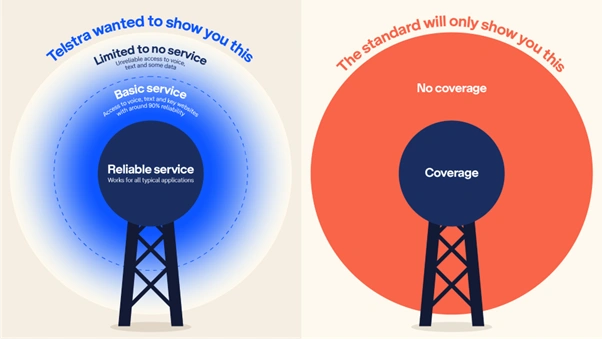
Telstra’s existing coverage map (left) compared to the projected reduced map under the ACMA standard (right). [Telstra]
Optus and TPG Are on the Other Side
Not everyone agrees with Telstra’s reading.
TPG Telecom urged the ACMA to adopt the -115 dBm threshold, saying it was “deemed acceptable” by the federal government’s National Audit of Mobile Coverage. The carrier also repeated claims that its engineers could not make calls in areas Telstra labelled as full coverage.
A TPG spokesperson called the new standard “a win for consumers,” saying coverage should mean a phone actually works, not that it might show a bar of signal that cannot support a call.
The ACCC also backed the stricter approach, saying the lack of a transparent standard had prevented it from taking enforcement action against misleading coverage claims. The competition regulator recommended that telcos not be given flexibility to adopt alternative thresholds, at least for now.
What the New Standard Actually Requires
The new rules are not just about what counts as coverage. They also standardise how maps are presented.
The ACMA acknowledged that in areas shown as having no coverage, some people may still be able to make calls or send SMS, but overall service is expected to be very limited, inconsistent, or non-existent. Maps must also be updated at least every three months.
ACMA Chair Nerida O’Loughlin said the rules would ensure every carrier is giving the public a like-for-like comparison of service coverage in any location across Australia.
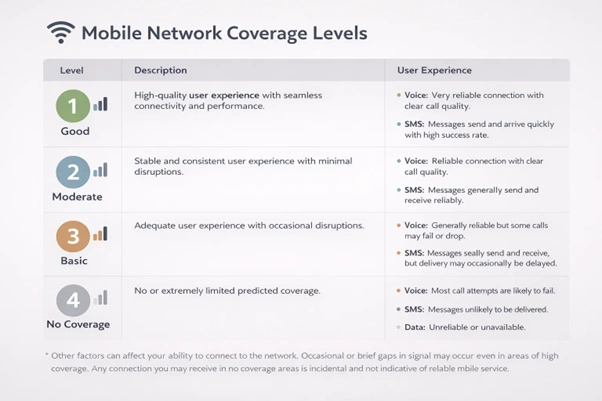
The four new coverage tiers under the ACMA’s Telecommunications (Mobile Network Coverage Maps) Industry Standard 2026. [ACMA]
For Telstra, the change is significant. Nothing has changed about Telstra’s actual network. No sites have been switched off. No coverage has been removed. The only thing that is changing is what will be shown on a comparable map.
That distinction is important for regional customers trying to plan travel, work remotely, or access emergency services in areas where every bar of signal counts. Australians interested in how ASX-listed tech companies are navigating regulatory change will want to watch this space closely.
Also Read: Albanese Pulls a New Lever as Australia’s Fuel Crisis Deepens
FAQs
Q: Why are Telstra’s coverage maps changing?
A: The ACMA has introduced a new industry standard that requires all Australian telcos to use the same method for displaying mobile coverage. Any signal weaker than -115 dBm will now be labelled as “no coverage,” which will remove a large portion of Telstra’s current mapped area.
Q: Will Telstra’s actual network get smaller?
A: No. Telstra has confirmed no sites have been turned off and no coverage has been physically removed. The change is to how coverage is displayed on standardised, comparable maps, not to the network itself.
Q: What does the Telstra coverage maps change mean for regional Australians?
A: People in remote and regional areas may find that locations where their phones currently work now appear as “no coverage” on the new maps. Telstra says this could cause confusion when planning travel or assessing phone usability in those areas.
Q: When do the new coverage maps take effect?
A: Telcos must publish the new standardised maps by 30 June 2026 under the Telecommunications (Mobile Network Coverage Maps) Industry Standard 2026.
Q: What are the four coverage categories under the new rules?
A: The new standard uses good coverage (above -95 dBm), moderate (-95 to -105 dBm), basic (-105 to -115 dBm), and no coverage (below -115 dBm).
Disclaimer: This article is for informational and news purposes only. It does not constitute financial, investment, or professional advice. Readers should seek independent guidance before making any financial decisions.
Source:
- https://www.telstra.com.au/exchange/making-sense-of-australia-s-new-mobile-coverage-maps-standard
- https://www.acma.gov.au/articles/2026-03/new-rules-mobile-phone-coverage-maps