
Prime Minister Anthony Albanese announced the historic appointments on Monday, 13 April 2026, alongside a broader command restructure that includes a new Chief of the Defence Force and a new Chief of Navy.
The announcement marks a turning point for the Australian Army, an institution that has been operating for 125 years without a woman at its helm.
“From July we will have the first ever female Chief of Army in the Australian Army’s 125 year history,” Albanese said in an official statement.
The changes are subject to Governor-General approval and will be presented to the Federal Executive Council.
Why This Appointment Is Being Called a Historic Moment for the ADF
The Australian Army has not seen a reshaping of this kind in a long time. Not just in terms of structure but in terms of what it signals to serving women across the defence force.
Susan Coyle is not new to breaking barriers. She was the first woman to command Joint Task Force 633, overseeing more than 1,200 ADF personnel across Middle East operations. In 2024, she became the first female domain lead in the ADF when she was appointed Chief of Joint Capabilities, taking charge of Australia’s Space and Cyber warfighting domains.
Now she steps into the biggest role of her career.
Deputy Prime Minister and Defence Minister Richard Marles called it an honour to confirm the appointments. “I know that in these roles, each of them will continue to make an enormous contribution to the safety and security of Australia,” he said.
Who Is Susan Coyle?
Lieutenant General Susan Coyle enlisted as a soldier in the Army Reserves in 1987. She was commissioned into the Royal Australian Corps of Signals in 1992 after completing a Science degree at the Australian Defence Force Academy.
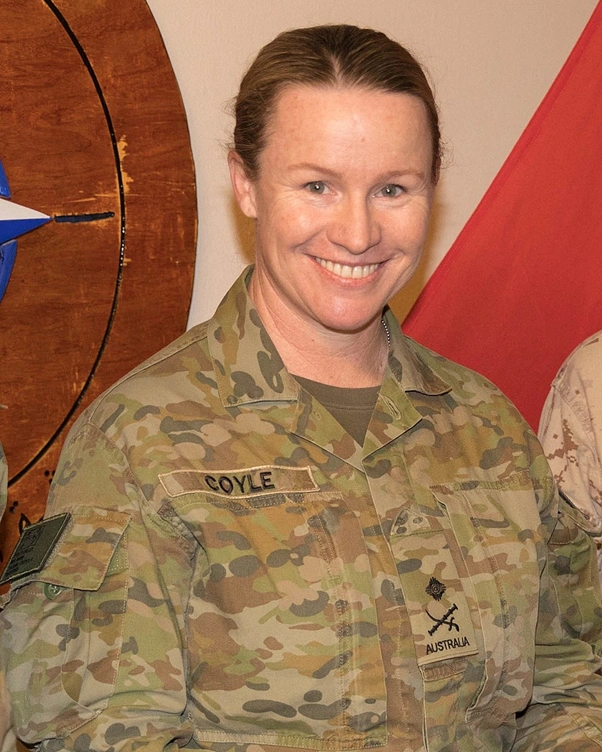
Lieutenant General Susan Coyle, incoming Chief of Army and the first woman to hold the role in 125 years. [Wikipedia]
Her career since then has been anything but ordinary.
She has commanded at every rank and served in operational theatres across East Timor, the Solomon Islands, Afghanistan, and the Middle East. She holds three postgraduate degrees, including a Master of Strategic Studies from the United States Army War College, where she graduated as a Distinguished Graduate.
Her decorations tell a similar story: Member of the Order of Australia, Distinguished Service Medal, Conspicuous Service Cross, and a U.S. Army Commendation Medal.
Coyle has spoken publicly about her “People First” leadership philosophy. She has said her goal is to ensure every member of the organisation reaches their full potential. It is a philosophy that clearly runs deeper than slogans.
The Full Scope of the Leadership Changes
The Coyle appointment is one of several major command changes announced by the Albanese government. Here is the full picture:
- Chief of the Defence Force: Vice Admiral Mark Hammond AO RAN, currently Chief of Navy, will be promoted to the top job. Hammond has served for 40 years, including extensive service commanding submarines and the Australian Fleet.
- Chief of Army: Lieutenant General Susan Coyle, currently Chief of Joint Capabilities, will take command of the Army. She becomes the first woman to hold this role in the Army’s 125-year history.
- Chief of Navy: Rear Admiral Matthew Buckley AM CSC RAN, currently Deputy Chief of Navy, will be promoted to lead the Navy. Buckley brings significant submarine experience, including commanding HMAS Collins and heading the Nuclear Submarine Capability at the Australian Submarine Agency.
- Chief of the Defence Force (retiring): Admiral David Johnston AC RAN, who has served in the ADF for more than 48 years, will retire when the changes take effect. He has been described as the longest-serving ADF officer at the three and four-star ranks.
- Chief of Army (retiring): Lieutenant General Simon Stuart AO DSC will also step down. Stuart was notably the first Chief of Army to have begun his career as a soldier.
The incoming Navy chief, Buckley, is particularly well placed to support Australia’s AUKUS obligations. His background in nuclear submarine capability makes him a natural fit as Australia accelerates its path toward acquiring conventionally armed, nuclear-powered submarines.
You can read more about the Navy’s current fleet and AUKUS trajectory here.
What Comes Next for the ADF
The transition takes effect in July 2026. Until then, the current leadership team remains in place.
A new Chief of Joint Capabilities will be announced in due course, the government confirmed. That appointment will fill the role Coyle is vacating.
The broader context matters here. These changes come as Australia continues to upgrade its defence posture across the Indo-Pacific. The country is in the middle of implementing the 2024 National Defence Strategy, which Admiral Johnston helped design before his retirement. It is a strategy that shapes everything from air defence capabilities to regional partnerships like the Australia-PNG Defence Treaty.
The full text of the Prime Minister’s announcement is available on the official PM website.
Also Read: Fortescue Boss Calls Mining Lobby’s Fuel Tax Push “Absolutely Ridiculous”
FAQ
Q: Who is Susan Coyle?
A: Lieutenant General Susan Coyle is a senior Australian Army officer who enlisted in the Army Reserves in 1987. She has served in East Timor, the Solomon Islands, Afghanistan, and the Middle East. In July 2026, she will become the first woman to serve as Chief of Army in the Australian Army’s 125-year history.
Q: Why is Susan Coyle’s appointment significant?
A: Coyle will be the first woman to command the Australian Army since it was founded. She has already set several other firsts in her career, including becoming the first female commander of Joint Task Force 633 and the first woman to lead a warfighting domain within the ADF.
Q: Who is becoming the new Chief of the Defence Force?
A: Vice Admiral Mark Hammond, currently serving as Chief of Navy, will be promoted to Chief of the Defence Force in July 2026. He replaces Admiral David Johnston, who is retiring after more than 48 years of service.
Q: When do the ADF leadership changes take effect?
A: All changes are set to take effect in July 2026, subject to Governor-General approval.
Q: Who will be the new Chief of Navy?
A: Rear Admiral Matthew Buckley will be promoted and appointed as Chief of Navy. He previously served as Deputy Chief of Navy and Head of Nuclear Submarine Capability at the Australian Submarine Agency.
Disclaimer:
This article is for informational purposes only and does not constitute investment or financial advice.
Source:
Last modified: April 13, 2026