
St George Mining Limited (ASX: SGQ) (“St George” or the “Company”) has released a new batch of diamond drill results from its 100%-owned Araxá Niobium and Rare Earths Project in Minas Gerais, Brazil, with 16 holes returning thick, high-grade mineralisation from surface, including some of the highest-grade intercepts ever recorded at the Project.
The results add to a growing body of data supporting Araxá’s status as one of the most significant undeveloped rare earths and niobium deposits in the world.
What the Drilling Found
Sixteen diamond drill holes delivered consistent mineralisation from surface across the deposit, with several standout intervals that extend both the grade and continuity of the resource.
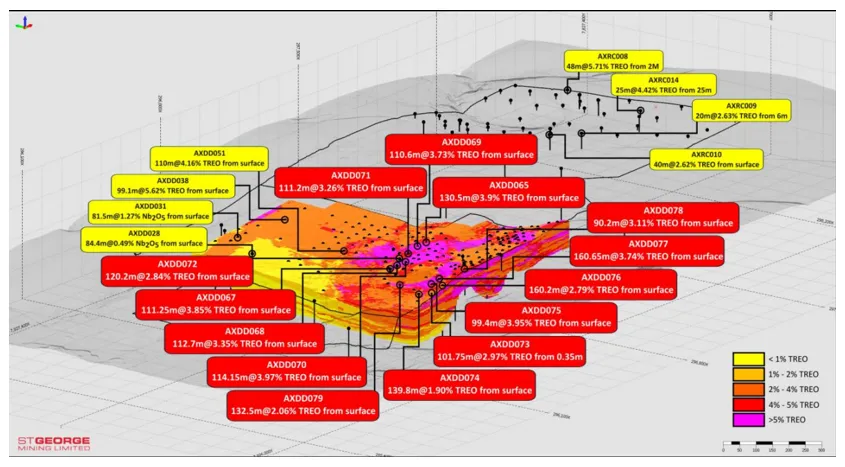
Figure 1: Oblique section showing some of the latest diamond drill holes [St George Mining]
The headline result came from hole AXDD077, which returned 160.65 metres at 3.74% Total Rare Earth Oxides (TREO) and 0.54% Nb₂O₅ from surface. Within that interval, the Company recorded a 1-metre hit grading 24.54% TREO, one of the highest-grade intersection in the Project’s history. The same hole also returned 38.85 metres at 8.52% TREO, including 15.35 metres at 13.86% TREO.
Other notable intercepts include:
- AXDD065: 101m @ 4.72% TREO, 0.65% Nb₂O₅ from surface; incl. 32.55m @ 6.65% TREO
- AXDD067: 111.3m @ 3.85% TREO, 0.66% Nb₂O₅ from surface; incl. 16.5m @ 7.58% TREO and 1.25m @ 5.05% Nb₂O₅ from 73.75m
- AXDD069: 110.6m @ 3.73% TREO, 0.57% Nb₂O₅ from surface; incl. 68m @ 4.82% TREO
- AXDD075: 99.4m @ 3.95% TREO, 0.76% Nb₂O₅ from surface; incl. 51.4m @ 4.62% TREO
- AXDD078: 90.2m @ 3.11% TREO, 0.51% Nb₂O₅ from surface; incl. 16m @ 5.83% TREO
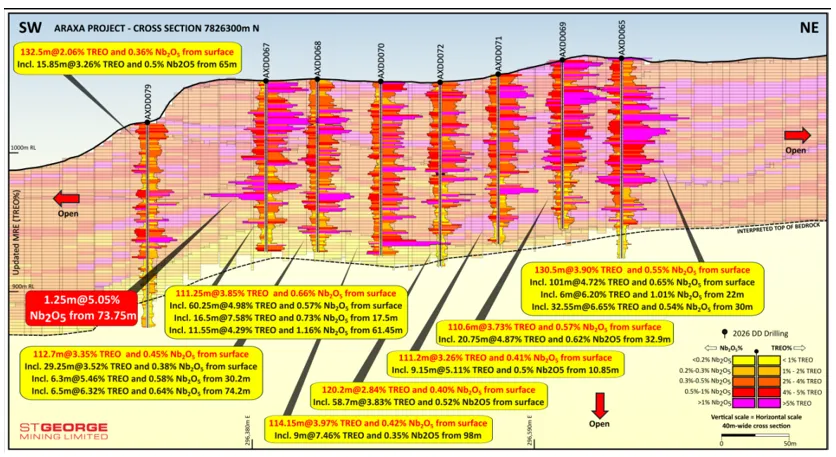
Figure 2: Section A – A’ showing high-grade TREO intercepts (cut-off 1% TREO) and high-grade Nb₂O₅ intercepts (cut-off 0.2% Nb₂O₅) [St George Mining]
The mineralisation starts at the surface across all 16 holes, consistent with the near-surface profile that characterises the broader Araxá deposit. Three diamond core rigs and one reverse circulation rig are currently operating around the clock, with 23 additional holes already at the laboratory awaiting assay results.
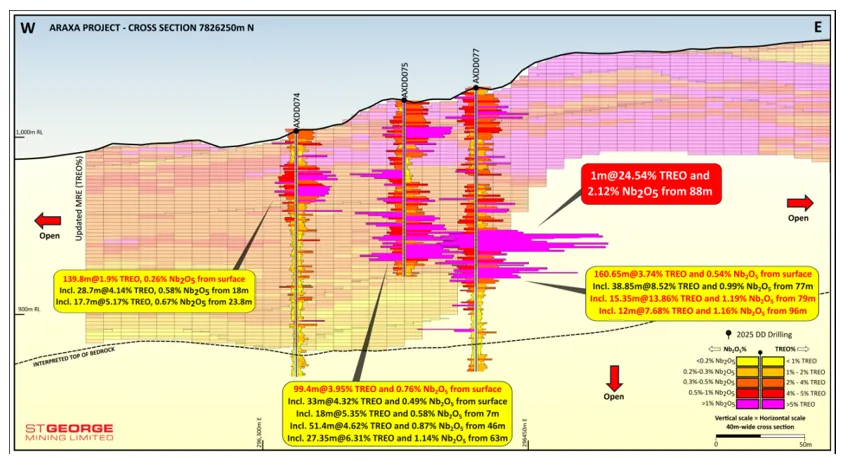
Figure 3: Section B – B’ showing high-grade TREO intercepts (cut-off 1% TREO) and high-grade Nb₂O₅ intercepts (cut-off 0.2% Nb₂O₅) [St George Mining]
The Resource Behind the Results
The drill results build on a JORC 2012-compliant Mineral Resource Estimate announced on 3 March 2026, just eight days prior, which confirmed Araxá as the largest and highest-grade carbonatite-hosted rare earth resource in South America.
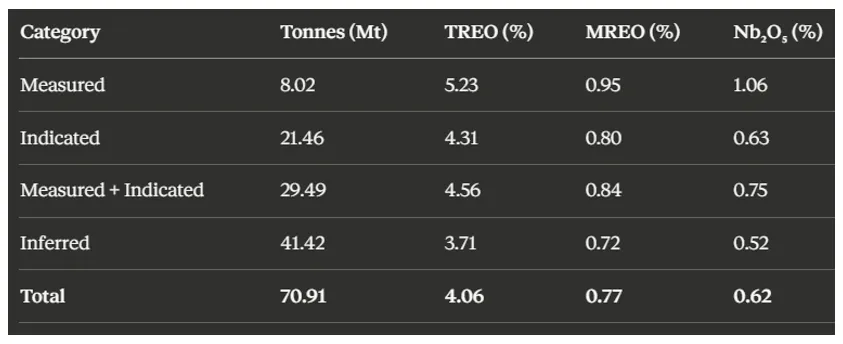
Figure 4: Araxá Mineral Resource Estimate (2% TREO cut-off)
At a 0.2% Nb₂O₅ cut-off, an additional 24.56 million tonnes averaging 0.52% Nb₂O₅ brings the combined niobium inventory to 95.47 million tonnes across the full Project. The MRE has been defined to a depth of only 120 metres, with mineralisation confirmed to be open at depth and in all lateral directions.
Why Araxá’s Location Matters
The Project sits adjacent to CBMM’s Araxá niobium mine in Minas Gerais, the single operation that supplies roughly 80% of the world’s niobium. That proximity gives St George Mining direct access to established transport corridors, a skilled local workforce, and ready connections to renewable energy infrastructure.
The Brazilian government has provided backing for expedited permitting, and the Company has assembled an experienced in-country team. The deposit’s near-surface nature and carbonatite host geology make it amenable to open-pit mining and conventional processing, a factor the Company notes is reflected in ongoing metallurgical test work.
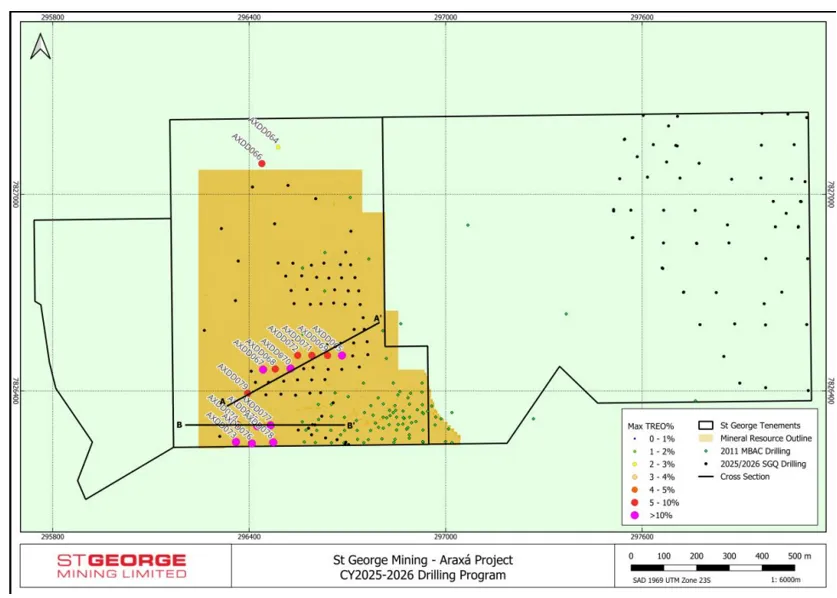
Figure 5: Plan view map of the Araxá area showing the location of the diamond drilling relative to the MRE [St George Mining]
The Geopolitical Context
Rare earths and niobium are drawing increasing attention from governments in the United States, Europe, and Australia as supply chains come under pressure. China accounts for the majority of global rare earth processing, while niobium supply is similarly concentrated in Brazil.
Executive Chairman John Prineas addressed this directly in the announcement.
“Neither China nor the US have a domestic supply of niobium, giving our world-class niobium resource, a commodity that is critical to the manufacture of weapons and other military hardware, added importance at this time of heightened geopolitical tension,” Prineas said.
He added: “Drilling is continuing 24/7 with three diamond core rigs and one RC rig, and 23 drill holes at the laboratory with assays pending.”
The global rare earth oxides market was valued at approximately US$6.2 billion in 2024 and is Projected to reach US$18.2 billion by 2034, reflecting a compound annual growth rate of 12.6%. Niobium demand is also tracking upward, with market volumes forecast to grow from 79.68 kilotons in 2025 to 103.18 kilotons by 2031, driven by steel production and emerging niobium-lithium battery technology.

Figure 6: Global Rare Earth Oxides market growth overview
Investor’s Outlook
St George Mining Limited (ASX: SGQ) shares are currently trading at approximately $0.142 per share, within a 52-week range of $0.015 to $0.180. The Company’s market capitalisation stands at approximately $476.83 million.
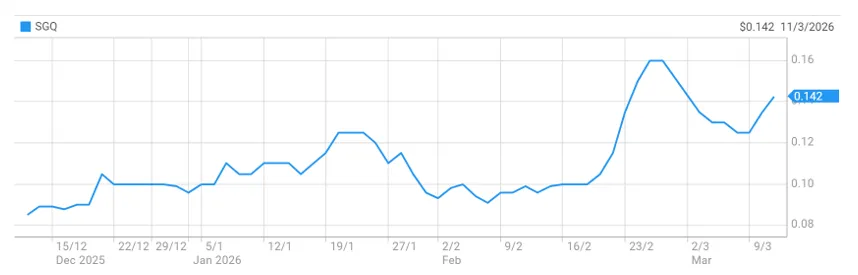
Figure 7: SGQ Price chart [ASX]
The current round of drilling continues to add intercepts ahead of a planned resource update. With 23 holes already in the lab and three rigs operating continuously, St George Mining is generating a steady pipeline of data that will inform the next phase of resource definition work.