On February 28, 2026, skywatchers will have a short window after sunset to see six planets, including Mercury, Venus, Jupiter, Saturn, Uranus, and Neptune, appearing together across the evening sky in a rare planetary alignment.
Six-Planet Alignment Set for February 28, 2026
Astronomy outlets and space agencies have identified February 28 as the central viewing date. On that evening, six planets will appear grouped along the ecliptic shortly after sunset.
The alignment includes Mercury, Venus, Saturn, Jupiter, Uranus, and Neptune. Four of these planets can be seen without optical aid under clear skies.
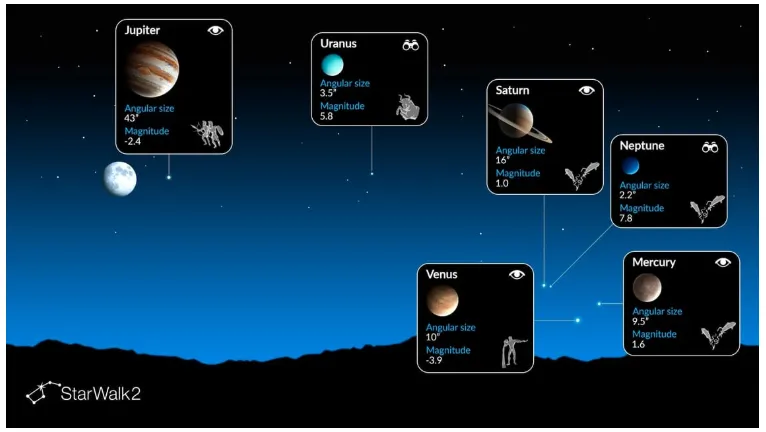
A top-down view of the Solar System shows how the planets appear grouped from Earth during the February 28 alignment. [Starwalk]
The event has been widely described as a “planet parade.” However, astronomers note that the grouping spans several days in late February and early March.
Reports published by space observers explain that February 28 offers a balanced viewing window. On that date, the planets appear most tightly clustered for many global locations.
What a Planetary Alignment Means
A planetary alignment occurs when several planets appear in the same region of the sky. They do not form a perfect line in space.
Instead, the grouping is a visual effect caused by Earth’s viewing angle. The planets follow the ecliptic, the Sun’s apparent yearly path.
During this alignment, observers will see the planets spread from the western horizon toward the southeast. The arc follows the natural curve of the ecliptic.
Such gatherings are not extremely rare. However, seeing six planets visible during convenient evening hours draws public attention.
Best Time and Viewing Window
The best time to observe the planetary alignment is about 30 minutes after local sunset. Timing is critical due to the low position of several planets.
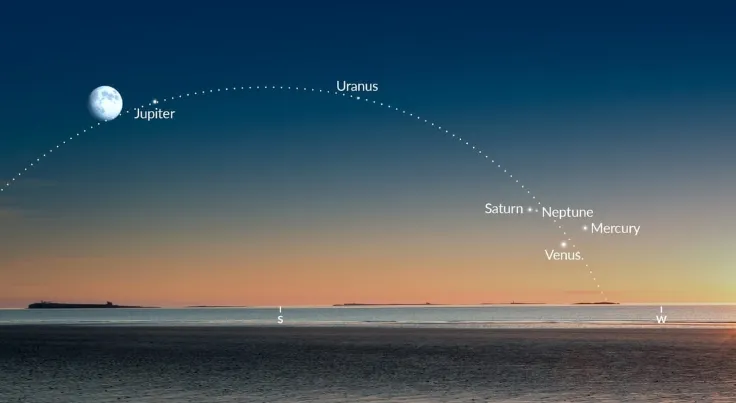
Mercury, Venus, Saturn, and Neptune will appear low in the western sky shortly after sunset. [Starwalk]
Mercury and Venus will be closest to the horizon. They will set quickly, often within an hour after sunset.
Saturn and Neptune will follow later in the evening. Uranus will remain visible longer, while Jupiter will set last.
Astronomy writers have advised starting observation as twilight deepens. An unobstructed western horizon improves the chance of spotting the lower planets.
Which Planets Will Be Visible
Four planets can be seen with the naked eye under suitable conditions. These are Mercury, Venus, Saturn, and Jupiter.
Venus will shine brightest, appearing low in the western sky. It will serve as a reference point for locating nearby planets.
Jupiter will appear higher in the southeast. It will be one of the easiest planets to identify.
Mercury will be faint and positioned very low. Clear skies and quick observation will be necessary.
Saturn will glow steadily above the horizon. Its light will appear constant rather than twinkling.
Two additional planets require optical assistance. Uranus can be found with binoculars under dark skies.
Neptune will be fainter and may require a telescope. It will sit close to Saturn in the sky.
Moon and Constellation Landmarks
A waxing gibbous Moon will be present during the alignment. It will appear high in the eastern sky near Jupiter.
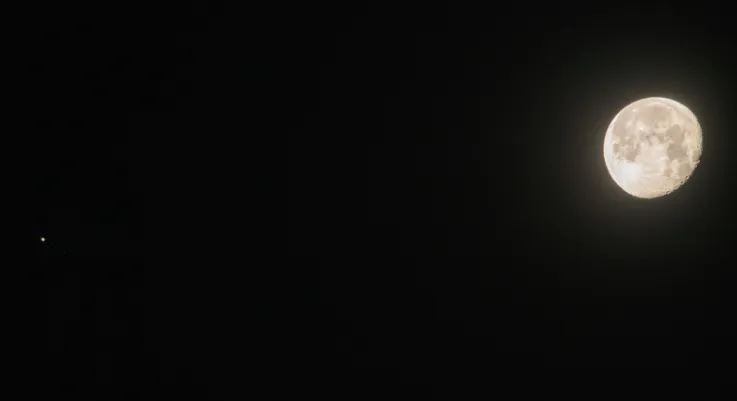
Jupiter will shine high in the southeast, with a bright waxing gibbous Moon nearby. [Space]
The Moon’s brightness may reduce contrast for fainter objects. Uranus and Neptune could be harder to detect because of this glare.
Jupiter will appear in the constellation Gemini. Nearby bright stars Castor and Pollux can assist with orientation.
Uranus will sit beneath the Pleiades cluster in Taurus. That cluster is visible to the naked eye under darker skies.
Meanwhile, Mercury, Venus, Saturn, and Neptune will cluster near Pisces and Aquarius. Their low position will require quick identification.
Viewing Conditions Across Locations
The alignment will be visible worldwide, though dates vary slightly. February 28 represents a midpoint for many cities.
Reports note that locations such as New York, Athens, Tokyo, and Mexico City align closely with that date. London, Berlin, and Beijing may see peak grouping around March 1.
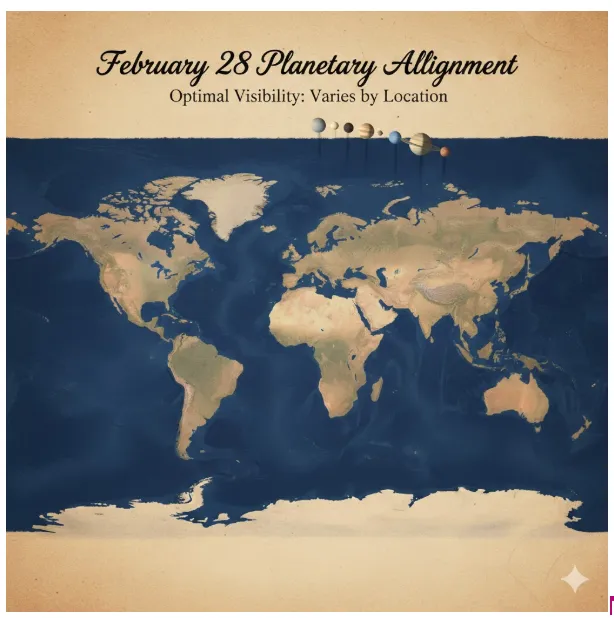
The February 28 planetary alignment will be visible worldwide, with optimal dates varying slightly by location.
In India, observers in Delhi, Mumbai, Bengaluru, and Chennai are expected to have viewing opportunities if skies remain clear.
Astronomy writers have stressed the need for favorable weather. Haze or light pollution may limit visibility near the horizon.
National Geographic and other outlets have reported that the alignment spans multiple evenings. Therefore, observers are not limited to a single date.
Additional Planetary Events in 2026
Astronomy calendars list several other alignments later in the year. A smaller morning grouping is expected on April 18, 2026.
Another evening alignment of Mercury, Jupiter, and Venus is scheduled for June 12. A larger morning event is expected in August.
Observers also recall a triple superior conjunction in January 2026. That event occurred near the Sun and was visible only through solar observatories.
Images of that conjunction were captured by space-based instruments. However, it was not observable with the naked eye.
Compared with that event, the February alignment offers public viewing potential. Its early evening timing allows broader participation.
How the Alignment Changes Through the Evening
As the evening progresses, the configuration will shift. Mercury and Venus will disappear below the horizon first.
Saturn and Neptune will follow soon after. Uranus will remain visible longer for those using binoculars.
Jupiter will dominate the sky for much of the night. It will remain visible after the other planets set.
Because of these changing positions, early observation is essential. Waiting too long may result in missing several planets.
Skywatchers are encouraged to prepare in advance. A clear western horizon and prompt timing will increase success.
The February 28 planetary alignment provides an opportunity to observe six planets in one session. While visibility varies by location, the event remains accessible to prepared observers under clear skies.
FAQs
Q1: When is the six-planet alignment in 2026?
Ans. The six-planet alignment will be most visible after sunset on February 28, 2026. However, the grouping can be observed for several days in late February and early March.
Q2: Which planets will align on February 28, 2026?
Ans. The alignment includes Mercury, Venus, Jupiter, Saturn, Uranus, and Neptune.
Q3: What time is best to see the planetary alignment?
Ans. The best time to view the alignment is about 30 minutes after local sunset, when the sky is dark enough but the lower planets have not yet set.
Q4: Will all six planets be visible to the naked eye?
Ans. No. Mercury, Venus, Saturn, and Jupiter can be seen without optical aid under clear skies. Uranus and Neptune usually require binoculars or a telescope.
Q5: Where should I look to see the planets?
Ans. Look along the ecliptic path. Mercury, Venus, Saturn, and Neptune will be low in the western sky, Uranus higher in the southwest, and Jupiter high in the southeast.
Q6: Is the February 2026 planetary alignment rare?
Ans. Planetary alignments happen periodically, but seeing six planets grouped in the evening sky with several visible to the naked eye is less common.
Q7: Do I need special equipment to view the alignment?
Ans. Binoculars are recommended for Uranus, while Neptune may require a telescope. A clear western horizon and minimal light pollution will improve visibility.
Q8: Are there more planetary alignments in 2026?
Ans. Yes. Additional alignments are expected in April, June, August, and November 2026, including another six-planet grouping later in the year.