Silver traders woke to chaos as the precious metal swung violently from an all-time high of $83.75 per ounce to below $74 within hours. The wild ride triggered panic selling and spawned unverified rumours that a major bank had blown up its silver futures position overnight.
The dramatic collapse came just minutes after futures trading opened, with silver surging 6 per cent in 20 minutes before cratering as trading volume exploded and the Chicago Mercantile Exchange (CME) implemented emergency margin hikes.
Margin Call Carnage Hits Silver Markets
The CME raised initial margin requirements for March 2026 silver futures to $25,000 per contract on 26 December, marking the second hike in just two weeks. The move effectively tripled the cost of entry for many retail and institutional traders compared to early 2025.
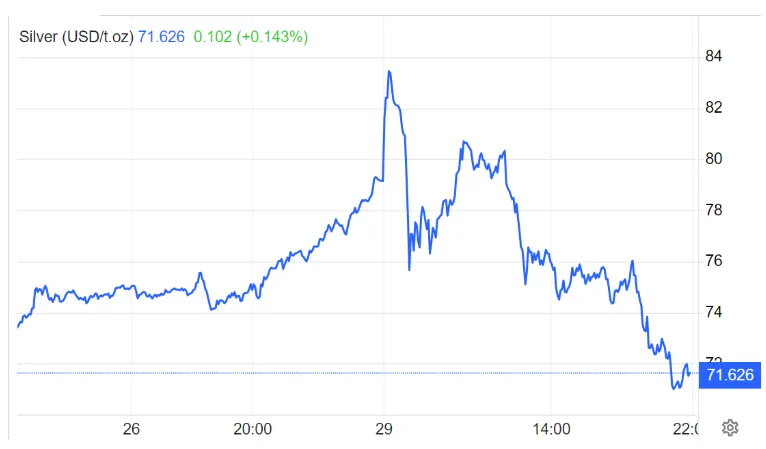
Silver’s violent 5-day price action shows record high followed by sharp correction
When Asian markets opened Sunday night, silver gapped down to $73.72 on the Shanghai Futures Exchange. The selloff accelerated as leveraged long positions were forcibly liquidated across COMEX trading desks.
By Monday afternoon Australian Eastern Standard Time, silver prices had stabilised around $75 per ounce, still down more than 10 per cent from Friday’s record close.
Unverified Bank Failure Claims Spark Market Frenzy
Social media erupted with claims that a systemically important bank had failed to meet a $2.3 billion margin call by 2:00 am US time and was liquidated by futures exchanges at 2:47 am.
Unverified posts suggested the bank held massive short silver positions numbering hundreds of millions of ounces and exhausted every line of credit trying to raise emergency cash. No names were attached to the claims.
Reports also circulated that the Federal Reserve pumped $34 billion into the banking system through emergency overnight repo operations. However, official Fed data shows these were routine year-end liquidity management operations, not emergency interventions.
The Federal Reserve conducts daily repo operations to maintain the federal funds rate within its target range. Recent increases in repo usage reflect normal month-end demand, not systemic stress.
No FDIC bank failures, SEC emergency filings, or official regulatory announcements have confirmed any bank collapse. Major financial news outlets have not verified the rumours despite their viral spread on platforms like X.
The rumor says a major bank collapsed on a silver margin call at 2:47 AM December 28.
I cannot verify that.
What I can verify is more interesting.
JPMorgan filed an 8K on December 27 disclosing 4.875 billion dollars in unrealized silver losses. They flipped from 200 million… https://t.co/APUBF85Xk2 pic.twitter.com/xw7S3zaKEz
— Shanaka Anslem Perera ⚡ (@shanaka86) December 29, 2025
China’s Export Controls Add Fuel to Silver’s Fire
The silver rally leading up to Monday’s crash was driven partly by China’s impending export licensing system. Starting 1 January 2026, Chinese authorities will require government licenses for silver exports, restricting access to 60-70 per cent of global refined silver supply.
China’s Ministry of Commerce announced on 30 October 2025 that only firms producing at least 80 tonnes of silver annually would qualify for export licenses. The policy aims to secure domestic supply for China’s booming solar panel and electric vehicle industries.
Elon Musk weighed in on social media over the weekend, warning that “this is not good” as silver remains critical for industrial processes. His comments came as Tesla and other manufacturers face potential supply shortages for EV components and semiconductors.
Silver’s industrial applications have driven unprecedented demand in 2025. Solar panel manufacturing alone accounts for 20 per cent of global consumption, while EVs use up to 50 grams of silver per vehicle.
Physical Market Shows Different Story
Despite the paper market collapse, physical silver premiums in Shanghai remained stubbornly high. Chinese buyers were paying more than $8 per ounce above London prices on Monday, the widest spread on record.
This growing divergence between Western futures prices and Asian physical prices suggests the paper market may be losing its influence over actual metal pricing. Analysts describe it as the “Great Divergence” between financial instruments and real supply.
COMEX silver inventories have reportedly dropped around 70 per cent over five years, while China’s domestic stocks sit near decade lows. The global silver market faces its fifth consecutive annual deficit, with 2025 alone showing a 117.7 million ounce shortfall.
Echoes of Silver Thursday
Market veterans quickly drew comparisons to “Silver Thursday” in March 1980, when the CME raised margins to crush the Hunt Brothers’ attempt to corner the silver market. That intervention triggered a 50 per cent price collapse and bankrupted the Texas oil billionaires.
The 2011 silver peak also followed a similar pattern. As prices approached $50 per ounce, the CME raised margins five times in nine days, forcing leveraged funds out and sending silver tumbling 30 per cent within weeks.
However, today’s fundamentals differ sharply from past bubbles. The 1980 rally was driven by two wealthy individuals trying to manipulate markets. The 2025 surge reflects genuine industrial demand from solar energy, electric vehicles, and artificial intelligence hardware.
Also Read: Why United States Antimony Corporation Could Be Your Next Strategic Play
What Happens Next?
Precious metals markets remain on edge as the final trading week of 2025 unfolds. Gold also retreated sharply from record highs above $4,500 per ounce, falling back below $4,400 as traders took profits.
The silver price crash has sparked intense debate about whether the rally was overheating or whether CME’s actions represent coordinated price suppression.
Critics argue margin hikes disproportionately benefit institutional players with deeper collateral reserves while forcing retail traders into panic exits. Supporters claim the measures were necessary to prevent market instability.
Analysts expect continued volatility through year-end rebalancing and into early 2026 as China’s export controls take effect. Whether this marks a temporary shakeout before prices rebound or the end of silver’s historic 2025 rally remains to be seen.
The white metal has still tripled in value year-to-date, rising from around $29 per ounce in January to current levels near $75. For ASX-listed silver miners and investors, the wild swings underscore both the opportunity and risk in precious metals markets.