Provaris Energy Ltd (ASX: PV1) (“Provaris” or the “Company”) has reached a major technical milestone that moves it closer to commercialising large-scale carbon dioxide (CO₂) transport and storage solutions. In January 2026, the Company successfully completed Phase 1 of the Front End Engineering and Design (FEED) program for its pioneering 25,000 cubic metre (cbm) low-pressure liquid CO₂ (LCO₂) tank, and did so on time and within budget.
This achievement, delivered in partnership with Yinson Production, marks a meaningful advance in the development of next-generation maritime CO₂ infrastructure. It also positions Provaris as a serious player in emerging carbon capture and storage (CCS) supply chains, particularly in Europe’s North Sea region.
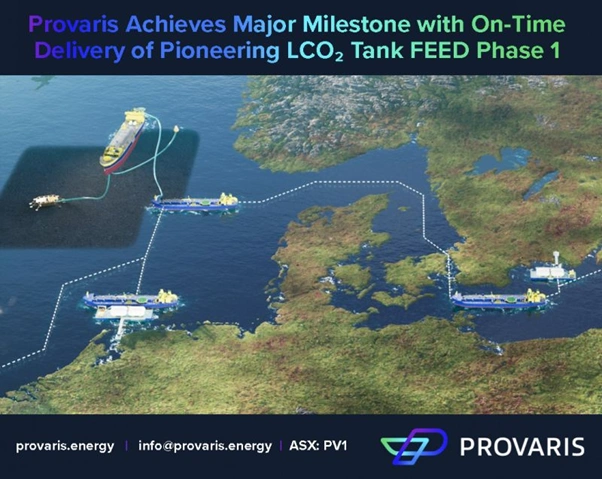
Figure 1: Provaris advancing large-scale offshore CO₂ transport and storage infrastructure across the North Sea. [LinkedIn/ Provaris Energy]
Provaris’ Chief Technical Officer, Per Roed, has mentioned, “We are proud to have achieved this milestone in the development and delivery of our pioneering 25,000 cbm LCO₂ tank FEED program, on schedule and within budget.”
What Phase 1 delivered and why it matters
Phase 1 of the FEED program did not simply tick technical boxes — it proved that Provaris’ proprietary tank concept can progress through rigorous engineering scrutiny while staying within cost and schedule constraints.
Major outcomes from Phase 1 included:
- Completion of the first suite of detailed engineering deliverables
- Progress on materials and weld testing for the new tank design
- Integration planning with Yinson’s Floating Storage and Injection Unit (FSIU) concept
- Ongoing engagement with classification society DNV for regulatory alignment
Crucially, the work forms part of a broader Joint Development Agreement (JDA) between Provaris and Yinson Production, which fully funds the FEED program through to its targeted completion in June 2026.
Moving into FEED Phase 2
With Phase 1 complete, Yinson Production has formally directed Provaris to proceed into Phase 2 of the FEED program. This next stage will deepen the technical work and bring the Project closer to commercial readiness.
Phase 2 will run through to June 2026 and focus on:
- Finalising detailed engineering and finite element modelling (FEM)
- Completing structural validation and performance testing
- Advancing fabrication methods at Provaris’ automated facility in Norway
- Progressing digitised, robot-assisted welding and manufacturing processes
- Securing DNV’s General Approval for Ship Application (GASA) certification
This phase will also deliver a fully costed fabrication plan, including a detailed tank production cost estimate, an important step toward potential commercial orders.
The 25,000 cbm tank: a step change in design
At the heart of the announcement sits Provaris’ 25,000 cbm low-pressure LCO₂ tank — a design that significantly exceeds the capacity of existing Type C tanks, which typically store far smaller volumes.
Rather than relying on multiple smaller pressure vessels, Provaris has pursued a single, large, multi-layer “sandwich” tank that complies with the International Code for the Construction and Equipment of Ships Carrying Liquefied Gases in Bulk (IGC Code).
The tank will integrate directly into Yinson’s proposed FSIU, which aims to hold 100,000 cbm of LCO₂ and inject captured CO₂ into subsea geological formations at the Havstjerne CCS project in the North Sea.
Beyond the FSIU application, the tank design also has broader utility for:
- Dedicated LCO₂ carriers
- Offshore storage terminals
- Onshore interim storage facilities
- Multi-hub CO₂ transport networks
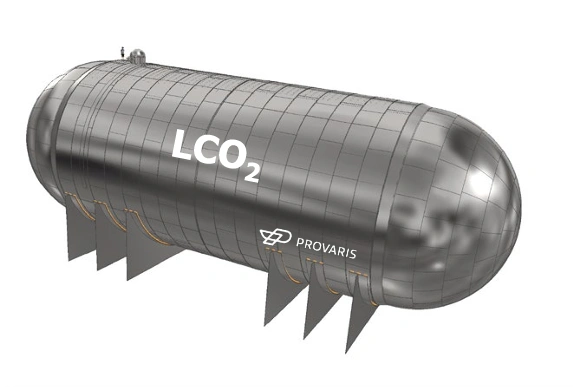
Figure 2: Illustration showing Provaris’ 25,000 bcm low-pressure LCO₂ tank developed for integration with Yinson’s 100,000 bcm FSIU. [Provaris Energy]
Why larger tanks unlock commercial viability
One of the most significant implications of Provaris’ work lies in the economics of CO₂ transport.
Current maritime CO₂ solutions rely on multiple smaller tanks, which increase complexity, weight, and cost. By developing a tank that holds three to four times more volume, Provaris aims to transform vessel design and operating efficiency.
The Company expects several benefits:
- Lower capital costs
- Smaller vessel hull dimensions
- Better use of available deck and cargo space
- Fewer onboard processing systems
- Lower operating costs
- Simplified operations
- Reduced maintenance requirements
- Fewer components to monitor and manage
Ultimately, this approach seeks to reduce the cost per tonne of LCO₂ transported, a critical factor in making large-scale CCS commercially attractive.
Partnership with Yinson Production
The collaboration with Yinson Production sits at the core of Provaris’ strategy. Yinson brings deep expertise in floating offshore infrastructure, while Provaris contributes proprietary tank technology and fabrication know-how.
Yinson continues to progress its FSIU development, with a targeted Final Investment Decision (FID) in late 2026. If approved, the FSIU could become one of the first large-scale floating CO₂ storage and injection units deployed in the North Sea.
This alignment of timelines means Provaris’ tank technology could play a central role in a real-world CCS deployment rather than remaining purely conceptual.
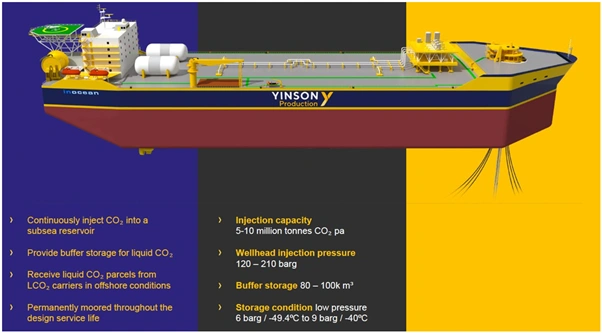
Figure 3: Concept illustration of Yinson Production’s Floating Storage and Injection Unit (FSIU). [Provaris Energy / Yinson Production]
Management perspective — confidence in delivery
Provaris’ Chief Technical Officer, Per Roed, framed the milestone as both a technical and strategic success:
“This accomplishment reflects the dedication, innovation and technical expertise of our team and partnership with Yinson and marks a major step forward in advancing large-scale CO₂ storage solutions for the market. These advancements position us to deliver real value to Yinson and other prospective partners and customers seeking efficient, cost-effective solutions for CO2 supply chains at scale.”
The statement underscores that Provaris does not view this as a one-off engineering exercise but as a platform for broader commercial engagement across the CCS value chain.
Automated fabrication — a competitive advantage
A distinctive element of Provaris’ approach lies in its advanced manufacturing strategy.
Rather than relying solely on conventional shipbuilding methods, the Company plans to leverage:
- Digitised design workflows
- Robot-assisted fabrication
- Laser and laser-hybrid welding processes
- Automated quality control systems
These innovations aim to reduce fabrication time, improve precision, and lower production costs, all of which strengthen Provaris’ competitiveness in a market that will likely scale rapidly over the coming decade.
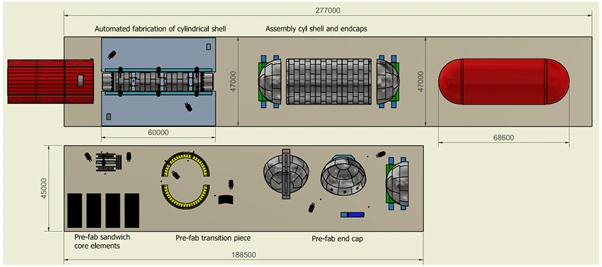
Figure 4: Concept design of an LCO₂ tank fabrication facility and automated assembly line based on Provaris’ robotic fabrication technology. [Provaris Energy]
Share price and market positioning
At the time of the announcement, Provaris Energy’s share price activity on the ASX reflected cautious but positive sentiment:
- Last price: $0.012
- Change: +$0.001 (9.09%)
- Market capitalisation: $10.77 million
The near-10 per cent gain suggests investors responded favourably to evidence of technical progress and disciplined project delivery. While still a small-cap company, Provaris now occupies a strategically important niche in the emerging CCS ecosystem.
What comes next
Between now and June 2026, investors will watch for:
- Progress updates on Phase 2 FEED milestones
- DNV classification developments
- Further details on fabrication costs and timelines
- Potential commercial discussions with Yinson or other partners
- Signs of alignment with large-scale CCS projects in Europe
The late-2026 FID decision on Yinson’s FSIU will likely represent the next major inflection point for the Company.
Investors Outlook
Provaris sits at an interesting intersection of engineering innovation and climate policy momentum. The successful delivery of FEED Phase 1 demonstrates that the Company can execute complex technical programs on time and within budget, a critical credibility factor for institutional and strategic investors.
If Phase 2 delivers a robust, class-approved, cost-competitive tank design, Provaris could move from a development-stage technology company to a potential supplier within global CCS infrastructure projects. The partnership with Yinson adds commercial relevance and real-world application rather than purely theoretical potential.
For investors with a long-term view on decarbonisation, maritime gas transport, and offshore energy infrastructure, Provaris offers exposure to a niche but strategically vital segment of the energy transition, one that could expand rapidly as nations accelerate their net-zero ambitions.