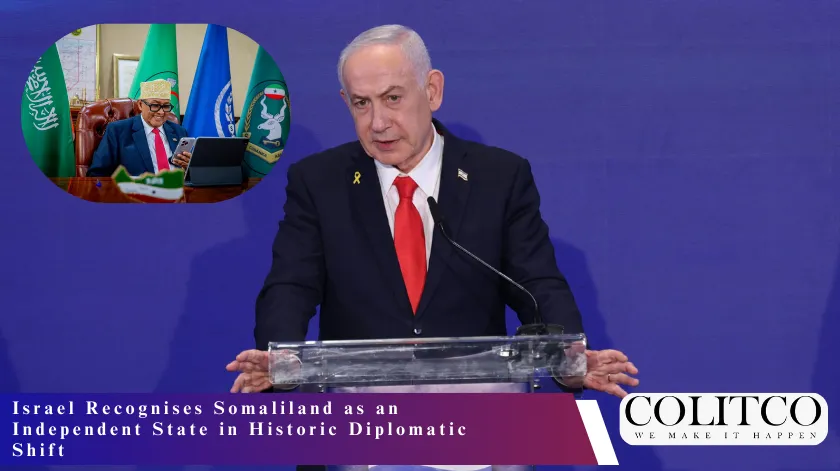
Israel has become the first country to formally recognise Somaliland as an independent state, marking a major diplomatic development more than three decades after the region declared independence from Somalia. The announcement was made on December 26, 2025, following the signing of a joint declaration between Israeli Prime Minister Benjamin Netanyahu and Somaliland President Abdirahman Mohamed Abdullahi.
https://www.youtube.com/watch?v=LveATEKEtV0
The agreement establishes full diplomatic relations, including the opening of embassies and the exchange of ambassadors. The move places Somaliland on the international diplomatic map for the first time since it broke away from Somalia in 1991.
Israel–Somaliland Agreement Announced
Prime Minister Netanyahu confirmed the recognition in a public statement, describing the agreement as being in the spirit of the Abraham Accords. These accords were created to expand Israel’s diplomatic ties with countries in the Middle East and Africa.
Israeli Foreign Minister Gideon Saar said the deal followed a year of dialogue between the two governments. He stated that diplomatic relations would include cooperation in areas such as agriculture, healthcare, security, and technology. Israel also confirmed that embassies will be opened in both Tel Aviv and Hargeisa.
I was glad to speak just now with the President of Somaliland Abdirahman Mohamed Abdullahi, on this important day for both countries.
Over the past year, based on an extensive and ongoing dialogue, relations between Israel and Somaliland have taken shape. Following the decision… pic.twitter.com/jHnfIPpoyR— Gideon Sa’ar | גדעון סער (@gidonsaar) December 26, 2025
President Abdullahi welcomed the recognition, calling it a historic moment for Somaliland and confirming that the region would join the Abraham Accords. He said the agreement marks the beginning of a long-term strategic partnership.
Somalia Condemns the Recognition
Somalia strongly rejected Israel’s move. Prime Minister Hamza Abdi Barre described the recognition as a direct attack on Somalia’s sovereignty and territorial integrity. The Somali government maintains that Somaliland remains an inseparable part of the country.
Somalia’s foreign ministry also issued a statement accusing Israel of violating international law by recognising a breakaway region without the consent of the central government.
The decision triggered urgent diplomatic discussions between Somalia and several regional allies, including Egypt, Turkey, and Djibouti. These countries reaffirmed their support for Somalia’s unity and warned that recognising breakaway regions could set a dangerous international precedent.
Regional and International Reaction
Egypt, Turkey, Somalia, and Djibouti jointly condemned Israel’s decision. They warned that recognising Somaliland could destabilise the Horn of Africa and undermine existing political agreements.
The African Union also criticised the move, stating that Somaliland remains part of Somalia under international law. The AU said the recognition could have far-reaching implications for peace and political stability across Africa.
Several governments also raised concerns that the move could encourage separatist movements in other parts of the continent.
Why Somaliland Matters Strategically
Somaliland sits on the Gulf of Aden, one of the world’s busiest shipping routes linking Africa, the Middle East, and Asia. The region has its own currency, security forces, parliament, and border controls, operating as a de facto state since the late 1990s.
Israel’s recognition is seen as part of its broader strategy to strengthen influence in the Red Sea region. Somaliland’s proximity to Yemen makes it a valuable location for monitoring security developments in the area, including activity by Houthi forces.
The United Arab Emirates already operates a military base in Somaliland’s port city of Berbera, highlighting the region’s growing geopolitical importance.
US and Global Position Remains Unclear
The United States has not recognised Somaliland. Although several US lawmakers have publicly supported recognition, Washington continues to back Somalia’s territorial unity.
President Donald Trump previously suggested the issue was under review, but has not taken official action. The US currently maintains military operations in Somalia as part of its campaign against the armed group al-Shabab.
Some analysts believe Israel’s move could increase pressure on other countries to reconsider their stance, though most governments remain cautious.
Also Read: Ukraine’s Zelenskyy Confirms Upcoming Meeting With Trump as Peace Negotiations Continue
Final Thoughts
Israel’s recognition of Somaliland represents the most significant diplomatic breakthrough for the breakaway region since 1991. It establishes formal international legitimacy for Somaliland and opens the door to new political, economic, and security partnerships.
However, the move has also intensified regional tensions, particularly with Somalia and its allies, who see the decision as a threat to national unity and stability.
Whether other countries follow Israel’s lead remains uncertain, but the recognition has reshaped diplomatic calculations across the Horn of Africa.
FAQs
- Is Somaliland officially recognised as a country?
Somaliland is now recognised by Israel, making it the first UN member state to do so. However, most countries and international organisations still treat Somaliland as part of Somalia.
- Why was Somaliland not recognised for so long?
Most governments follow international rules that protect existing borders. Because Somalia continues to claim Somaliland, many countries have avoided recognition to prevent instability in the region.
- Where exactly is Somaliland located?
Somaliland lies in the northwest of Somalia along the Gulf of Aden. It borders Ethiopia and Djibouti and controls important ports and trade routes.
- How many countries recognise Somaliland?
At this stage, Israel is the only country that has formally recognised Somaliland as a sovereign state.
- What did Israel and Somaliland agree on?
Both sides agreed to establish full diplomatic relations, including opening embassies, appointing ambassadors, and expanding cooperation in trade, security, and development.
- Does Somalia accept Somaliland’s independence?
No. Somalia’s government rejects the decision and says Somaliland remains part of its national territory.
- Why is Somaliland important internationally?
Its location along major shipping lanes near the Middle East gives it strategic value for trade, security, and regional influence.
- Will other countries recognise Somaliland now?
Israel’s decision may encourage debate, but most countries remain cautious because recognising breakaway regions can create political and security risks.