Gold has just nudged above US$5,075/oz. Silver is trading around US$84/oz.
After a staggering 2025, those numbers alone tell you this isn’t a quiet market anymore.
Gold has climbed nearly 74% over the past year, while silver has surged more than 160%. Even over six months, gold is up roughly 51% and silver about 118%. Those aren’t normal gains, they’re historic.
So the real question isn’t whether the rally has been strong. It’s whether it can continue into 2026.
Let’s break it down properly.
Gold: Already at US$5,000; What Now?
Gold’s current level around US$5,075/oz effectively means the US$5,000 forecast for late 2026 has already been reached early.
Over the past 12 months:
- Gold is up about 74%
- Over 6 months, it has gained 51%
- Even over 30 days, it’s up nearly 10%
That’s extraordinary momentum.
J.P. Morgan’s Global Research team projected gold would average US$5,055/oz by the fourth quarter of 2026 and rise toward US$5,400/oz by the end of 2027. Longer term, US$6,000/oz has been floated as a plausible upside scenario.
Given where prices sit today, the forecast no longer looks ambitious; if anything, the market may be running slightly ahead of expectations.
But momentum alone doesn’t sustain a bull market. Demand does.
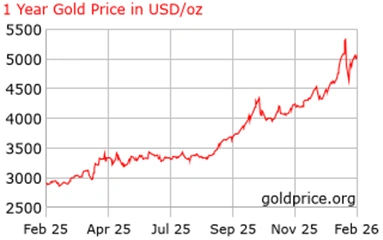
Figure 1: 1-year gold price [Goldprice]
The Engine Room: Central Banks and Investors
The backbone of this rally has been structural buying.
In the September quarter of 2025, investor and central bank demand reached roughly 980 tonnes, more than 50% above the previous four-quarter average. At prevailing prices, that equated to around US$109 billion in quarterly inflows.
For 2026, analysts expect quarterly demand from investors and central banks to average about 585 tonnes. Historically, around 350 tonnes of quarterly net demand is enough to push prices higher. Every additional 100 tonnes can translate into roughly 2% quarter-on-quarter gains.
Central banks remain critical players.
Even after three consecutive years of more than 1,000 tonnes of annual purchases, 2026 buying is expected to remain elevated at around 755 tonnes. That’s lower than peak years, but still well above the 400–500 tonne averages seen before 2022.
Gold now makes up close to 20% of global official reserves, up from around 15% in late 2023. The diversification away from US dollar holdings remains a structural trend, not a short-term trade.
If countries with under 10% gold reserves increase allocations to that threshold, the implied demand runs into hundreds of billions of dollars.
That’s not speculative demand. That’s policy-driven.
ETFs and the Rate Cycle
Investor positioning also matters.
Gold ETFs typically benefit when interest rates fall, as non-yielding bullion becomes more attractive relative to bonds and cash. If the US Federal Reserve eases policy further in 2026, ETF inflows could re-accelerate.
Currently, gold holdings represent about 2.8% of total global investor assets under management. That share could rise toward 4–5% over the coming years if diversification continues.
One scenario suggests that if just 0.5% of foreign US asset holdings shifted into gold, prices could reach US$6,000/oz.
With mine supply relatively inelastic and slow to respond, demand shocks translate quickly into price spikes.
Silver: The Volatile Overachiever
If gold has been impressive, silver has been explosive.
At roughly US$84/oz:
- Silver is up more than 161% over one year
- Up 118% over six months
- Still up over 200% across five years
J.P. Morgan forecasts silver to average US$81/oz in 2026, meaning current prices are already hovering above the projected annual average.
But silver’s story differs from gold’s.
Around 60% of silver demand comes from industrial uses, including solar panels, electronics and electrical systems. That industrial exposure has fuelled strong demand, particularly amid renewable energy growth.
However, it also introduces risk.
If prices remain elevated, manufacturers may:
- Reduce silver content in products (“thrifting”)
- Shift to alternative technologies such as cadmium telluride thin-film solar panels
- Delay capital expenditure in price-sensitive industries
Unlike gold, silver doesn’t have central banks acting as structural buyers on dips. That absence makes silver more volatile and sentiment-driven.
We’ve already seen that volatility in early 2026, with sharp corrections following shifts in US monetary leadership and renewed US dollar strength.
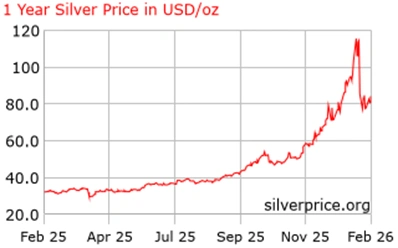
Figure 2: 1-year price of silver in USD [Goldprice]
What Could Derail the Bull Case?
Forecasts assume several supportive conditions continue:
- Ongoing geopolitical uncertainty
- Moderate or easing interest rates
- Continued central bank diversification
- Strong investor appetite
Risks include:
- A sharp US dollar rebound
- Sticky inflation forcing higher-for-longer rates
- Cooling ETF inflows
- Industrial substitution in silver
Neither gold nor silver moves in a straight line. After 70–160% annual gains, consolidation would be normal.
Also Read: ANZ Delivers Strong 1Q26 Result as ANZ 2030 Strategy Gains Early Momentum
So, Is Now a Good Time to Buy?
It depends on your objective.
If you’re chasing momentum after massive gains, caution is warranted. Pullbacks can be swift.
If you’re allocating for long-term portfolio diversification, gold still has strong structural support. Central bank demand, reserve diversification and limited supply create a firm floor beneath prices.
Silver offers higher potential upside but also greater volatility and industrial risk.
For Australian investors, currency adds another dimension. A softer Australian dollar amplifies USD-denominated gains in local terms.
The reality for 2026 is this:
Also Read: Origin Energy Reports Mixed Half-Year Performance Amid Energy Transition Push
Gold has already validated much of the bullish forecast. Silver has exceeded expectations but remains more fragile beneath the surface.
This isn’t a speculative frenzy driven purely by hype. It’s a market underpinned by structural shifts in global reserves, monetary policy uncertainty and constrained supply.
But after such powerful gains, patience may matter as much as conviction.
The bull story remains intact, just remember that even in powerful uptrends, the path is rarely smooth.