IBM has launched SQL Data Insights Pro, an AI-powered analytics solution that uncovers hidden patterns inside mission-critical Db2 data in real time, and keeps that data exactly where it already lives.
What Is IBM SQL Data Insights Pro, and Why Does It Matter?
If you have been wondering what is IBM AI tool SQL Data Insights Pro and how it differs from everything else on the market, the answer starts with where the AI lives.
Most enterprise analytics tools pull data out of its native environment, ship it to a separate platform, and run analysis there. SQL Data Insights Pro, also known as SQL DI Pro, does not work that way. IBM built the AI directly into Db2 for z/OS on IBM Z and LinuxONE, so the intelligence runs where the data already sits.
That design decision removes one of the biggest friction points in enterprise AI adoption: costly, risky data movement. Organisations with mainframe environments can now run advanced AI queries on transactional data in real time, with high throughput and low latency, without ever shifting that data to a separate analytics stack.
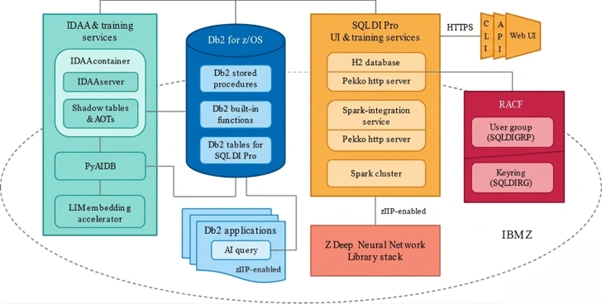
Figure 1: Architecture of IBM SQL Data Insights Pro [IBM]
For businesses exploring what AI can do without disrupting their infrastructure, SQL DI Pro represents a meaningful leap forward. It is also one of the clearest examples of IBM’s strategy of embedding AI into the tools its enterprise customers already depend on, a strategy that mirrors how major technology companies are approaching large-scale AI infrastructure investment.
The Company Behind the Tool
IBM built SQL Data Insights Pro specifically for the enterprise environments where its Db2 database engine already runs critical operations, banks, insurers, government agencies, healthcare providers, and large-scale logistics businesses.
IBM designed the tool for a wide range of user types within those organisations, including:
- Business analysts who need to explore customer behaviour without writing complex queries
- Data scientists who want semantic search and similarity discovery built in
- Database administrators who need to manage AI objects without learning a separate platform
- Application developers who want to automate insights through REST APIs or a shell CLI
Unlike tools that require a dedicated AI team to configure and maintain models, SQL DI Pro handles model training, updates, and lifecycle management internally. No manual model building. No specialised AI skills required.
When IBM Made This Available
IBM SQL Data Insights Pro version 1.1.0 is now available in IBM’s documentation ecosystem, with the tool currently operational for organisations running Db2 for z/OS on IBM Z and LinuxONE infrastructure.
The release continues IBM’s broader trajectory of integrating AI directly into its enterprise data stack throughout 2025 and into 2026. The Db2 ecosystem has seen a steady stream of AI capability additions, from SQL-based semantic queries in the base Db2 13 for z/OS engine to the expanded capabilities that SQL DI Pro now delivers.
IBM AI business insights explained through SQL DI Pro also align with findings from IBM’s own 2025 Chief Data Officer research, which found that 78% of senior leaders consider leveraging proprietary data their top strategic objective. SQL DI Pro directly addresses that goal by activating data that organisations already hold.
This comes at a time when the AI sector is reshaping how companies allocate capital and structure their workforces, making tools that deliver ROI without requiring major new infrastructure all the more attractive.
Why Businesses Need This Now
The problem SQL DI Pro solves is not a new one, but it has become a lot more urgent.
Most enterprise organisations maintain enormous reservoirs of transactional data in their mainframe databases. That data contains patterns: clusters of similar customer behaviour, early warning signs of fraud, anomalies that predict risk, and relationships between records that traditional SQL queries simply cannot surface.
The challenge has always been that uncovering those patterns required either moving the data, which is expensive and often prohibited by compliance requirements, or building and maintaining a separate AI infrastructure on top of it. Neither option was practical for most regulated businesses.
SQL DI Pro removes both barriers. IBM AI business insights explained this way make a compelling case: the AI trains directly on the Db2 data in place, and every insight surfaces through familiar SQL-based queries. There is no new platform to procure, no data pipeline to build, and no AI model to manage manually.
Regulatory environments in financial services and healthcare demand that sensitive data stays within controlled boundaries. The intersection of AI adoption and compliance is already reshaping corporate strategy across Australia, and tools that deliver AI capability without creating new compliance exposure are fast becoming essential.
Which Capabilities SQL DI Pro Delivers
The Core Query Types
Understanding what is IBM AI tool SQL DI Pro at a technical level means understanding the five types of AI queries it enables, each powered by built-in Db2 AI functions:
- Semantic similarity — Finds groups of records that share meaningful patterns, even when those patterns are not visible in structured columns
- Semantic dissimilarity — Surfaces the outliers: records that deviate significantly from the norm, useful for fraud detection and risk monitoring
- Semantic clustering — Groups entities based on contextual relationships and evaluates whether new entities belong in an existing cluster
- Semantic commonality — Identifies which records carry the most common or least common patterns across a dataset
- Semantic analogy — Determines whether the relationship between two entities holds true for a second pair, enabling complex relational reasoning
What Makes the Underlying Model Different
SQL DI Pro trains its neural network using ibm-data2vec, a z/OS native self-supervised learning function that IBM developed for relational database environments.
Instead of treating each column as an isolated field, ibm-data2vec builds a relationship map across the entire table. This map captures the semantic connections between values in different columns to provide a more holistic understanding of the data. The model converts each row into a structured text format, tags every value with its column name and a cluster identifier, and then trains on that composite picture of the data.
The result is a trained model that understands the meaning of data relationships across columns.
Once trained, the model loads directly into Db2. Queries run through built-in Db2 scalar functions, which means the familiar SQL interface does not change for the teams using it.
How SQL DI Pro Works in Practice
Getting SQL DI Pro operational follows a clear sequence. After installation and configuration, users connect the application to Db2 through the web UI, REST API, or shell CLI. They then:
- Create an AI object from an existing Db2 table or view
- Select a model training engine — either z/OS Spark or Db2 Analytics Accelerator for z/OS
- Configure column data types (categorical, numeric, text, or key) to guide the model
- Enable the object for AI query, triggering data preprocessing and model training
- Run queries at any time once the model loads into Db2
Query results display the first 50 rows directly in the SQL DI Pro web UI, with the complete result set loading into a Db2 table for export or downstream use.
Conclusion
IBM SQL Data Insights Pro brings AI capability to where it matters most, inside the data businesses already rely on every day.
For organisations running Db2 on IBM Z and LinuxONE, the tool removes the two biggest blockers to AI adoption: the cost and risk of moving sensitive data, and the complexity of managing AI models from scratch.
The result is straightforward. Teams ask better questions, surface hidden patterns faster, and do it all within the compliance boundaries they already operate in.
As businesses across industries look for AI tools that deliver real value without creating new problems, SQL Data Insights Pro makes a strong case for itself, not by doing the most, but by doing the right things well.
Disclaimer: The information in this article is intended for general informational purposes only. While every effort has been made to ensure accuracy at the time of publication, IBM’s products, features, and availability are subject to change without notice. Readers should refer directly to IBM’s official documentation for the most current and complete specifications regarding SQL Data Insights Pro.
This article does not constitute professional IT, legal, or compliance advice. Organisations should assess IBM SQL Data Insights Pro against their own regulatory requirements, infrastructure environment, and business objectives before making any purchasing or implementation decisions.
The internal and external links included in this article are provided for reference only. We are not responsible for the content or accuracy of third-party websites.
Frequently Asked Questions (FAQs)
1. What is IBM SQL Data Insights Pro and how is it different from traditional analytics tools?
Ans: IBM SQL Data Insights Pro (SQL DI Pro) is an AI-powered analytics solution that runs directly inside Db2 for z/OS on IBM Z and LinuxONE. Unlike conventional analytics platforms that require you to extract and move data to a separate environment before running analysis, SQL DI Pro keeps everything in place. It trains a neural network model on your existing Db2 tables and lets you run semantic AI queries, covering similarity, dissimilarity, clustering, commonality, and analogy, through standard SQL, without any data leaving your mainframe environment.
2. Do you need advanced AI or data science skills to use SQL Data Insights Pro?
Ans: No. IBM designed SQL DI Pro specifically to eliminate that barrier. The tool handles model training, updates, and lifecycle management automatically, so users do not need to build or maintain AI models themselves. Business analysts, database administrators, and application developers can all interact with the system through a web UI, REST API, or shell CLI, depending on their preference. The AI query interface uses familiar SQL syntax, which means teams already working in Db2 environments face a minimal learning curve.
3. How does SQL Data Insights Pro support regulatory compliance for sensitive data environments?
Ans: Because SQL DI Pro runs entirely within the Db2 for z/OS environment, sensitive data never moves to an external platform or third-party AI service. All model training, query processing, and result generation happen inside the same governed infrastructure where the data already lives. This architecture means organisations in heavily regulated industries — such as financial services, healthcare, and government, can apply AI analytics without creating new data sovereignty or compliance exposure. Every query type also maps to a documented Db2 AI function, giving auditors full visibility into how results were generated.
Sources
- IBM Documentation
- IBM Documentation
- TipRanks
- IBM Documentation
- IBM
- IBM Think
- IBM Newsroom
- IBM: Data Roadmap 2025