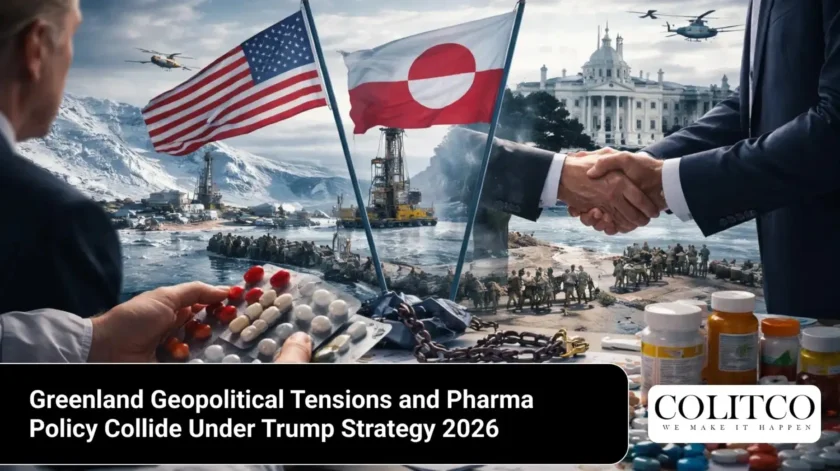
The opening days of 2026 have brought Greenland geopolitical news to the forefront of global discussions. Donald Trump renewed calls highlighting Greenland’s strategic importance, prompting a sharp response from Denmark’s leadership on 04 Jan 2026, urging Washington to de-escalate its rhetoric.

Figure 1: Aerial view of a coastal settlement in Greenland. [Source: CNBC]
These developments intersect with sweeping pharmaceutical policy shifts, signalling how Trump strategy 2026 is influencing both foreign relations and healthcare markets. From Arctic territorial focus to drug manufacturing tariffs, geopolitics is now playing a central role in shaping pricing frameworks, investment decisions, and global supply chains.
Greenland Returns to US Strategic Focus
Greenland geopolitical news intensified after Trump stated in early Jan 2026 that the territory is strategically important for US defence. The remarks followed heightened US military activity in the Western Hemisphere and renewed focus on Arctic security.
Denmark’s Prime Minister Mette Frederiksen firmly rejected the notion of any US takeover, reiterating that Greenland’s sovereignty is non-negotiable. The response underscored rising diplomatic friction and highlighted the sensitivity surrounding US Greenland relations.
The rhetoric extended beyond official statements, with public commentary from Trump allies amplifying tensions. While symbolic in nature, such messaging contributed to market unease and reinforced perceptions of a more assertive US geopolitical posture.

Figure 2: Louisiana Governor Jeff Landry speaking at a public event. [Source: Illuminator]
Trump’s appointment of Louisiana Governor Jeff Landry as special envoy to Greenland in Dec 2025 further signalled sustained US interest in the Arctic. Analysts view the move as part of a broader strategy to secure influence over strategically critical regions rather than a precursor to formal territorial action.
Trump Strategy 2026 Targets Pharmaceutical Manufacturing
The same strategic logic driving Greenland discussions is reshaping pharmaceutical policy. Under Trump strategy 2026, the US has signalled plans to impose tariffs of up to 100% on certain branded and patented pharmaceutical products, with the objective of reducing reliance on overseas manufacturing.
Tariff exemptions apply to Companies actively constructing or expanding drug manufacturing facilities within the US. This framework is designed to encourage rapid reshoring and domestic investment rather than immediate supply disruption, , aligning closely with the broader goals of Trump strategy 2026.

Figure 3: Pharmaceutical manufacturing line illustrating automated drug production. [Source: Manufacturing Today India]
Major pharmaceutical Companies responded by announcing significant long-term US investment commitments, collectively running into hundreds of billions of dollars. These announcements reflect a structural shift in industry thinking, with manufacturing location increasingly treated as a geopolitical decision rather than a cost-driven one.
Importantly, the policy does not apply to generic medicines, and existing trade agreements that cap pharmaceutical tariffs remain in force. These carve-outs help moderate near-term market disruption while still nudging capital allocation toward US-based production.
Ozempic and GLP-1 Drugs Face Pricing Pressure
Few drug categories better illustrate the convergence of politics and healthcare than GLP-1 weight-loss medications. In late 2025, the Trump administration announced agreements with leading manufacturers to significantly reduce prices for eligible patients beginning in 2026.
Under the new framework, monthly prices for leading GLP-1 drugs such as Ozempic and Wegovy will fall sharply when purchased through a government-supported platform. Public healthcare programs will also begin covering obesity treatments for the first time, lowering out-of-pocket costs for millions of Americans.

Figure 4: Ozempic (semaglutide) injection packaging. [Source: ScienceDaily]
Oral GLP-1 alternatives are also approaching market entry, with regulatory approvals late in 2025 opening the door to additional competition in 2026. These developments reinforce GLP-1 therapies as one of the fastest-growing and most politically sensitive segments of global pharmaceuticals.
However, analysts note a policy contradiction. Tariffs and reshoring efforts raise production costs at the same time political pressure demands lower consumer prices. This tension risks margin compression and potential supply bottlenecks, particularly for biologic drugs with complex manufacturing requirements.
Supply Chains Become Strategic Assets
Under expanded use of emergency economic powers, broad tariffs now apply across imported goods, including pharmaceutical inputs and manufacturing equipment. Active ingredients, excipients, packaging materials, and specialised machinery are all affected, increasing compliance complexity and near-term costs.
This shift mirrors the logic underpinning US Greenland relations, where control, access, and resilience outweigh efficiency. Whether the asset is Arctic territory or drug manufacturing capacity, strategic independence has become a policy priority shaped by Greenland geopolitical news and broader national security thinking.
Market Implications for Pharmaceutical Investors
Throughout 2025, market reactions to tariff announcements underscored growing investor sensitivity to political risk. Pharmaceutical equities experienced sharp volatility following signals of aggressive trade policy, reflecting uncertainty around costs, pricing power, and supply continuity.
Companies with established US manufacturing capacity may benefit from policy support and regulatory alignment. In contrast, firms reliant on international supply chains face rising exposure to trade disruption and margin pressure.
Despite these risks, demand fundamentals remain strong. GLP-1 medications continue to drive revenue growth, reinforcing weight-loss treatment as one of healthcare’s most lucrative segments heading into the second half of the decade.
Also Read: Vanguard ASX ETF Distribution 2026: Final Payments Announced
FAQs
Q1. How does Greenland geopolitical news affect pharmaceutical markets?
Ans. It reflects broader US strategic priorities under Trump strategy 2026, including supply chain control and pharmaceutical reshoring, and increasing market volatility.
Q2. What is Trump strategy 2026 for pharmaceutical manufacturing?
Ans. It uses tariffs of up to 100% on branded drugs to push domestic manufacturing, with exemptions for companies building US facilities.
Q3. How do US Greenland relations impact healthcare policy?
Ans. They show how healthcare supply chains are now treated as national security assets, similar to strategic territories.
Q4. What are the GLP-1 drug price changes in 2026?
Ans. Prices for leading GLP-1 drugs will fall through government-supported platforms, with oral alternatives also nearing market entry.