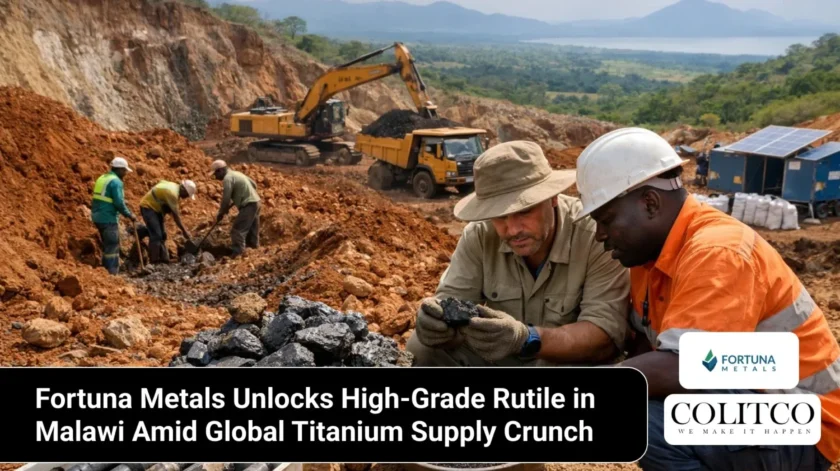
Fortuna Metals (ASX: FUN) confirms a rutile discovery at the Mkanda project in Malawi. The company identifies mineralisation across 18 square kilometres through an exploration programme.
High-grade results from the drilling programme include hole MHA0023, which yielded 10 metres at 1.66% rutile, terminating in mineralisation at 1.59%. Additionally, drill hole MHA0050 returned 10 metres at 1.62% rutile, featuring a peak terminal grade of 2.15%.
Anomalies covering 37 square kilometres confirm the presence of surface titanium and graphite. Phase 1 soil sampling and hand auger drilling have solidified the discovery, with XRD and QEMSCAN analysis verifying rutile as the primary titanium mineral.
- Drill hole MHA0020 shows 10 metres at 1.32% rutile.
- Drill hole MHA0057 yields 9 metres at 1.30% rutile.
- Drill hole MHA0046 returns 10 metres at 1.23% rutile.
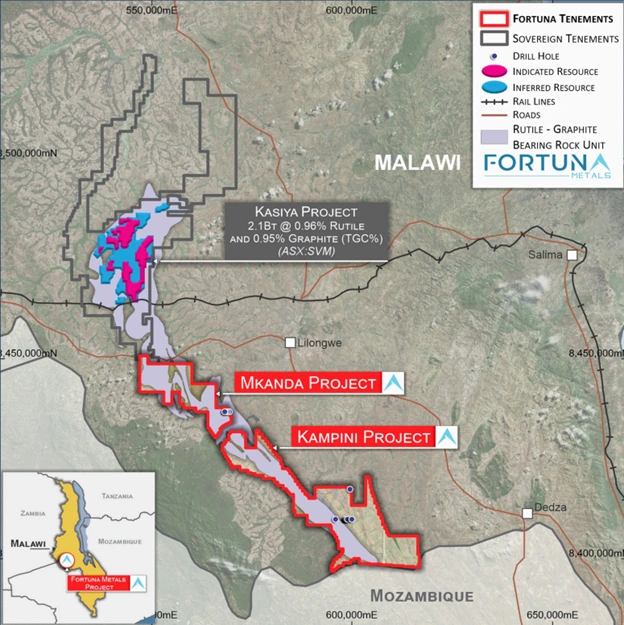
Figure 1: Fortuna Metals Project in Malawi [FUN]
Supply Constraints and Demand Growth
Global titanium supply is currently facing a sharp decline, with rutile production falling 44% from its 2017 peak. This shortage is exacerbated by mine closures in Kenya in 2024 and reduced output from Australia in 2025.
As supply tightens, demand is surging within the aerospace and defence sectors. High-performance aircraft like the F22 Raptor are comprised of 40% titanium by weight, highlighting the metal’s critical role in modern defence.
The United States currently imports 100% of its titanium requirements, reporting zero domestic sponge production in 2025. Simultaneously, the rise of humanoid robotics is creating a new frontier for demand, specifically for titanium-based joints and actuators.
With each robotic unit requiring 3 to 6 kilograms of Ti-6Al-4V alloy, Goldman Sachs forecasts a production rate of 1.4 million units annually by 2035. This emerging market could potentially increase titanium production requirements by 200 times.
- Titanium reduces weight by 45% compared to steel.
- Alloys provide strength three to five times greater than stainless steel.
- The metal resists corrosion in coastal and offshore environments.
- The iPhone 15 Pro utilises a titanium frame.
- Titanium pairings with niobium optimise superconductors.
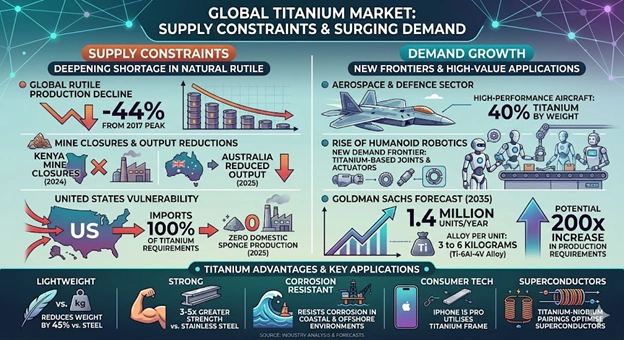
Figure 2: Global Titanium Market
Corporate Management and Technical Teams
Fortuna Metals (ASX: FUN) is spearheading exploration in Malawi with a market capitalisation of $18.06 million and an enterprise value of $10.86 million.
Backed by $6.991 million in cash as of December 2025, the company is led by CEO Tom Langley, who brings 14 years of specialised experience in exploration and mining.
Langley, an alumnus of the University of Western Australia with a Master’s in Economic Geology, previously led the discovery of the Lyons rare earths project. He is supported by Non-Executive Chairman Peter Pawlowitsch.
Pawlowitsch offers 20 years of expertise in capital markets and is a Fellow of the Governance Institute of Australia. The board also includes Non-Executive Directors Brian Thomas and David Frances.
Thomas previously chaired Azure Minerals during a $1.7 billion takeover. Frances brings 30 years of experience in discovery and operation of assets in Africa. Matt Foy serves as the Company Secretary.
- Hilton Banda serves as Country Manager through Akatswiri Resources.
- Richard Stockwell acts as the Resource Geologist.
- David Bougourd manages metallurgy and planning.
- Sovereign Metals operates as a neighbour to the project.
- Rio Tinto holds an 18% stake in Sovereign Metals.
- Mitsui and Traxys maintain memorandums of understanding for offtake.
Regional Infrastructure and Logistics
Located in Malawi’s Central Region, the project covers 658 square kilometres and sits just 20 kilometres south of the major Kasiya deposit.
The site is conveniently situated 30 kilometres from the capital, Lilongwe, with bitumen road access. Additionally, 90% of the land has already been cleared by local farming activity.
Logistics are bolstered by the Nacala rail line, located 11 kilometres away, which connects to the Nacala Deep Water Port. This corridor has benefited from a $7 billion investment from the Japanese Government.
- The rail line has a capacity of 22 million tonnes per annum.
- The project location allows a 2.5-hour flight from Johannesburg to Lilongwe.
- Malawi enacted a modernised investment framework in 2024.
- The jurisdiction carries zero exposure to US sanctions.
Project Timeline and Milestones
Fortuna Metals acquired the project in September 2025 and established Malawian operations by late 2025. Key exploration results were formalised in March 2026.
The company aims to release an exploration target in April 2026, coinciding with global supply curtailments in Kenya and Australia.
Also Read: Culpeo Minerals Strengthens Its Position at Lana Corina with Improved Earn-In Terms
With bullish forecasts from Citi and Elon Musk regarding AI-robots, the long-term demand for titanium appears robust through 2040.
- Morgan Stanley projects 63 million units in the US by 2050.
- The company targets an inferred resource for the 2026 calendar year.
- Indicated resource estimates will follow in 2027.
- Feasibility studies will conclude in 2027.
How It Will Play Out
Fortuna Metals utilises a “hub and spoke” production model. Surface pits will supply a central processing hub, with 2026 drilling testing depths up to 25 metres.
This depth facilitates efficient free-dig mining. The company is currently conducting systematic drilling on a 400-metre grid and performing bulk sample testwork.
The workflow includes the establishment of an in-country laboratory. Environmental studies will begin in the fourth quarter of 2026. The company targets the completion of an inferred resource in early 2027.
- Natural rutile requires no upstream upgrading for the chloride process.
- The product supports carbon emission reductions of 97% compared to synthetic rutile.
- Production costs stay low due to mineralisation at surface.
- Rutile serves as the feedstock for aerospace-grade Ti-6Al-4V.
- Robotic joints use titanium for servo motors.
- Harmonic drive flexisplines align servos using titanium components.
- Actuator shafts drive servos in humanoid units.
- Sensors measure force through titanium fasteners and springs.