
Far East Gold Limited (ASX: FEG) (“FEG” or “the Company”) has fired the first shots in what could prove to be a defining chapter for the Company’s Australian portfolio. Drilling officially commenced on 6 November 2025 at the Mount Clark West Copper-Gold Project in central Queensland, marking the start of 1,800-metre campaign designed to test the heart of an interpreted porphyry copper-gold system.
The moment arrives after months of strategic groundwork. A Conduct and Compensation Agreement (CCA) has been signed with landowners, Eagle Drilling NQ Pty Ltd has been engaged, and one rig is now on site testing targets refined through MIMDAS geophysics, geochemistry and structural mapping.
This is not a speculative stab in the dark. Historical drilling by Medusa Mining in 2019 clipped what the Company believes to be the outer edge of a significant system, returning 104 metres at 0.1% copper from 114 metres, including 14 metres at 0.23% copper from 180 metres in hole MCDD002.
Drilling the Core
The initial three-hole program will deploy both reverse circulation (RC) and diamond drilling to test coincident magnetic and MIMDAS chargeability anomalies. An optional fourth hole may follow if results warrant.
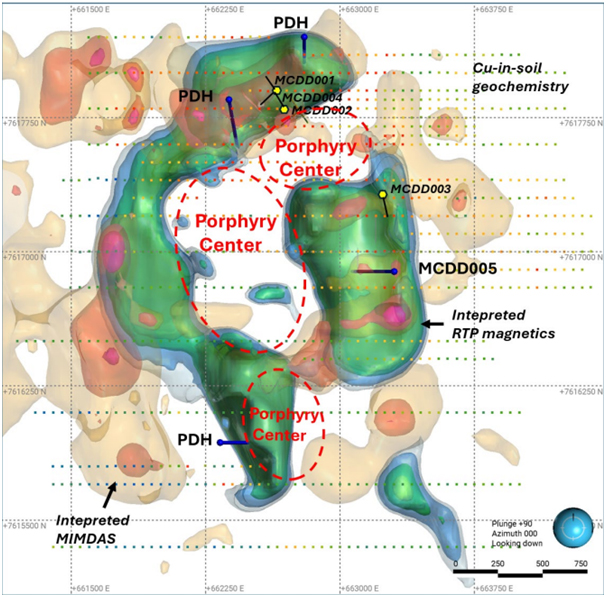
Figure 1: Map showing extent of interpreted RTP magnetics and MIMDAS chargeability anomalies
CEO Shane Menere said the Company has pinpointed a higher-priority target inside the tenement that was previously inaccessible without the CCA.
“In the first scout program, there’s compelling evidence that we clipped the edge of what we believe to be a large porphyry copper-gold system. Those early results, combined with more recent geophysics, geochemistry and sampling, have now allowed FEG to pinpoint a new, higher-priority target,” Menere explained.
“Everything we’ve learned points to a mineralised system beneath surface. The MIMDAS geophysical signatures, copper-molybdenum anomalies and alteration mapping all line up to suggest we’re drilling closer to the heart of a porphyry system this time around.”
A Strategic Location in the Connors Arc
The Mount Clark West Copper-Gold Project sits 24 kilometres north of Nebo in Queensland’s Connors Arc volcanic belt. This is not marginal ground. The Connors Arc hosts multiple Tier-1 deposits along strike, including Evolution Mining’s former Mount Carlton mine and the Cracow gold deposit.
Yet despite this pedigree, the district remains underexplored for porphyry-style copper-gold mineralisation. Far East Gold believes the magnetic and geochemical signatures at Mount Clark West reflect a cluster of porphyry bodies, each with potential to host significant copper-gold mineralisation.
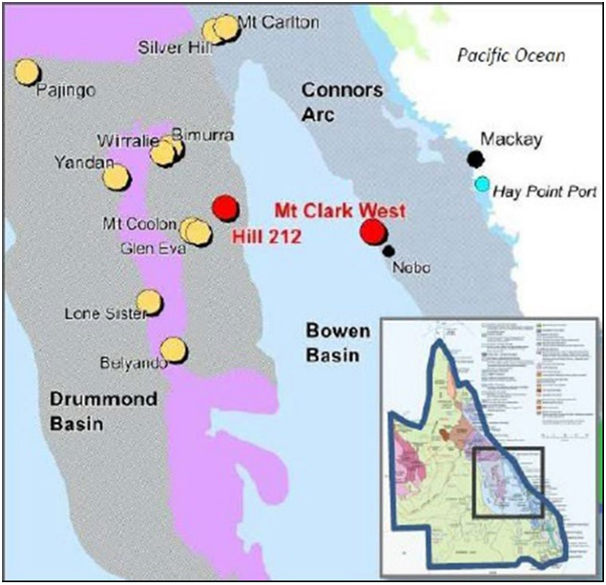
Figure 2: Image shows the location of the Mt. Clarke West (MCW) and Hill 212 tenements
The project tenure covers 1,912 hectares under EPM 26008. Geological mapping has identified at least three interpreted porphyry centres, characterised by low-magnetic zones, encircled by high chargeability and magnetic anomalies.
These features, combined with coincident copper-molybdenum soil geochemistry, are consistent with classic porphyry hallmarks.
Market Tailwinds for Copper-Gold
The timing could scarcely be better. Copper prices have rallied strongly through 2025, with investment giant Goldman Sachs upgrading its second-half price forecast to US$9,890 per tonne, an 8.2% increase from previous predictions.
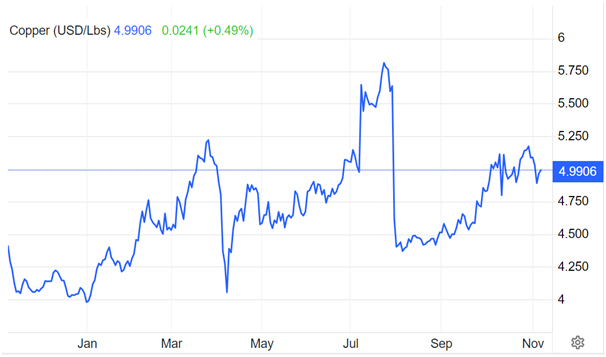
Figure 3: Copper Price Chart
The copper market finds itself at a critical juncture. Global mine output is projected to reach 23.2 million tonnes in 2025, representing just 3% growth from 2024 levels. Meanwhile, refined copper demand reached 21.2 million tonnes in the first nine months of 2024 alone, a 4.3% increase year-on-year.
Australia’s copper production is forecast to grow to 821,000 tonnes in 2025-26, a 2.6% year-on-year increase. But this gradual expansion underscores the challenges of developing new copper resources even in established mining jurisdictions.
The International Copper Study Group projects 2.5-3.0% annual demand growth through 2030, driven by continued industrialisation and the energy transition. Electric vehicle production alone grew 35% globally in 2024, requiring approximately 2.8 million tonnes of copper.
For gold, the outlook remains equally robust. Australia’s gold sector is projected to generate approximately $56 billion in export earnings in FY26, making it the nation’s third-largest resource export earner behind iron ore and LNG.
Porphyry Systems: The Prize Worth Chasing
Porphyry copper deposits represent the dominant source of copper mined globally. These ore bodies form from hydrothermal fluids originating from voluminous magma chambers several kilometres below the deposit itself.
Because of their large volume, porphyry ore bodies can be economic from copper concentrations as low as 0.15% and often contain meaningful by-products such as molybdenum, silver and gold.
The Connors Arc’s geological setting places it within Australia’s broader porphyry-epithermal provinces. Geoscience Australia notes that porphyry deposits in eastern Australia currently contain an estimated 13.5 million tonnes of copper and 1,700 tonnes of gold across nine known deposits.
The challenge is that porphyry systems require precision targeting. Historical exploration at Mount Clark West intersected altered volcanics with low-grade copper, but Far East Gold’s technical team believes those intercepts were peripheral to the core system.
What’s Next?
Drilling has commenced at site MCDD005. The program will test three primary targets, with each hole designed to intersect coincident chargeability-resistivity responses flanking low-magnetic cores interpreted as intrusive porphyries.
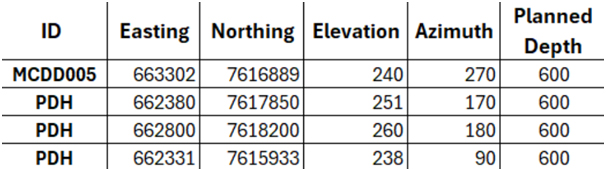
Table 1: Planned drillholes at MCW. The 4th hole is optional if results warrant.
Assay results from the initial phase are expected in the coming weeks, with the Company maintaining a disciplined quality assurance and quality control protocol throughout.
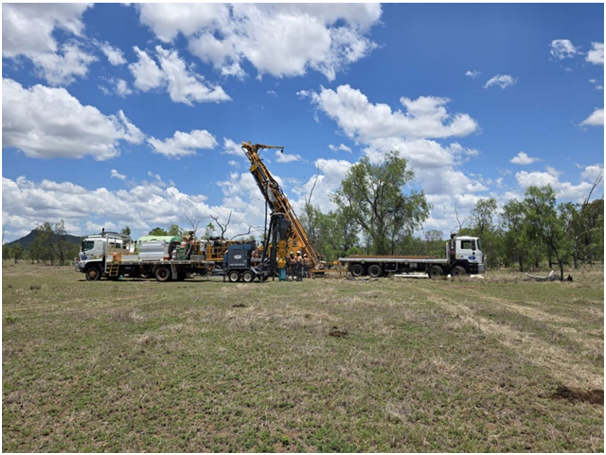
Figure 4: RC drill setup at drill site MCDD005
Every metre drilled will add to the geological understanding of what could prove to be a significant mineral system in one of Queensland’s most prospective but underexplored copper-gold belts.
Investor Outlook
Far East Gold’s share price has responded positively to the Company’s exploration momentum across both its Australian and Indonesian portfolios. Based on the latest available data, FEG shares are trading at approximately $0.15 per share, with a 52-week range of $0.110 – $0.200. The Company’s market capitalisation sits at approximately $53.2 million, reflecting the early-stage nature of its assets.
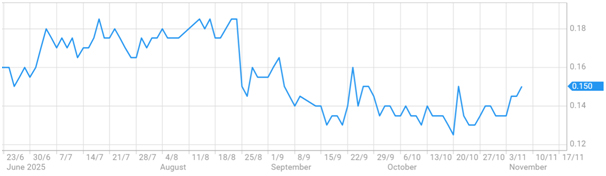
Figure 5: FEG Price Chart
However, with drilling now underway at Mount Clark West, a JORC resource of 540,000 ounces of gold at 4.1 grams per tonne at the Idenburg Project in Papua, and a portfolio spanning six advanced projects across Indonesia and Australia, Far East Gold is positioning itself as a genuine discovery-focused explorer.
Shane Menere’s final comment captures the sentiment driving the current program.
“The goal couldn’t be clearer: to prove Mount Clark West has the potential to host a significant copper-gold discovery in Queensland.”
For investors tracking Australia’s copper-gold space, the next few weeks could prove instructive. The rig is turning. The targets are defined. Now comes the test.