
Shayne Elliott, who led Australia’s fourth-largest bank for nearly a decade, has filed legal proceedings against his former employer. The dispute centres on more than $13 million in cancelled bonuses.
The lawsuit landed in the New South Wales Supreme Court on Thursday, just days before ANZ faces shareholders at its Annual General Meeting. The timing couldn’t be more sensitive for the Melbourne-based lender.
Elliott retired as CEO in July 2025 after steering ANZ through significant regulatory challenges. His departure came months before the bank agreed to pay a record $240 million penalty to Australia’s corporate watchdog.

Shayne Cary Elliott is a New Zealand banker, and a former chief executive officer (CEO) of ANZ Bank
The Heart of the Dispute
The ANZ board stripped Elliott of $13.5 million in short and long-term incentives. The decision came after the bank admitted to widespread misconduct affecting tens of thousands of customers.
Elliott has now broken his silence on the matter. In a statement reported by The Australian, he said his expectation was simple – that contractual terms would be honoured.
“As you would expect, having entered into a contract, my expectation is that those terms would be honoured,” Elliott stated. “I accept the need for accountability, which is why I voluntarily proposed to the Board that I would forgo my incentives in 2024.”
The bank’s response was swift and firm. Chairman Paul O’Sullivan said ANZ would defend its position vigorously. The board maintains it acted properly in assessing remuneration outcomes.
A Record Settlement That Changed Everything
The bonus cancellation stemmed from ANZ’s agreement to pay $240 million in penalties. ASIC described it as the largest corporate penalty in Australian history.
The settlement resolved five separate investigations spanning institutional and retail operations. Key failures included:
- Unconscionable conduct in a $14 billion government bond deal
- Charging fees to deceased customers over an 11-year period
- Misleading the government about bond trading turnover data
- Systemic failures in managing non-financial risks
The bond trading scandal proved particularly damaging. In April 2023, ANZ was helping the Australian Office of Financial Management with a major bond issuance.
Instead of trading gradually to limit market impact, ANZ sold significant volumes of bond futures around pricing time. This placed downward pressure on bond prices.
ASIC estimated the conduct cost taxpayers around $26 million. The funds were earmarked for essential services including health and education systems.
More Than One Executive Affected
Elliott wasn’t alone in facing financial consequences. The board implemented sweeping accountability measures across senior leadership.
Current and former executives lost more than $32 million in total bonuses. Even the new CEO, Nuno Matos, had a $975,000 bonus cancelled.
Matos took the helm in July 2025, replacing Elliott after a global executive search. He said staff must “absolutely respect” the board’s decision despite the historic failures not occurring under his watch.
The Portuguese-born banker has been working to draw a line under past problems. His focus has been on transformation and cost-cutting to restore profitability.
December Showdown at Annual Meeting
ANZ shareholders will vote on the bank’s remuneration report on 18th December 2025. The meeting could prove explosive for management.
Two influential proxy advisers have already weighed in. Both Glass Lewis and Institutional Shareholder Services recommended shareholders vote against the pay report.
Their criticism centres on what they see as insufficient consequences. The advisers argue that $32 million in clawed-back bonuses doesn’t fully reflect the scale of failures.
Last year, shareholders delivered a “first strike” against executive pay. More than 25% voted against the remuneration report.
A second strike this year would trigger a board spill resolution. All directors would face potential re-election. The symbolic impact alone would be significant for governance.
Elliott’s Nine-Year Tenure
Shayne Elliott joined ANZ in 2009, working his way up through institutional banking and the CFO role. He became CEO in January 2016.
His tenure saw major strategic shifts:
- Shrinking Asian operations to focus on Australia and New Zealand
- Leading the $4.9 billion Suncorp Bank acquisition
- Launching the ANZ Plus digital banking platform
- Building one of the world’s leading institutional banking franchises
Chairman Paul O’Sullivan previously praised Elliott’s contribution. He said Elliott was the first CEO to identify the need for simplification in Australian banking.
Under Elliott’s leadership, ANZ delivered total shareholder returns of 111% over nine years. The bank’s share price rose 20% in his final year.
But regulatory issues emerged during his watch. ASIC has brought 11 civil penalty proceedings against ANZ since 2016. Total penalties now exceed $310 million.
Industry Reactions and Legal Precedent
One former senior ANZ trader told The Nightly the situation was “getting farcical.” The comment reflected broader unease about ongoing governance issues.
The lawsuit represents a rare escalation in Australian banking. Former executives rarely take legal action against their employers over remuneration decisions.
Elliott’s case centres on contract law rather than regulatory matters. He argues the board breached his employment agreement by cancelling vested incentives.
ANZ maintains it had obligations under APRA’s framework. The regulator requires banks to design remuneration encouraging prudent risk management.
The board must also link executive pay to performance and risk outcomes. This includes considering matters when releasing unvested equity annually.
Market Impact and Investor Sentiment
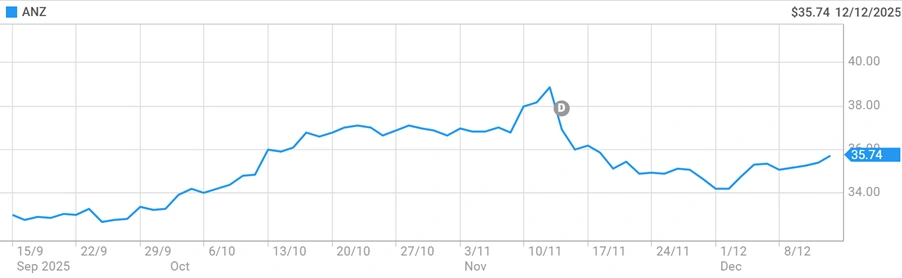
ANZ shares have performed strongly through 2025 despite the regulatory storm. The stock was trading around $35.33 on 12th December 2025.
That represents a gain of approximately 24% year-to-date. ANZ has outpaced several major banking peers in Australia.
The 52-week range sits between $26.220 – $38.930. Current levels position the stock near the upper end of that band.
Analysts remain divided on ANZ’s outlook:
- Morgan Stanley rates it Equal-weight with a $34 target
- Jarden maintains Overweight with a $35 target
- Some brokers have Sell or Underweight ratings citing regulatory risks
The bank offers a trailing dividend yield of approximately 4.7% to 5.0%. ANZ maintained its dividend at $1.66 per share for 2025.
Regulatory Oversight Continues
The Australian Prudential Regulation Authority increased ANZ’s capital requirements by $1 billion. The decision reflected concerns about non-financial risk management.
APRA also imposed a court-enforceable undertaking. This requires ANZ to submit detailed remediation plans and implement reforms.
The bank expects to spend $150 million on compliance improvements in the 2026 financial year. Integration costs for Suncorp and restructuring will add to expenses.
ANZ has not participated in a government bond deal since the April 2023 incident. The exclusion represents a significant commercial rebuke.
What Happens Next
Elliott has indicated he wants the earliest possible court hearing. He stated he’s fully committed to seeing the legal process through.
The case could set precedent for how Australian banks handle executive accountability. It raises questions about the boundaries of board discretion over unvested equity.
For ANZ, the lawsuit adds another layer of complexity to an already challenging period. The bank is managing:
- The Suncorp Bank integration
- A $800 million cost reduction program
- 3,500 job cuts announced earlier this year
- Ongoing APRA remediation requirements
- The December AGM showdown over executive pay
New CEO Nuno Matos has outlined an “ANZ 2030” strategy. The plan aims to lift return on tangible equity into the low-teens by decade’s end.
Success depends on executing major transformation without triggering fresh compliance issues. Cultural change remains central to rebuilding trust.
Also Read: Bupa Slapped with Record Fine After Wrongly Rejecting Thousands of Health Claims
Broader Implications for Banking Governance
The Elliott lawsuit highlights tensions in modern banking governance. Boards face pressure from regulators, shareholders and executives simultaneously.
Regulatory frameworks demand accountability when things go wrong. Shareholders want value and returns. Executives expect contractual terms to be honoured.
Finding the balance has become increasingly difficult. The two-strikes rule and proxy adviser influence add further complexity.
Australian banks have paid billions in penalties and remediation over the past decade. The Royal Commission into banking misconduct exposed systemic cultural issues.
ANZ’s situation demonstrates that legacy problems can persist years after leadership changes. The bank’s market capitalisation stands at approximately $104 billion.
With both sides preparing for a legal battle, the outcome could reshape how Australian banks approach executive remuneration and accountability in the years ahead.