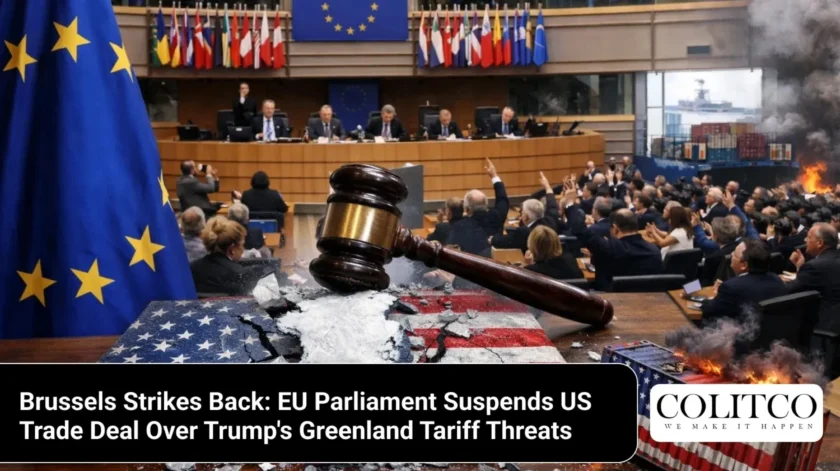
The European Union has delivered a sharp rebuke to Washington after the EU Parliament suspended its US trade deal on Wednesday.
The move came in direct response to President Donald Trump’s escalating tariff threats tied to his pursuit of Greenland.
It marks a dramatic turning point in transatlantic relations and threatens to unravel months of diplomatic groundwork.
What Triggered the Freeze?
On Saturday, 17 January 2026, Trump announced a 10% tariff on eight European nations starting 1 February. The tariff would climb to 25% by 1 June unless Denmark agreed to sell Greenland to the United States.
The countries affected include:
- Denmark
- Norway
- Sweden
- France
- Germany
- United Kingdom
- Netherlands
- Finland
Trump described the tariff as necessary to force a “complete and total purchase” of the Arctic territory. He claimed that Russia and China posed security risks to Greenland and accused European allies of interfering.
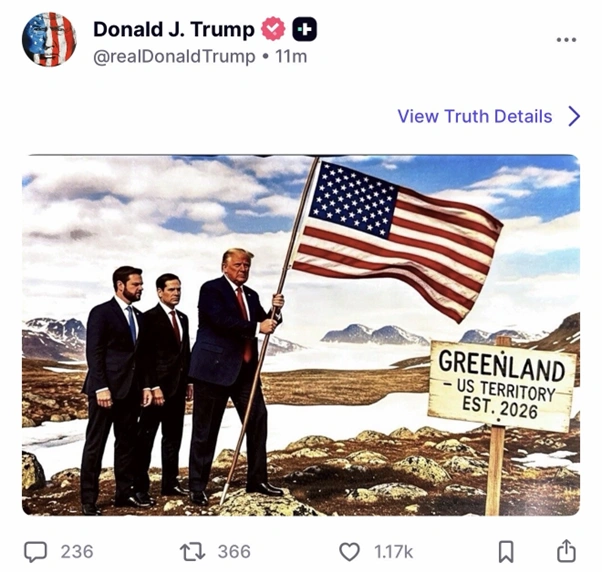
President Trump posted a photo of him, JD Vance and Marco Rubio planting the American Flag in Greenland [@MAGAVoice on X]
Bernd Lange, chairman of the European Parliament’s international trade committee, responded firmly. He stated that the EU had “been left with no alternative but to suspend work” on the trade deal.
He added: “Our sovereignty and territorial integrity are at stake.”
The Trade Deal at Risk
The suspended agreement, struck in July 2025 at Trump’s Turnberry golf resort in Scotland, was supposed to bring stability. It capped US tariffs on most EU products at 15%, while the EU agreed to cut its own tariffs on US industrial imports to zero.
The deal still required formal parliamentary approval. That vote was scheduled for next week. Now, it sits frozen indefinitely.
European lawmakers argue that Trump’s latest threats breach the terms of the Scotland agreement. They view the tariffs as a direct attack on European territorial sovereignty.
Several key political groups in the European Parliament, including the EPP, S&D, and Renew, supported the suspension. Even countries that backed last year’s agreement have now turned against it.
As European Commission President Ursula von der Leyen noted, “Tariffs would undermine transatlantic relations and risk a dangerous downward spiral.”
This isn’t the first time global trade tensions have escalated under Trump’s leadership. Markets worldwide have reacted nervously to his tariff-heavy approach.
Europe’s Nuclear Option: The Anti-Coercion Instrument
The EU isn’t stopping at suspending the trade deal. European leaders are now discussing deploying their most powerful economic weapon: the Anti-Coercion Instrument (ACI).
French President Emmanuel Macron has pushed aggressively for its activation. The ACI, dubbed the “trade bazooka,” was adopted in 2023 but has never been used.
What does it do?
The instrument allows the EU to:
- Impose steep retaliatory tariffs on US goods
- Restrict US access to the EU’s 450-million customer single market
- Block US companies from public procurement contracts
- Limit foreign direct investment from American firms
- Curtail access to EU financial markets
The European Parliament’s trade committee will meet on Monday to discuss whether to trigger the ACI. Lange described it as a tool “created exactly for such a case when a foreign country uses tariffs and investment for political and coercive pressure.”
However, deploying the ACI takes time. The European Commission has up to four months to investigate whether economic coercion is occurring. Member states then need a qualified majority vote to activate it.
Even if approved, countermeasures could take six months to implement. But simply launching an investigation would send a strong signal that Brussels is prepared to fight back.
Market Reactions and Global Fallout
Financial markets have responded with alarm. European stocks tumbled on Monday following Trump’s weekend announcement. Luxury goods makers like LVMH and Kering saw sharp declines.
Pharmaceutical giants also took a hit. Novo Nordisk dropped 2.1%, while Sanofi fell 0.9%. Energy stocks slid as well, with Norway’s Equinor down 3.4%.
The uncertainty mirrors previous episodes of market turmoil triggered by Trump’s tariff policies.
Germany, which holds the largest trade surplus with the US among European nations, faces the most exposure. In 2024, US-Germany trade totalled USD 236 billion.
Economists warn that a full-blown trade war could push global growth lower and destabilise supply chains. Mohit Kumar, chief economist at Jefferies, suggested that the 1 February deadline might be postponed through diplomatic channels.
But he cautioned: “For Greenland, the position for Europe is very clear: it’s not for sale, and they will not tolerate aggression.”
We prefer science to conspiracy theories, rule of law to rule of force, dialogue to threats.
Nous préférons la science au complotisme, l’État de droit à la loi du plus fort, le dialogue aux menaces. pic.twitter.com/e4qK6mdFsa
— Emmanuel Macron (@EmmanuelMacron) January 20, 2026
Trump Doubles Down at Davos
Trump addressed the World Economic Forum in Davos on Wednesday. While he ruled out using military force to acquire Greenland, he maintained his tariff threats.
“You can say yes, and we will be very appreciative, or you can say no, and we will remember,” Trump told the gathering.
He dismissed concerns that his approach would damage US credibility. Instead, he portrayed America as the undisputed global leader.
But EU foreign affairs chief Kaja Kallas suggested the standoff benefits Russia and China. “They are the ones who benefit from divisions among allies,” she posted on X.
Danish officials have repeatedly stated that Greenland is not for sale. The semi-autonomous territory is covered by NATO’s collective defence clause, complicating any US attempt to acquire it.
Also Read: Trump at Davos 2026: Markets Reverse Course After President Rules Out Military Force for Greenland
What’s Next?
The EU Parliament’s suspension of the trade deal leaves transatlantic relations in a precarious state. Both sides have invested significant political capital into the agreement.
Monday’s committee meeting will determine whether the EU escalates further by triggering the Anti-Coercion Instrument. If activated, it could reshape the global trade landscape.
For now, European leaders remain united in their opposition to Trump’s demands. Eight countries issued a joint statement on Sunday affirming full solidarity with Denmark and Greenland.
They described the joint military exercises in Greenland, which triggered Trump’s ire, as posing “no threat to anyone.”
As tensions simmer, the world watches closely. The outcome could define not just US-EU relations, but the future of the rules-based international order.