China’s holdings of U.S. Treasury securities have declined to their lowest level since the 2008 financial crisis, based on official figures. The reduction reflects shifting reserve allocation strategies amid global market volatility, while broader foreign demand has helped maintain stability in the Treasury market.
Holdings Decline to 17-Year Low
China-based investors currently hold about $682.6 billion in U.S. Treasuries, according to data from the U.S. Department of the Treasury. The figure represents a steep drop from the $1.32 trillion peak reached in late 2013.
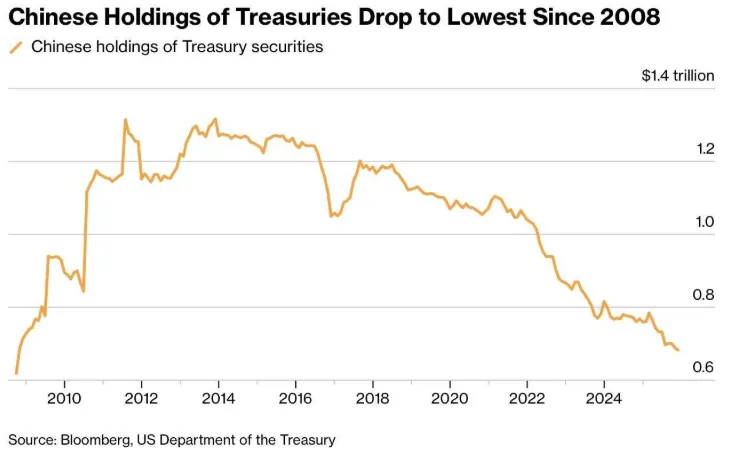
Source: Bloomberg, U.S. Department of the Treasury
The decline has unfolded gradually over several years rather than through sudden divestment. Treasury data show a consistent downward trend in direct holdings reported under China’s name.
The latest figures have drawn renewed market attention. Commentary shared on X by accounts such as Crypto Rover referenced the updated data, pointing to the long-term contraction in China’s Treasury portfolio.
💥BREAKING:
China’s holdings of U.S. Treasuries have fallen to their lowest level since the 2008 financial crisis. pic.twitter.com/K6EZh3KEOr
— Crypto Rover (@cryptorover) February 10, 2026
Even with the reduction, China remains the third-largest foreign holder of U.S. government debt. Japan and the United Kingdom continue to occupy the top two positions in overall Treasury ownership.
Belgium’s Role in Custodial Holdings
Some market analysts note that part of China’s exposure may be reflected in Belgium’s reported holdings. Belgium’s Treasury portfolio has expanded to approximately $481 billion since the end of 2017, according to Bloomberg data.
Financial institutions often use custodial centers for asset management purposes. Belgium is widely viewed as a location where Chinese-linked accounts may be recorded for administrative reasons.
This structure can complicate interpretations of official country-by-country data. While China’s direct holdings have declined, some positions may still be indirectly linked through custodial arrangements.
As a result, headline numbers alone may not provide a complete representation of China’s total exposure to U.S. government securities.
Regulatory Guidance and Market Response
Recent reports indicate that Chinese regulators have advised domestic financial institutions to rein in Treasury holdings during periods of heightened volatility. The guidance was described as part of broader risk management measures.
Following these reports, U.S. long-dated yields edged higher in early trading sessions. At the same time, the dollar weakened against several major currencies.
However, the market reaction remained limited. Analysts noted that there were no signs of disorderly selling or abrupt portfolio liquidation.
Bond traders observed that adjustments appeared gradual and measured. That approach has contributed to relatively stable conditions across global fixed-income markets.
Broader Global Reallocation
China’s reduction in Treasury exposure aligns with trends seen in other emerging economies. Countries such as India and Brazil have also scaled back holdings of U.S. government debt in recent years.
Central banks have increasingly emphasized diversification within foreign exchange reserves. This strategy often includes reallocating assets across currencies and sovereign issuers.
Gold has attracted renewed interest amid geopolitical tensions and currency fluctuations. Nevertheless, U.S. Treasuries remain a core component of global reserve portfolios.
At the same time, several countries have expanded their Treasury positions. Canada, Norway, and Saudi Arabia recorded increases in reported holdings over the past year.
These inflows have helped offset reductions from other jurisdictions. The broader distribution of demand has supported overall market balance.
Treasury Market Performance
Despite ownership shifts, U.S. Treasuries have delivered steady returns. Over the past year, the asset class posted gains of approximately 5.3 percent, according to Bloomberg data.
Among comparable sovereign bond markets, only a few, including Singapore and Israel, achieved stronger performance. The relative stability has reinforced Treasuries’ position in global portfolios.
Market participants continue to regard U.S. government bonds as a liquid and reliable asset class. This perception supports consistent demand during periods of uncertainty.
In addition, Treasuries remain central to international financial infrastructure. They are widely used as collateral and benchmark instruments across markets.
Economic Data and Federal Reserve Outlook
Treasury yields moved modestly lower ahead of key U.S. economic releases. Investors are focused on employment and inflation data scheduled for publication this week.
Yields on 10-year notes slipped toward 4.2 percent during recent sessions. Shorter-dated maturities also reflected cautious positioning among traders.
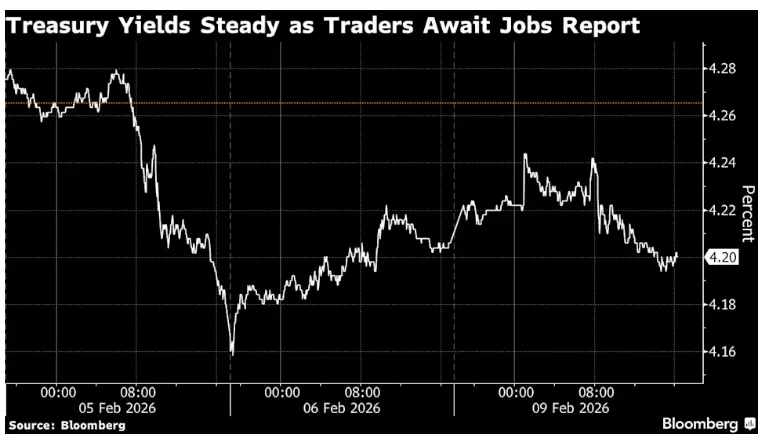
The U.S. 10-year Treasury yield edged lower ahead of key employment and inflation data releases. [Yahoo Finance]
Comments from National Economic Council Director Kevin Hassett suggested slower job growth in the coming months due to population trends. Those remarks influenced expectations for upcoming labor market data.
According to economist surveys, the unemployment rate is expected to hold near 4.4 percent. January’s consumer price index data will follow shortly afterward.
Traders broadly anticipate that the Federal Reserve will maintain its current policy rate range at the next meeting. The central bank previously voted to keep rates between 3.5 percent and 3.75 percent.
Upcoming data releases are likely to shape near-term expectations regarding monetary policy. However, market pricing currently reflects a wait-and-see stance.
Stability in Foreign Participation
Although China’s reported holdings have reached their lowest level since 2008, overall foreign participation in the Treasury market remains robust. Other sovereign investors continue to hold substantial positions.
In addition to Japan and the United Kingdom, several smaller economies maintain meaningful Treasury portfolios. Their participation contributes to liquidity and pricing stability.
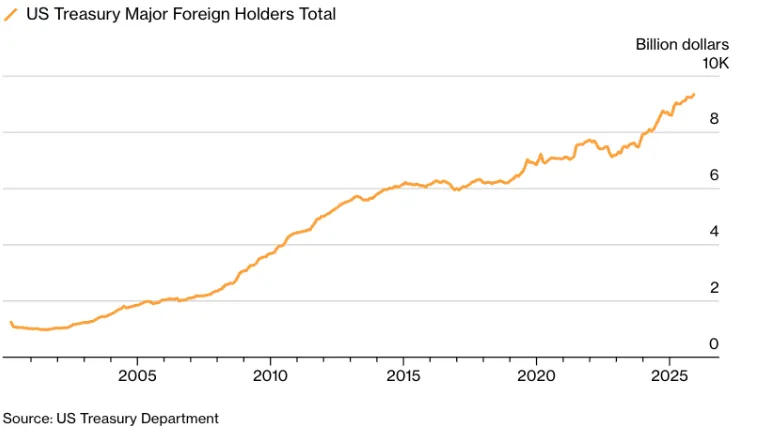
Japan, the United Kingdom, and China remain the largest foreign holders of U.S. Treasuries. [FA Mag]
Analysts emphasize that China’s reduction has occurred over a prolonged period. Gradual adjustments have limited disruptions to yields and global financial conditions.
Furthermore, when Chinese holdings of U.S. agency bonds and equities are considered alongside Treasuries, total exposure to American securities has remained relatively stable since late 2023.
Also Read: Fed Rate Cut Odds Fall as Warsh Nomination Looms
Ongoing Adjustments in Global Finance
The latest data illustrate a steady recalibration in global reserve management practices. Central banks and sovereign investors continue to balance diversification goals with liquidity needs.
Treasury markets have absorbed these changes without sharp dislocations. Yields have moved within typical ranges despite ongoing news regarding foreign ownership.
While attention has centered on China’s declining holdings, the broader picture shows continued international engagement with U.S. government debt. Demand remains diversified across regions and institutions.
As economic data and policy decisions unfold in the coming weeks, investors are expected to monitor both domestic indicators and foreign participation trends. For now, the Treasury market continues to function with measured adjustments rather than abrupt shifts.
FAQs
- Q: Why is China reducing its U.S. Treasury holdings?
A: China has gradually reduced its U.S. Treasury holdings as part of broader reserve diversification efforts. Authorities have also encouraged domestic institutions to manage exposure during periods of market volatility. The reductions have taken place over several years rather than through rapid selloffs.
- Q: How much U.S. debt does China currently hold?
A: According to the latest U.S. Treasury data, China holds approximately $682.6 billion in U.S. Treasury securities. This represents the lowest reported level since the 2008 financial crisis.
- Q: Is China still one of the largest holders of U.S. Treasuries?
A: Yes. Despite the decline, China remains the third-largest foreign holder of U.S. government debt. Japan and the United Kingdom currently hold larger positions.
- Q: Why are Belgium’s Treasury holdings increasing?
A: Belgium’s reported holdings have risen sharply since 2017. Analysts often view Belgium as a custodial center where Chinese-linked accounts may be recorded. As a result, part of China’s exposure may appear under Belgium’s name.
- Q: Could China’s selling of Treasuries affect U.S. interest rates?
A: Large-scale and sudden sales could push yields higher. However, China’s reductions have been gradual. Treasury markets have remained stable, indicating no abrupt disruption so far.
- Q: How have U.S. Treasuries performed recently?
A: Over the past year, U.S. Treasuries returned about 5.3 percent, according to Bloomberg data. This performance placed them ahead of many sovereign bond markets globally.
- Q: Why do countries hold U.S. Treasuries?
A: Countries hold U.S. Treasuries as part of their foreign exchange reserves. These securities are considered highly liquid and are widely used in global financial and reserve management strategies.