
Boss Energy Limited (ASX: BOE) dropped a significant update on 19 March 2026, revealing a major upgrade to its satellite uranium deposits and laying out a detailed permitting roadmap. The announcement sent ripples through the uranium investment community, and raises serious questions about the Boss Energy share price forecast heading into the second half of 2026.
A Landmark Resource Upgrade for Two Satellite Deposits
The Numbers Behind the Update
Boss Energy released updated Mineral Resource Estimates (MREs) for both Gould’s Dam and Jason’s Deposit — two satellite uranium projects sitting adjacent to its producing Honeymoon Operation in South Australia.
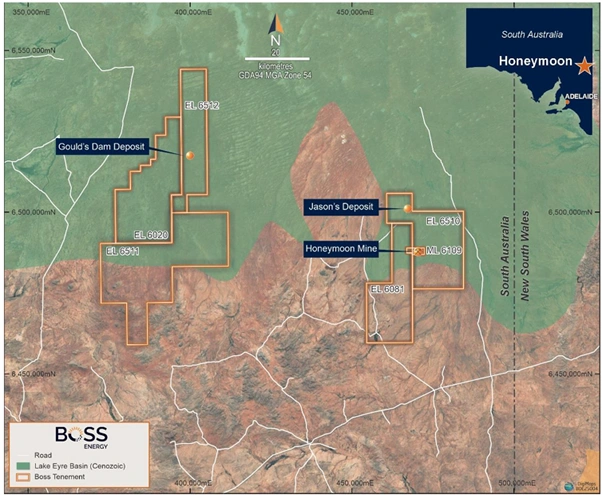
Figure 1: A map illustrating the location of Honeymoon Mine in relation to Gould’s Dam and Jason’s Deposit. [Boss Energy]
The headline numbers are hard to ignore:
- Gould’s Dam now holds 1 million pounds (Mlbs) of U₃O₈ across 38.7 million tonnes at 388 ppm, a 30% increase in contained uranium from the 2016 estimate
- Jason’s Deposit holds 0 Mlbs of U₃O₈ across 13.3 million tonnes at 410 ppm — up 9% from the 2017 estimate
- Combined, the two deposits represent over 45 Mlbs of uranium sitting close to an already operating ISR (in-situ recovery) processing facility
Both resources remain open, meaning further drilling could push these numbers even higher.
Why the Grade Decline Isn’t a Concern
Average grades fell at both deposits — down 24% at Gould’s Dam and 48% at Jason’s. At first glance, that looks alarming. But the reason matters enormously.
Boss applied a permeability filter for the first time, constraining the resource to zones genuinely amenable to ISR mining. They also applied improved geological interpretations drawn from operating experience at Honeymoon. The result is a more realistic, more actionable resource — not a weaker one.
Boss Energy Leads the Charge on Permitting
What the Company Is Actually Doing Right Now
Boss isn’t sitting on these numbers. Managing Director Matthew Dusci confirmed the company actively accelerated the development pathway for both deposits over the past six months.
Work already underway includes the following:
- Baseline flora and fauna surveys — completed
- Preliminary flood modelling — completed
- Radiological baseline surveys — commenced
- Groundwater modelling — in progress
- Leaching assessment laboratory testing — underway
- Initial stakeholder engagement — commenced
The company targets submission of Mining Lease applications and an EPBC referral in the second half of CY2026.
The Approval Timeline Investors Need to Understand
The permitting journey from here follows a structured path. Once applications go in, the process looks like this:
- EPBC referral and Mining Lease Assessment — Q4 CY2026
- Mining Lease granted — estimated 18 to 24 months post-application
- PEPR (Program for Environment Protection and Rehabilitation) approval — a further six to 12 months after that
Full construction cannot begin until all approvals land. That means, realistically, these deposits won’t reach production before late 2028 or 2029 at the earliest. Anyone tracking the Boss Energy share price forecast should factor that timeline into their models.
The Strategic Logic: Leveraging Honeymoon’s Infrastructure
Why These Deposits Matter Beyond Their Resource Size
The real value here isn’t just the uranium in the ground. It’s the proximity to infrastructure.
Gould’s Dam sits approximately 80 km west of Honeymoon. Jason’s Deposit is just 13 km to the north. Both deposits share the same geology, the same ISR-amenable stratigraphy, and the same Eyre Formation mineralisation style as Honeymoon.
Boss explicitly noted that the wide-spaced wellfield extraction approach currently being trialled at Honeymoon could apply directly to both satellite deposits. If successful, that technique could deliver high conversion of resource tonnes into actual wellfield mining inventory.
Jason’s Deposit looks likely to operate via a simple trunk line connection back to Honeymoon, similar to the East Kalkaroo model. Gould’s Dam, given its distance, will probably need a satellite processing facility, making it a more complex and longer-dated project.
The broader picture fits squarely into the growing narrative around Australian uranium prospects in the global rally of 2026, where domestic producers with scalable infrastructure hold a distinct edge.
Where the Share Price Sits — and What the Market Thinks
Current Trading Snapshot
BOE shares closed at $1.52, down 6.75% on the day of the announcement. The market’s reaction tells a story about where sentiment sits right now:
- Trading at $1.52 — sitting near the lower end of its 52-week range of $1.07 to $4.75, well off its highs
- Rough week and month — down 5.59% over the past week and 7.88% over the past month, reflecting near-term selling pressure
- 2026 has been marginally positive — up 3.75% year-to-date, suggesting some early-year recovery attempt before the recent pullback
- The one-year picture is sobering — shares have lost nearly 39% over 12 months, meaning investors who bought at the peak around $4.75 are sitting on significant losses
- Market cap of ~$631 million — still a meaningful mid-tier ASX resources stock, but a far cry from what it commanded at its 52-week high
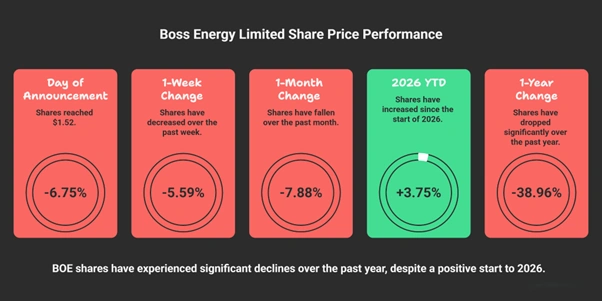
Figure 2: Boss Energy Limited Share Price Performance
The stock sits well below its 52-week high of $4.75. For investors and analysts tracking the Boss Energy share price forecast, the gap between current price and historical highs reflects both broader uranium market softness and the early-stage nature of these satellite projects.
The upcoming catalyst schedule gives investors clear milestones to watch:
- Q3 CY2026 — Drilling commences at both deposits
- Q4 CY2026 — Permitting applications submitted
- Q3 CY2027 — Updated MRE and Pre-Feasibility Study
Those milestones mirror the kind of structured development timelines seen at other emerging Australian explorers. Investors interested in how other companies are managing similar expansion phases may find parallels in Resolution Minerals’ major 45-hole drilling campaign and the project development strategy outlined in the Emerald Resources investor presentation.
The Bottom Line
Boss Energy is building something real at Gould’s Dam and Jason’s Deposit. The resource upgrade validates years of drilling. The permitting machinery is moving. And the infrastructure at Honeymoon gives the company a structural cost advantage most junior developers simply don’t have.
But the timeline is long. Approval processes in South Australia are rigorous. And the share price already reflects considerable risk.
For anyone monitoring the Boss Energy share price forecast, the next six months, and those permitting applications, will tell investors a great deal about whether management can execute on what the geology is promising.
Frequently Asked Questions
1. What is the current Boss Energy share price and how has it performed recently?
Ans: As of 19 March 2026, BOE shares trade at $1.52 on the ASX. The stock is down 6.75% on the day, 5.59% over the past week, and 38.96% over the past 12 months. Despite the recent weakness, it has managed a modest gain of 3.75% for 2026 year-to-date.
2. When will Gould’s Dam and Jason’s Deposit actually go into production?
Ans: Boss Energy targets permitting applications in the second half of CY2026. From there, securing Mining Leases typically takes 18 to 24 months, followed by a further six to 12 months for PEPR approval. Realistically, neither deposit is likely to reach production before late 2028 or 2029 at the earliest — assuming the approvals process runs smoothly.
3. Why did the average uranium grade fall in the updated resource estimates?
Ans: The grade decline reflects a deliberate methodological improvement, not a deterioration of the deposit. Boss applied a permeability filter for the first time, removing material that isn’t amenable to ISR mining regardless of its uranium content. They also applied better geological interpretations learned from operating Honeymoon. The result is a leaner, more realistic resource — and the total contained uranium actually grew by 30% at Gould’s Dam despite the lower average grade.
Disclaimer
The information contained in this article is for general informational and educational purposes only. It does not constitute financial advice, investment advice, or any form of recommendation to buy, sell, or hold any security, including shares in Boss Energy Limited (ASX: BOE).
The content draws on publicly available information, including Boss Energy’s ASX announcements, company disclosures, and market data current as of 19 March 2026. While every effort has been made to ensure accuracy, we make no representations or warranties of any kind regarding the completeness, accuracy, or reliability of the information presented.
Share price data and forecasts discussed in this article are not guarantees of future performance. Mineral resource estimates are subject to geological, technical, and economic uncertainties and may change over time.
Readers should conduct their own independent research and seek advice from a licensed financial adviser before making any investment decisions. Past performance is not an indicator of future results.
Sources
- Boss Energy ASX Announcement
- Boss Energy Limited Corporate Website
- ASX Company Announcements — BOE
- Market Index
- Geoscience Australia