
Bitcoin fell below the $90,000 mark on Tuesday, extending its 2026 selloff as global markets weakened. TradingView data showed the cryptocurrency touching an intraday low near $89,800, reversing gains from earlier sessions.
The decline followed a broader retreat in risk assets and rising political uncertainty in the United States and Japan. Traders responded to the Supreme Court’s decision not to rule on the Trump tariffs case and growing fears of tighter monetary policy in Asia.
Bitcoin Slips Below Key Psychological Level
Bitcoin was trading at $89,769 at the time of reporting, down over 2% on the day. The flagship crypto had earlier climbed toward $93,000 before sellers regained control and pushed prices lower.
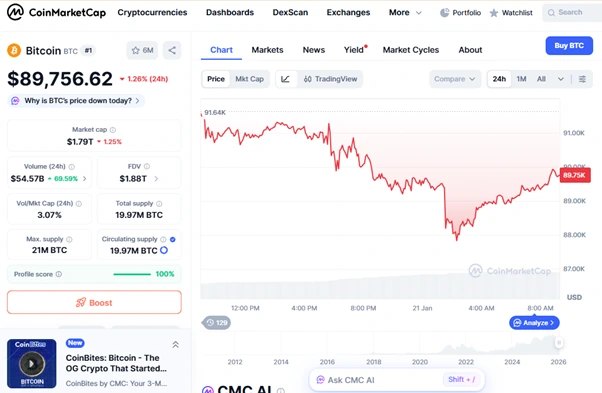
A Bitcoin price chart showing BTC falling below the $90,000 level during Tuesday’s trading session. (Source: CoinMarketCap)
Daily trading data showed a session range between $88,145 and $90,005. The move confirmed that the $90,000 level remains a difficult barrier for bulls to reclaim.
Market capitalization fell to about $1.79 trillion, reflecting the broader decline across digital assets. Trading volume rose sharply, suggesting heightened activity during the selloff.
Bitcoin’s 24-hour trading volume surged nearly 70% to $54.57 billion. The spike pointed to increased participation during the downturn rather than a quiet retracement.
Supreme Court Delays Trump Tariffs Ruling
The selloff followed the Supreme Court’s decision not to issue a ruling on the Trump tariffs case. The court had listed Tuesday as an opinion day, raising expectations of a decision.
However, the court delivered opinions in three unrelated cases. None involved the president’s authority to impose new tariffs.
The delay unsettled markets already pricing in potential trade disruptions. A ruling in favour of the tariffs would allow new duties to proceed from February 1.
The proposed measures include a 10% tariff on goods from France, Germany, the United Kingdom, the Netherlands, Denmark, Norway, Finland, and Sweden.
Investors fear renewed trade tensions could slow global growth and pressure risk assets. Cryptocurrencies have remained sensitive to shifts in macroeconomic sentiment.
Market chatter around the delay circulated widely on social media. Several analysts posted that prolonged uncertainty could weigh on digital asset prices.
Japan Rate Hike Fears Add Pressure
Bitcoin’s decline also coincided with fresh concerns about monetary tightening in Japan. The Bank of Japan has hinted at further rate hikes following its last move.
Officials have signalled that inflation risks remain elevated. This has increased speculation that policy normalisation may accelerate.
Rising Japanese bond yields have already rattled domestic markets. Investors worry about a collapse in the yen carry trade.
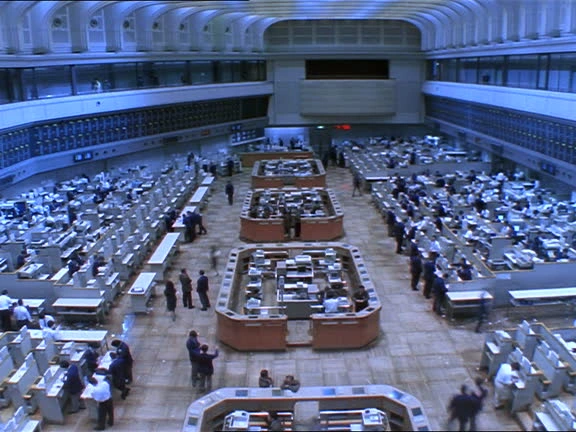
The Tokyo Stock Exchange fell as fears of further Bank of Japan rate hikes weighed on global risk assets. (Source: gettyimages)
The carry trade has long supported risk assets, including cryptocurrencies. A reversal could trigger further selling across global markets.
Prime Minister Sanae Takaichi’s announcement of a snap election added to investor unease. The move raised questions about fiscal policy and government spending.
Traders interpreted these developments as bearish for Bitcoin. The combination of political uncertainty and tighter financial conditions reduced risk appetite.
Polymarket Odds Signal Rising Tariffs Risk
Prediction market Polymarket showed rising odds of a Supreme Court ruling in favour of Trump’s tariffs. The probability climbed to 37% from about 28% earlier in the day.
The increase followed the first delay in the court’s decision. Traders on Polymarket adjusted positions as uncertainty lingered.
The tariffs have previously weighed on crypto markets. Bitcoin saw a sharp decline toward the end of last year following tariff threats.
The October 10 crypto crash occurred after Trump warned of a 100% tariff on Chinese goods. The episode triggered heavy losses across digital assets.
Recent Polymarket data also showed declining odds of a near-term Bitcoin rally. The probability of BTC reaching $100,000 before month-end fell to 12%.
These shifts reflected growing caution among traders. Many reduced exposure amid rising political and economic risks.
Technical Signals Point to Weak Momentum
Technical indicators on TradingView suggested weakening momentum. Bitcoin’s daily chart showed tight candles and reduced volatility.
The MACD histogram turned negative, with the MACD line below the signal line. This configuration pointed to bearish momentum bias.
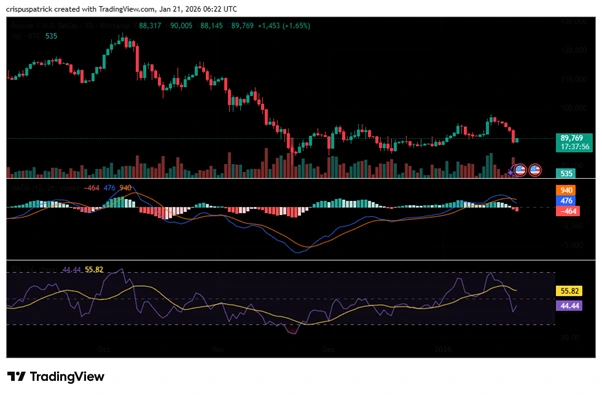
A Bitcoin daily chart with RSI and MACD indicators showing weakening momentum and range-bound price action. (Source: TradingView)
RSI stood at 44.44, below the neutral 50 level. The reading indicated weak buying strength without entering oversold territory.
Bitcoin remained range-bound between $85,000 and $91,000. Price action suggested a consolidation phase following a steep downtrend.
Support levels were visible near $88,000 and $85,000. Resistance remained firm around $90,000 to $91,000.
A break below $88,000 could expose the $85,000 zone. A move above $91,000 would be needed to restore bullish confidence.
Analysts Warn of Further Downside Risks
Veteran trader Peter Brandt has warned of potential lower prices. He recently projected a possible decline toward $58,000 to $62,000.
Brandt’s comments added to cautious market sentiment. Many traders already viewed recent rallies as corrective rather than impulsive.
Bitcoin’s broader trend remains bearish on higher timeframes. The asset has posted lower highs and lower lows since its peak near $130,000.
Price stabilised in December between $85,000 and $90,000. The current range continues to define near-term market behaviour.
Volume has declined during consolidation, suggesting reduced selling pressure. However, breakout attempts have lacked sustained follow-through.
Analysts noted that stronger volume would be needed to confirm any upside move. Without it, rallies risk being sold into.
Also Read: Rio Tinto Reports Robust Q4 2025 Production as Operational Performance Strengthens
Global Market Weakness Shapes Outlook
Bitcoin’s decline unfolded alongside weakness in global equity and bond markets. Investors shifted toward safer assets amid political and monetary uncertainty.
Risk-off sentiment spread across asset classes. Technology stocks, commodities, and emerging market currencies also faced pressure.
Cryptocurrencies have increasingly traded in line with macro trends. This correlation has grown as institutional participation expanded.
Market participants remain focused on upcoming court decisions and central bank signals. These factors are expected to shape near-term price action.
Bitcoin’s near-term direction hinges on holding key support levels. A sustained break below $88,000 could invite deeper losses.
A recovery above $90,000 would ease immediate downside pressure. However, traders remain cautious given unresolved macro risks.
For now, Bitcoin remains caught between political uncertainty, tightening financial conditions, and fragile technical momentum. The coming sessions are likely to determine whether the consolidation resolves higher or gives way to further declines.