The spot price for uranium recently climbed above $US100 per pound. This price level represents the highest point for the commodity since early 2024. Market analysts at BMI report a rally of over 25 per cent in recent months. This surge creates a positive environment for the Australian uranium sector. Australia holds the largest known uranium reserves in the world. These resources account for approximately 30 per cent of the global total.
Analysts expect a structural deficit in the uranium market by the early 2030s. The current supply meets global demand for the next two to three years. Production from Kazakhstan and Canada currently supports the international market. This situation changes as global nuclear capacity increases. Projections show capacity rising from 405 gigawatts in 2024 to 510 gigawatts by 2035. Many nations now view nuclear energy as a reliable source of baseload power.
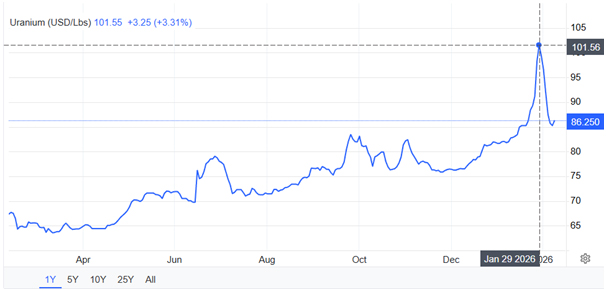
Uranium crossed US$100 mark recently
Drivers of Global Demand
The rise of artificial intelligence infrastructure increases electricity requirements. Data centres for cloud computing services need constant power. Tech giants now invest in nuclear energy to power their operations. Meta signed agreements with nuclear energy companies to power its AI superclusters. These deals aim to add 6.6 gigawatts of nuclear power by 2035. Reliable power sources remain essential for digital transformation initiatives.
Western governments also prioritise the security of supply for critical minerals. The United States maintains a ban on imports of Russian nuclear fuel. This policy drives interest in stable jurisdictions like Australia. The Australian Government committed $4 billion to the Critical Minerals Facility. This facility provides financing for projects that align with national strategies. Public money supports the development of domestic processing capabilities.
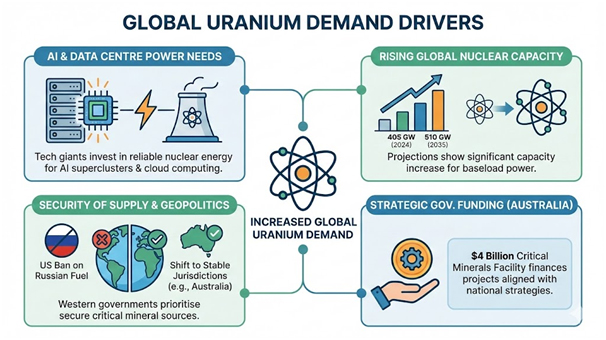
Global demand drivers for Uranium
Australian Export Growth
- Australia produces around 10 per cent of world’s uranium output.
- Export volumes should lift from 5 kilotonnes to 6.7 kilotonnes this financial year.
- Uranium export earnings are expected to reach a peak of $1.6 billion in 2025-26.
- Strict international safeguards ensure responsible uranium stewardship.
- The nation possesses an established infrastructure for nuclear material exports.
BHP operates the Olympic Dam mine in South Australia. This site remains one of the largest uranium deposits globally. Production at Olympic Dam is projected to reach 3,600 tonnes in 2026. Heathgate Resources also contributes to national output through the Beverley and Four Mile mines. These operations use in-situ recovery technology to extract uranium. Investment continues in innovative technologies to improve recovery rates.
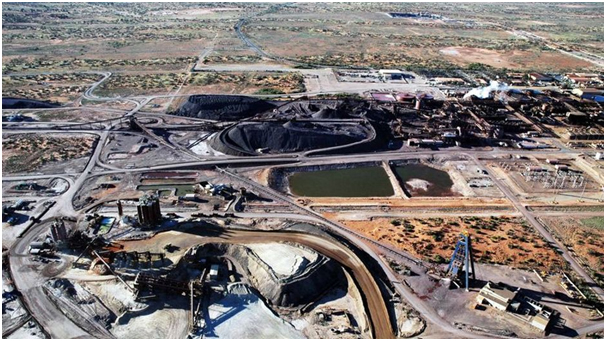
BHP’s Olympic Dam mine in South Australia
Progress at Key Projects
Alligator Energy recently reported progress across its assets in South Australia. The company completed a key construction plan on time and under budget. The Samphire pilot plant entered a phase of final commissioning. Preparations for field recovery remain on track for early this year. The trial generates data to support future mining lease approvals. Successful pilot results support applications for full-scale production.
Boss Energy maintains its production guidance for the Honeymoon project. The company achieved a sixth consecutive quarterly production increase. Cash costs fell to record lows through process optimisation. Boss Energy retains its production guidance of 1.6 million pounds for the 2026 financial year. Higher prices support the restart of care-and-maintenance assets. Developers revisit advanced exploration plays across Western Australia and the Northern Territory.
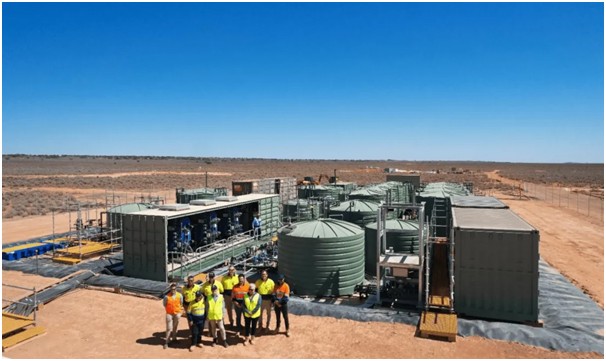
Alligator finalises construction at Samphire’s pilot plant
Regional Mining Activity
- South Australia remains a primary jurisdiction for uranium extraction.
- Western Australia hosts several permitted but undeveloped resources.
- The Northern Territory focuses on environmental management at legacy sites.
- Developers revisit sandstone-hosted deposits for in-situ recovery potential.
- Engineering teams update feasibility studies to reflect current costs.
Paladin Energy focuses on global integration and expansion. The company manages uranium assets across multiple international jurisdictions. Re-capitalisation efforts support improved compliance with environmental standards. Market observers note renewed investor interest in Australian mining equities. Shares in several uranium companies rallied sharply following price increases. Investors evaluate the prospects of the industry given the supply deficit.
Infrastructure and Technology
The deployment of small modular reactors creates new market opportunities. These advanced reactor designs modify long-term uranium requirements. Australia provides the raw materials for these next-generation technologies. The Australian Radiation Protection and Nuclear Safety Agency maintains established approval processes. Predictable timelines offer a comparative advantage for local project developers. Stable regulatory frameworks reduce risks for new mining operations.
Satellite-based geospatial analytics now play a role in exploration. Technology aids geoscientists in the discovery of new resources. Companies use digital site monitoring to manage environmental impacts. Progressive rehabilitation remains a focus for the uranium industry. Low-impact mining methods reduce the footprint of extraction activities. Modern operations prioritise sustainability and community engagement.
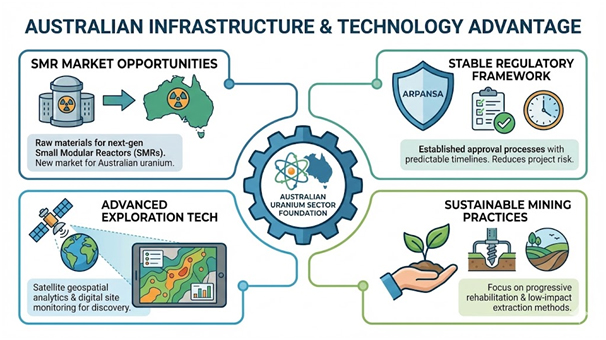
Infrastructure and technology advantage
Global Market Outlook
Bank of America analysts suggest uranium prices could reach $US135 in 2026. Geopolitical factors contribute to this bullish outlook for the commodity. Uncertainty regarding Russian supply underscores the issue of energy security. Utilities now seek long-term contracts to secure fuel for reactors. This trend strengthens the position of Australian producers in negotiations. Higher incentive pricing encourages the development of greenfield projects.
The market enters 2026 with renewed momentum and strategic tailwinds. Demand from major economies like China and India continues to grow. These nations seek low-carbon energy to meet decarbonisation goals. Australian uranium supports the global transition to clean power. The combination of rising demand and constrained supply creates long-term opportunities. Australia remains a cornerstone in the global nuclear energy mix.