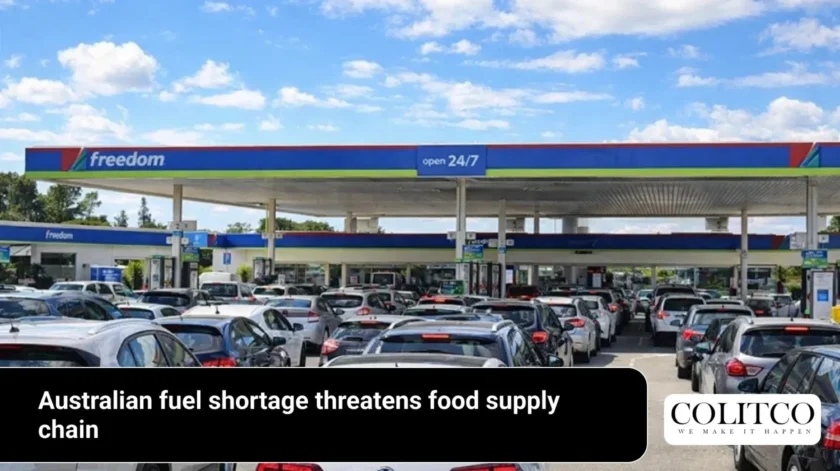
A combination of geopolitical instability and a chronic shortfall in domestic fuel reserves is now threatening to squeeze not just motorists but the entire Australian food supply chain.
From grain farms in Western Australia to cattle stations in Queensland, the message from the ground is consistent: this is serious, and it is happening now.
What Is Happening With Australia’s Fuel Supply?
Fuel supply disruptions are emerging across regional parts of Australia, with service stations in farming and remote communities reporting difficulties sourcing diesel.
Farm groups have raised the alarm, warning that the timing could not be worse heading into key planting and harvesting periods.
The Nationals WA has formally flagged the threat, stating that fuel shortages are putting Western Australian farmers and the broader food supply at direct risk.
Diesel powers virtually every piece of heavy farm equipment in the country, from harvesters and tractors to grain trucks and irrigation pumps.
Without it, crops do not get planted. Without crops, shelves go empty.
Why Australia Is So Exposed
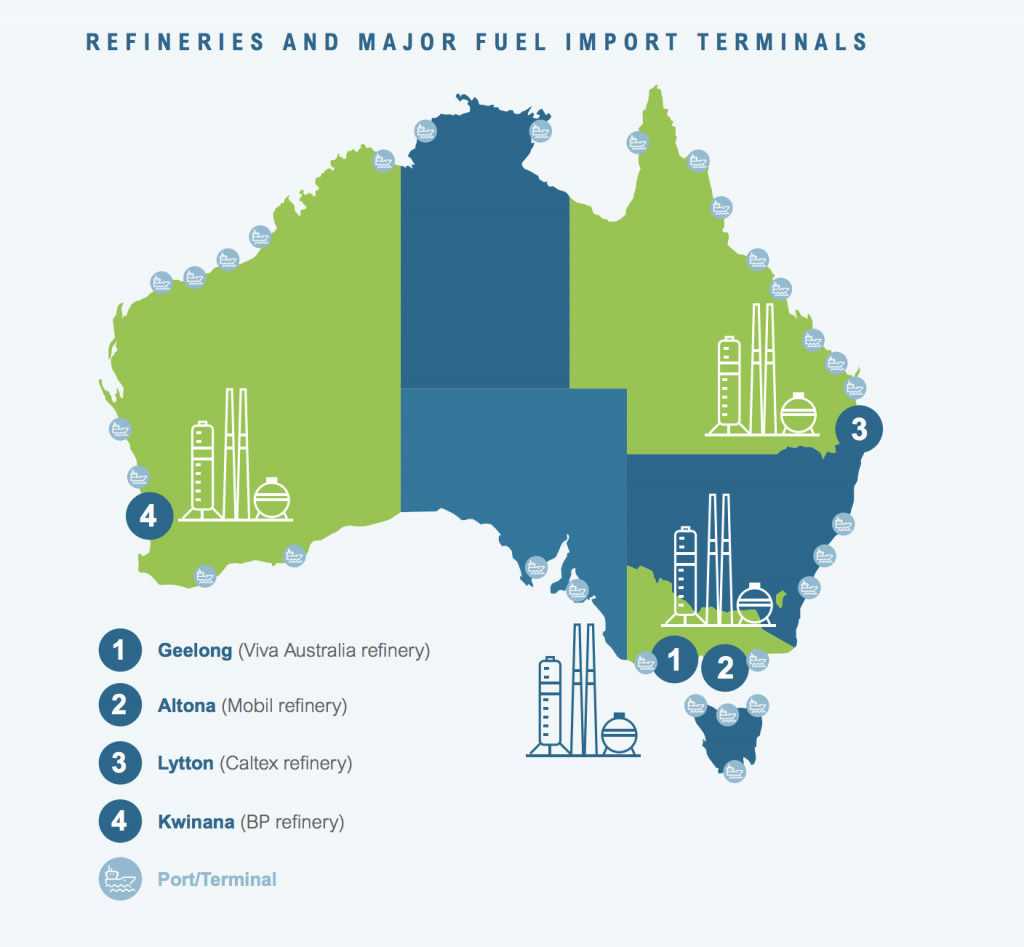
Australia has lost five of the seven oil refineries it once operated. Two remain, Ampol’s Lytton refinery in Brisbane and Viva Energy’s Geelong refinery in Victoria.
Both are currently operating under federal government subsidy arrangements running to mid-2027 and mid-2028, respectively. Without that financial support, both companies have previously flagged that converting the sites to import terminals would be the commercial alternative.
The refineries that did close, including BP’s Kwinana plant in Western Australia and ExxonMobil’s Altona facility in Victoria, both converted to import terminals in 2021, removed significant domestic processing capacity.
Together, Lytton and Geelong now cover less than 30 per cent of Australia’s fuel needs. The remainder arrives by ship, primarily from refining hubs in Singapore, South Korea, and Japan.
That makes Australia heavily exposed when global supply chains come under pressure.
Key vulnerabilities include:
- Domestic refining covers less than 30 per cent of national fuel needs
- Fuel reserves are well below the 90-day benchmark required under Australia’s International Energy Agency (IEA) treaty obligation
- Limited strategic onshore fuel storage, particularly in regional and remote areas
- Heavy reliance on a small number of import terminals concentrated along the coast
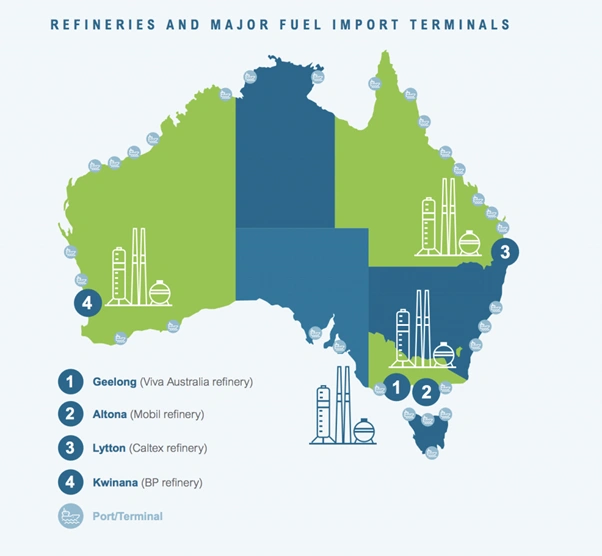
Australia’s fuel import infrastructure is heavily concentrated along the coast, with limited onshore storage in farming regions. [Pacific Hoseflex]
Farmers on the Frontline
For farmers, this is not a hypothetical future risk. It is an immediate operational problem.
Planting seasons wait for no one. A missed window due to a fuel shortage is not recovered in the following month.
It translates directly into lower yields, higher food prices at the supermarket, and, in worst-case scenarios, genuine supply gaps for staple commodities.
Western Australian grain producers, who supply a significant share of Australia’s wheat exports, are among those most exposed.
WA is geographically isolated from the eastern states and relies almost entirely on imported diesel arriving through Fremantle. Any disruption to that supply chain creates a bottleneck with no easy workaround.
The Victorian Farmers Federation has also weighed in. President Brett Hosking said modern farming relies heavily on liquid fuels to run machinery, harvest crops, and transport food and fibre.
The National Farmers’ Federation has similarly warned that Australia’s food security is only as strong as the supply chains that underpin it.

Diesel powers virtually every major piece of farm equipment in Australia. A supply disruption during planting or harvest season has direct consequences for food output.
How Many Days of Fuel Does Australia Actually Have?
Energy Minister Chris Bowen told Parliament this week that Australia currently holds 36 days’ worth of petrol, 34 days of diesel, and 32 days of jet fuel.
He said these figures represent the highest levels in 15 years and include only fuel held in Australia or within Australia’s exclusive economic zone.
Those numbers, while improved from recent years, still fall well short of the 90-day minimum required under the IEA agreement Australia signed in 1974. Australia has been non-compliant with that obligation since 2012.
The average among the 27 IEA member nations that are net oil importers sits at 141 days. Australia is last among that group.
The Geopolitical Trigger
The immediate catalyst for the current concern is renewed and serious instability across the Middle East, which has reignited fears over the security of global oil flows.
The Strait of Hormuz, through which roughly 20 per cent of global oil consumption passes daily, according to the US Energy Information Administration, is facing disruption.
Shipping traffic through the Strait has slowed sharply following US and Israeli military strikes on Iran. Oil prices have surged above USD 100 per barrel for the first time since 2022.
Australia’s exposure is real, though it is worth noting that the Middle East accounts for roughly 17 to 23 per cent of Australia’s crude oil imports, not the majority of its supply.
The country draws crude from diverse sources. A sustained disruption would still affect global pricing and the availability of refined products arriving from Singapore and South Korea, where Australian-bound fuel is processed.
What the Government Has Said
Minister Bowen confirmed this week that Australia’s minimum stockholding obligations, introduced by the current government in 2023, require refineries and major importers to maintain baseline fuel reserves within Australia. He said stocks are currently above those minimum thresholds.
He also drew a distinction between Australia’s domestic minimum stockholding obligation and the IEA’s 90-day net import coverage standard, arguing that the two measures are calculated differently and serve different purposes.
Critics, including Nationals leader David Littleproud, have questioned whether the figures include fuel still aboard tankers that have not yet berthed in Australian ports, and whether that provides genuine security during a disruption.
What This Means for Food Prices
Fuel costs feed directly into the price of everything in a supermarket. Transport, refrigeration, packaging, and farm operations all depend on diesel or petrol at some point in the supply chain.
If Australian fuel shortages persist or worsen, the flow-on effects for grocery prices could be significant.
Food inflation driven by supply-side constraints is notoriously difficult to resolve quickly. A structural supply shortage requires logistical fixes that take months, not weeks.
Consumers in regional towns, where fuel is already more expensive and alternatives are fewer, will feel it first and hardest.
What Happens Next?
Agricultural groups are pressing Canberra for a response that goes beyond current policy settings.
Calls include expanding domestic fuel storage in regional hubs, securing additional supply guarantees during periods of geopolitical tension, and reviewing what happens when the government subsidy arrangements underpinning Australia’s two remaining refineries expire.
The Fuel Security Services Payment program, which supports Lytton and Geelong, runs to 2027 and 2028, respectively.
Ampol has already flagged that it may seek to renegotiate the terms of that arrangement, given rising operating costs and low refining margins.
The broader question of energy sovereignty is one Australia has debated for years without a durable resolution. The current supply pressure is forcing that debate back into the open with considerably more urgency.
For farmers watching diesel supplies tighten and prices climb, the time for that conversation is right now.
FAQs
Q: Why are some Australian petrol stations running low on fuel?
A: Service stations in parts of regional Australia are experiencing supply disruptions, driven by a combination of heightened geopolitical instability in the Middle East, Australia’s heavy dependence on imported refined fuel, and limited onshore storage capacity outside major cities.
Q: How many oil refineries does Australia have?
A: Australia currently has two operating oil refineries: Ampol’s Lytton refinery in Brisbane, Queensland, and Viva Energy’s Geelong refinery in Victoria. Both operate under federal government subsidy arrangements. Australia once had seven refineries; five have closed or converted to import terminals since 2012.
Q: How many days of fuel does Australia currently hold?
A: As of early March 2026, Energy Minister Chris Bowen told Parliament that Australia holds approximately 36 days of petrol, 34 days of diesel, and 32 days of jet fuel. These figures include fuel held onshore and within Australia’s exclusive economic zone.
Q: What is the IEA 90-day fuel requirement, and does Australia meet it?
A: The International Energy Agency requires member nations that are net oil importers to hold stocks equivalent to 90 days of net imports. Australia has not met this obligation since 2012. The average among the 27 net-importing IEA members is currently 141 days.
Q: How could fuel disruptions affect food prices in Australia?
A: Diesel is embedded throughout the food supply chain, from farm machinery and irrigation through to refrigerated transport and supermarket logistics. Sustained fuel supply disruptions would increase costs at every stage, with regional Australians, who already pay more for fuel and have fewer alternatives, feeling the impact first.
Disclaimer: This article is for informational purposes only and does not constitute financial or investment advice. All figures attributed to government sources reflect statements made as reported. Readers should consult independent sources for the most current data.