Building a retirement portfolio Australia investors can rely on takes more than picking popular names. It takes balance. As retirement approaches, stability and income matter just as much as growth. Spreading capital across reliable dividend shares and broad global ETFs is one way to build that balance thoughtfully.
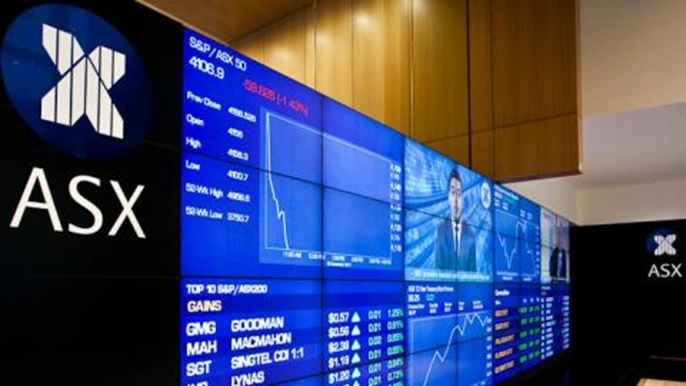
Figure 1: Australian Securities Exchange (ASX) market display showing stock performance and trading data [Finextra]
Here is how a retirement portfolio Australia worth $1 million could be structured on the ASX.
Half the Portfolio: Best ASX Shares for Retirement Income
The first half of the portfolio would sit in dependable Australian Companies with a strong history of cash flow and dividend payments. Across four key sectors, these stocks form the income engine of the strategy.

Figure 2: Digital investment interface representing online portfolio planning and financial strategy [Freepik]
Infrastructure is one natural starting point. Businesses owning long-life assets tend to generate predictable revenue, which supports consistent dividends. Transurban Group (ASX: TCL) and APA Group (ASX: APA) are examples of the type of infrastructure exposure suited to income-focused portfolios.
Defensive consumer businesses add another layer of stability. Supermarkets and essential retail tend to hold up during economic downturns as households continue spending on everyday goods. Woolworths Group Ltd (ASX: WOW) fits this profile and can reduce portfolio volatility over time.

Figure 3: Cash and coins stacked on banknotes symbolising income generation and dividend returns in investment portfolios [Freepik]
Australian banks have historically paid attractive fully franked dividends and remain among the largest income generators on the ASX. Commonwealth Bank of Australia (ASX: CBA) and Macquarie Group Ltd (ASX: MQG) are regularly featured in income-focused strategies for this reason. Rounding out the mix, major diversified miners have historically returned significant cash to shareholders during strong commodity cycles. BHP Group Ltd (ASX: BHP) and Rio Tinto Ltd (ASX: RIO) offer that resource exposure within a balanced strategy.
The Other Half: Global ETFs for Diversification and Growth
The remaining half of the portfolio would sit in broad, diversified ETFs. This reduces reliance on any single Company or sector and opens exposure to hundreds of businesses across global markets. For long-term investing Australia, this global layer is what helps the portfolio weather different market conditions over time.

Figure 4: Diversification concept illustration highlighting asset allocation and risk management in investment strategies [Freepik]
Two ETFs stand out here. The VanEck MSCI International Quality ETF (ASX: QUAL) focuses on global companies with strong balance sheets, high returns on equity, and stable earnings growth. The iShares S&P 500 AUD ETF (ASX: IVV) provides exposure to the 500 largest companies on Wall Street. Together, these two ETFs bring meaningful global diversification while the Australian dividend stocks continue doing the heavy lifting on income.
What Income Could This Portfolio Generate?
This is where the strategy becomes tangible for investors. A portfolio structured this way would be expected to deliver a dividend yield in the region of 3% to 4%.
On a $1 million investment, that translates to an income of $30,000 to $40,000 each year. With quality dividend stocks at the core, that income stream is also expected to grow year on year as Companies increase their distributions over time. For anyone focused on long-term investing habits in Australia, that compounding income effect is a key part of the appeal.
Industry Outlook
Australia’s superannuation system continues to channel record levels of capital into ASX-listed income assets. Demand for best ASX shares for retirement is expected to grow steadily as Australia’s ageing population seeks reliable yield in a low-volatility structure. Infrastructure, banking, and global ETFs remain the preferred building blocks for advisers constructing retirement portfolio Australia strategies at scale.
Building a Balanced Retirement Portfolio: The Bottom Line
A $1 million retirement portfolio Australia does not need to be complicated. The strategy is clear.
- Roughly half in reliable best ASX shares for retirement across infrastructure, banking, consumer staples, and resources
- The remaining half in diversified global ETFs such as QUAL and IVV
- Expected income of $30,000 to $40,000 per year at a 3% to 4% dividend yield
- Built for income today and growth over time through long-term investing Australia

Figure 5: Investor reviewing a retirement plan on a tablet, representing long-term financial planning for retirement portfolios [Freepik]
The combination of Australian dividend income and global ETF exposure creates a portfolio resilient enough to handle different market conditions while still growing purchasing power over retirement.
FAQ
Q1. What is a good dividend yield for a retirement portfolio in Australia?
Ans. A yield in the range of 3% to 4% is considered reasonable for a balanced ASX retirement portfolio, delivering $30,000 to $40,000 annually on a $1 million investment.
Q2. Why include ETFs in a retirement portfolio Australia strategy?
Ans. ETFs provide broad diversification beyond Australian shares, reducing concentration risk and offering exposure to global growth through hundreds of companies in a single holding.
Q3. Which ASX sectors are best suited for retirement income?
Ans. Infrastructure, banking, consumer staples, and resources have historically delivered strong, consistent dividends on the ASX, making them core components of long-term investing Australia strategies.
Q4. What is the difference between QUAL and IVV ETFs?
Ans. QUAL focuses on international quality companies with strong financials and stable earnings. IVV tracks the S&P 500, providing exposure to the 500 largest US companies in Australian dollars.