
Humanity’s return to the Moon starts today. Decades of setbacks, billions of dollars, and one very long wait have led to this moment.
NASA is targeting a launch window opening at 6:24 pm EDT today, Wednesday, April 1, with a two-hour window to get off the ground. If all goes to plan, this will be the first time humans have travelled beyond low Earth orbit since the Apollo 17 mission in December 1972.
Action. Wonder. Adventure. Artemis II has got it all. Don’t miss the moment. Our crewed Moon mission will launch as early as April 1.
Learn how to watch: https://t.co/fAg0bGAqEc pic.twitter.com/2uhg8EhwTv
— NASA (@NASA) March 30, 2026
Who Is Flying on the Artemis 2 Moon Mission
The ten-day mission will carry NASA astronauts Reid Wiseman, Victor Glover, and Christina Koch, along with Canadian Space Agency astronaut Jeremy Hansen.
The crew roster is historic in more ways than one.
Glover would become the first person of colour to leave low Earth orbit. Koch would be the first woman to travel beyond it. Hansen would become the first non-US citizen to venture to the Moon’s vicinity. Wiseman, at his age, would also set the record as the oldest person to travel beyond Earth’s orbit.
Each of them carries the weight of a milestone no astronaut has reached in over half a century.
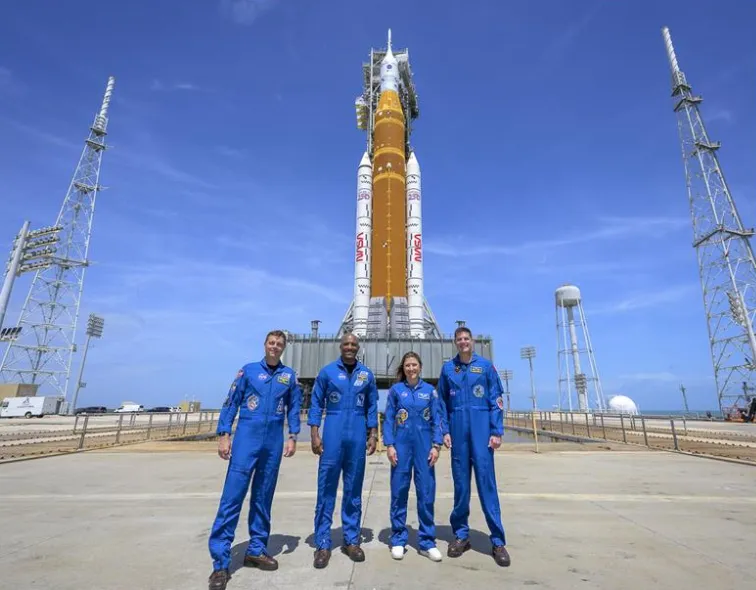
Artemis 2 crew of four astronauts at Kennedy Space Centre launch pad [NASA]
What Artemis 2 Will Actually Do in Space
Artemis II will fly around the Moon on a free-return trajectory, like Apollo 13 in 1970, rather than entering lunar orbit. The mission is built to test critical systems before NASA attempts a surface landing.
It will send the crew on an approximately 10-day journey around the Moon, during which NASA will test the Orion spacecraft’s life support systems for the first time with humans aboard.
For a launch on April 1, the crew is expected to surpass the record for humanity’s farthest distance from Earth previously set by Apollo 13, at 248,655 miles.
That record has stood for 56 years. Today, it may finally fall.
How the Launch Countdown Is Tracking Right Now
As of 8:35 am Eastern time today, the Artemis II launch team initiated the slow fill of liquid hydrogen and liquid oxygen into the SLS rocket core stage.
Sunny skies and few clouds greeted NASA teams, spectators, and journalists who gathered at Kennedy Space Centre, with pop-up rain showers considered a common occurrence along Florida’s Space Coast.
The weather forecast shows an 80% chance of favourable conditions, with primary concerns around cumulus clouds, ground winds, and solar weather.
Conditions are shaping up to be the best of the entire April launch window, which runs through Monday, 6 April.
Why This Mission Matters Beyond the Headlines
Artemis II will be the first crewed mission of the Orion spacecraft and the first crewed mission beyond low Earth orbit since Apollo 17 in 1972.
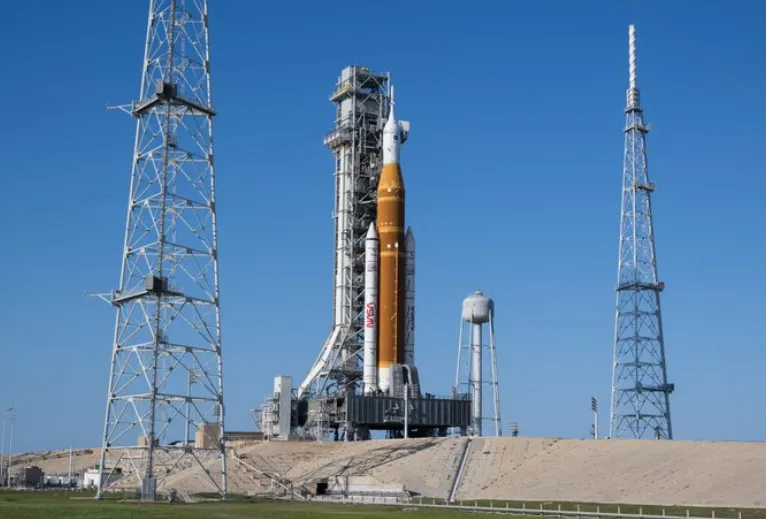
NASA’s Artemis II rocket with the core stage in orange and two white boosters on each side at the Kennedy Space Centre in Florida [NASA]
The road here has not been smooth. A liquid hydrogen leak during a February wet dress rehearsal pushed the mission back to March, then a helium flow issue triggered a rollback to the Vehicle Assembly Building, delaying everything again to April.
But those delays are behind NASA now.
The Artemis program has cost taxpayers roughly $100 billion since its inception, and it will take many billions more to realise the ambitious goals NASA has mapped out. That is a big number. But the program’s ambitions match it.
NASA wants a permanent Moon base. It wants humans on Mars. Artemis 2 is the first real crewed step toward all of it.
For context on the broader push to the Moon, we had previously coveredFirefly Aerospace’s historic Blue Ghost lunar landing and thefailed Ispace Resilience mission, both part of NASA’s wider commercial lunar strategy. The growing race forspace mining and lunar resources also means that what happens on Artemis 2 has economic consequences stretching well beyond exploration.
Apollo 13’s famous near-disaster in 1970 cast a long shadow over crewed lunar flight.Commander Jim Lovell, who flew that mission and passed away in 2025, never got to see humanity return to the Moon’s vicinity. Today’s crew will carry that legacy with them.
Also Read: Trump Set to Address the Nation on Iran War
FAQs: Artemis 2 Launch
Q: What time does the Artemis 2 launch happen?
A: NASA’s launch window opens at 6:24 pm EDT on Wednesday, 1 April 2026. A two-hour window is available. If today’s attempt is scrubbed, further opportunities run through 6 April.
Q: Who are the astronauts flying on Artemis 2?
A: The four-person crew consists of Commander Reid Wiseman, Pilot Victor Glover, and Mission Specialist Christina Koch from NASA, plus Mission Specialist Jeremy Hansen from the Canadian Space Agency.
Q: How long is the Artemis 2 mission?
A: The mission is approximately 10 days, including a free-return flight path around the Moon and return to Earth.
Q: What records will Artemis 2 break?
A: The mission is set to break multiple records including the first woman, first person of colour, and first non-US citizen beyond low Earth orbit. The crew is also expected to surpass Apollo 13’s record for the farthest distance any human has travelled from Earth.
Q: Is Artemis 2 landing on the Moon?
A: No. Artemis 2 is a lunar flyby, not a landing. NASA is targeting crewed Moon landings with the Artemis 3 mission, currently planned for 2028.
Q: What rocket is carrying the Artemis 2 crew?
A: NASA’s Space Launch System, the most powerful rocket the agency has ever built, is launching the Orion spacecraft carrying the four-person crew from Kennedy Space Center in Florida.
Disclaimer: This article is for informational purposes only and does not constitute financial advice. Space program timelines are subject to change based on technical and operational factors.
Source:
- https://www.nasa.gov/missions/artemis/artemis-2/nasa-sets-coverage-for-artemis-ii-moon-mission
- https://en.wikipedia.org/wiki/Artemis_II