
Artificial intelligence now functions as a primary driver for the Australian economy. New data reveals that AI technology could contribute $142 billion to the national gross domestic product by 2030. This shift marks a transition from experimentation to full integration across major sectors.
The Australian Information Industry Association reports that AI adoption currently adds $21 billion to the economy annually. This figure stems from gains in labour productivity and operational efficiency. Experts predict the economic value will increase sevenfold within the next four years as businesses automate routine tasks.
Workforce Projections and Job Creation
The Tech Council of Australia forecasts the creation of 200,000 new jobs by 2030. These roles focus on AI development, data management, and technical support. Demand for these specialists increases as industries seek to maintain a competitive edge globally.
Current estimates suggest that 1.5 million workers will transition into different roles by the end of the decade. This movement reflects the automation of repetitive duties in various sectors. Workers must acquire new skills to navigate the changing demands of the modern workplace.
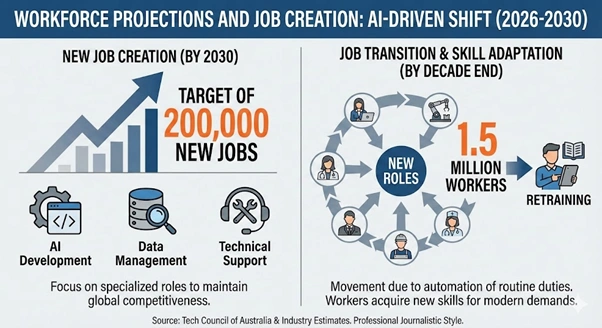
Workforce Projections and Job Creation: AI-driven shift
Economic Impact Across Major Sectors
AI technology transforms the healthcare and social assistance industries through improved data processing. These sectors face workforce shortages that AI helps alleviate by streamlining administrative work. This application allows medical professionals to dedicate more time to patient care.
The finance industry anticipates a $60 billion growth boost by 2035 through the use of generative AI. Banks and lenders use these tools for document review and fraud detection. These processes reduce costs and increase the speed of service delivery for customers.
Small Business Productivity Gains
Small businesses experience a productivity increase of 22 per cent through AI integration. These firms adopt technology faster than large corporations due to lower capital requirements. AI provides small enterprises with tools previously available only to major companies.
- Small firms use AI for marketing automation.
- Data entry tasks now require less human intervention.
- Predictive analytics assist with supply chain management.
- Customer service bots handle basic enquiries 24 hours a day.
Gender Pay Gap and Wage Growth
Research indicates that AI adoption could lead to a 7 per cent increase in average wages. Women might see wage growth 35 per cent higher than men due to their roles in care and education. These industries stand to gain the most from productivity improvements driven by AI.
This shift helps close the gender pay gap across the Australian workforce. AI handles the heavy documentation loads in health and teaching. This change increases the value of human-centric skills in the labour market.
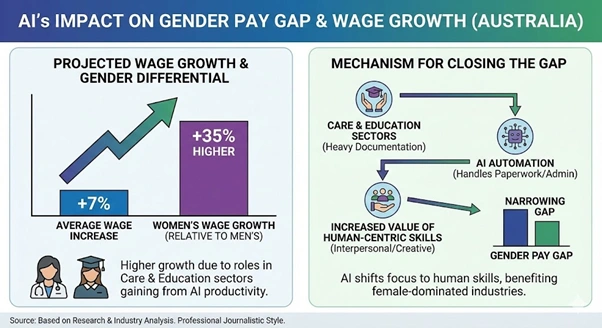
AI’s impact on gender pay & wage growth
Skills Shortages and Education Pathways
The technology workforce currently struggles to meet the rising demand for AI expertise. Industry leaders call for reforms to education and training systems to address this gap. Alternative entry pathways and mid-career retraining programs provide solutions for the labour shortage.
“The existing tech workforce is already straining to meet demand, but growing the number of AI development jobs could be achieved by offering alternative entry-level pathways,” states LinkedIn Australia Managing Director Matt Tindale. Success depends on the ability of the workforce to adapt to technical requirements.
Government Strategy and Implementation
The Australian Government released the Data and Digital Government Strategy 2025 Implementation Plan. This document outlines the responsible use of AI within the public service. Agencies use these tools to improve decision-making and respond to citizen needs faster.
- The plan establishes standards for ethical AI design.
- Government departments test AI agents for service delivery.
- Cyber resilience remains a priority for digital infrastructure.
- National data maturity tools track progress across agencies.
Challenges to AI Adoption
Economic uncertainty remains a threat to the pace of technology investment in Australia. Some business leaders cite rising costs and regulatory burdens as barriers to growth. These factors influence how quickly companies deploy new systems across their operations.
Privacy concerns and data governance also require attention from industry participants. Trust in technology influences the rate of adoption among the general public. Companies must demonstrate transparency to ensure long-term success with AI initiatives.
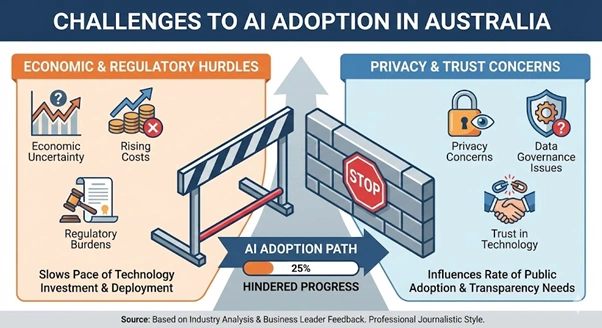
Challenges to AI adoption in Australia
Future Economic Outlook
“While 2024 was a big growth year for AI, there is huge potential for businesses to further embrace AI to work smarter and boost productivity,” says Tech Council CEO Damian Kassabgi. Australia aims to become a regional hub for AI computing and education in the Asia-Pacific.
Sovereign AI capabilities could add an additional $18 billion to the economy. This involves building local data centres and developing domestic software applications. This strategy reduces reliance on foreign technology and strengthens national security.
Productivity and National Competitiveness
Australia faces the slowest productivity growth in 60 years, according to the Productivity Commission. AI technology offers a solution to reverse this trend and secure future prosperity. Increased efficiency allows the nation to compete more effectively on the global stage.
“Artificial intelligence is no longer a distant ambition,” claims Australia’s AI Opportunities Report 2025. The transition to an AI-enabled economy requires cooperation between government, industry, and the community. This collective effort ensures that the benefits of technology reach all Australians.