

Australia’s fuel security is under serious scrutiny right now. As the conflict in Iran intensifies, oil prices are surging and global fuel supply chains are under growing strain. For everyday Australians, the consequences could move well beyond the petrol pump.
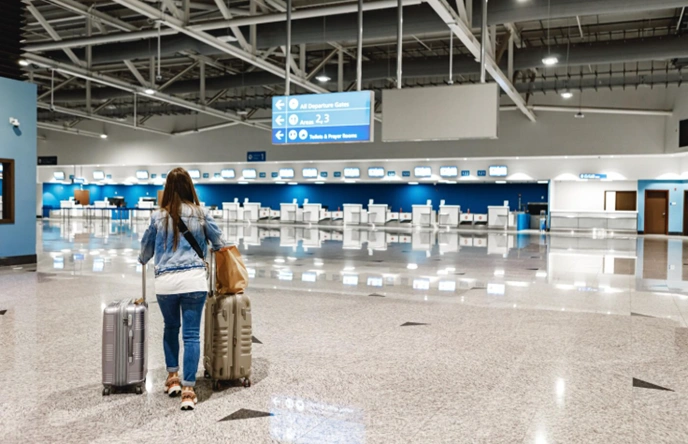
Figure 1: Traveller walking through an airport terminal with luggage [Freepik]
In a worst-case scenario, Australia travel restrictions on flights and work-from-home mandates could both be put on the table, according to a senior economist warning this week.
Why Australia’s Fuel Supply Is Under Threat
Australia relies on imports for 90 per cent of its refined liquid fuel needs. The Country has only two operational refineries remaining after six were closed in recent decades. Most refined fuel imports arrive from South Korea, Singapore, Japan, and Malaysia, all of which depend on crude oil from the Middle East transiting the Strait of Hormuz, which has effectively been closed amid the current conflict.

Figure 2: Benjamin Picton, Rabobank senior macro economist who warned about possible remote work mandates and travel restrictions in a worst-case fuel shortage scenario [Rabobank]
Compounding the problem, around 20 per cent of Australia’s refined liquid fuel imports come from refining facilities in China and Thailand. Both countries have now halted fuel exports, effective immediately, according to Bloomberg and Reuters reports.
Rabobank’s senior macro economist Benjamin Picton said that in the current environment, replacing that supply would be extremely difficult. “Everyone’s going to be scrambling to try to replace lost supply, and it’s going to be a case of who’s willing to pay the most, wins,” Picton told Yahoo Finance.
Work From Home Mandates and Flight Restrictions on the Table
If fuel shortages deepen and nations begin hoarding supplies, Australia could be forced into difficult domestic decisions. Picton warned that if conditions deteriorate far enough for long enough, remote work mandates AU could be introduced alongside restrictions on air travel and even fuel rationing.
“If it gets bad enough for long enough, then we start to get into the conversation around needing to limit usage. We might be talking about work-from-home mandates. We might be talking about restrictions on air travel and even rationing,” Picton said. Australia travel restrictions of this kind remain a worst-case outcome, but the economist stressed that the conditions driving that risk are already unfolding.
A Long Supply Chain With Limited Buffer
Australia’s fuel stocks currently sit at a 15-year high. However, they remain well below the Country’s international obligations. As a member of the International Energy Agency, Australia is required to hold a minimum of 90-day stocks of oil and refined fuels. That threshold has not been met.
Russia’s invasion of Ukraine previously exposed the fragility of Australia’s just-in-time supply strategy, which has historically minimised storage costs but left little buffer in times of global disruption. The Maritime Union of Australia this week called on the federal government to address the issue directly.

Figure 3: Jake Field, National Secretary of the Maritime Union of Australia, highlighting fuel security risks linked to global conflict [MUA]
Maritime Union of Australia National Secretary Jake Field described the Strait of Hormuz closure as a clear signal of how exposed Australia’s fuel supply chains are to global conflict. He called on the federal government to treat fuel security as a core national priority, sitting alongside economic and social policy at the highest level of decision-making.
How Australia Global Risk Updates Could Reshape Energy Diplomacy?
If broad-based attacks continue in the region and supply lines remain blocked, Australia may need to use exports of liquefied natural gas as a bargaining chip to secure an alternative fuel supply, Picton suggested.
Saudi Arabia is currently working to reroute millions of barrels of oil to its Red Sea ports to keep supply flowing to Asian refiners. However, other regional producers face a narrowing window to resume exports through the Strait of Hormuz.
Picton noted that other major Asian refiners could soon follow China and Thailand in announcing their own export restrictions, given their heavy reliance on imported crude. For Australia, sitting at the end of a long supply chain with high shipping costs already factored in, that dynamic further tightens the Country’s position.
ALSO READ: Tech Stock Showdown: GOOGL vs AMZN vs MSFT — Which Analysts Prefer?
Industry Outlook
Australia’s fuel vulnerability has become a focal point for national security and economic policy discussions. With only two domestic refineries operational and import dependence at 90 per cent, analysts and industry bodies are calling for structural reforms to storage, supply diversity, and energy diplomacy. Australia global risk updates tied to the Middle East conflict are now directly shaping conversations around long-term energy resilience and Australia travel restrictions planning at the federal level.
What This Means for Australians?
The immediate impact of the Iran conflict for Australians is rising petrol prices. The longer-term risk, however, is a supply squeeze that limits how people move and work. Key points to understand:
- Australia imports 90 per cent of its refined liquid fuel needs
- China and Thailand have halted fuel exports, removing around 20 per cent of Australia’s refined fuel supply
- Fuel stocks are at a 15-year high but below the IEA’s mandatory 90-day minimum
- Remote work mandates AU and Australia travel restrictions on flights are among the worst-case policy responses flagged by economists
- LNG exports could be used as leverage to secure an alternative fuel supply in a prolonged crisis

Figure 4: Professional working from home on a laptop, representing potential remote work mandates AU during a fuel supply crisis [Freepik]
For now, these remain contingency scenarios. But the conditions making them possible are already in motion, and Australia global risk updates are likely to continue escalating in the weeks ahead.
FAQ
Q1. Why is Australia vulnerable to fuel supply disruptions?
Ans. Australia relies on imports for 90 per cent of its refined liquid fuel needs and has only two operational refineries. Most imports come from countries that depend on crude oil transiting the Strait of Hormuz, which has been disrupted by the Iran conflict.
Q2. What are the worst-case scenarios flagged for Australia?
Ans. Rabobank economist Benjamin Picton flagged remote work mandates AU, Australia travel restrictions on flights, and fuel rationing as possible policy responses if the global fuel shortage worsens significantly.
Q3. How much of Australia’s fuel comes from China and Thailand?
Ans. Around 20 per cent of Australia’s refined liquid fuel imports come from refining facilities in China and Thailand, both of which have now halted fuel exports, effective immediately.
Q4. Are Australia’s fuel stocks currently adequate?
Ans. Fuel stocks sit at a 15-year high but remain below Australia’s International Energy Agency obligation of maintaining a minimum 90-day supply of oil and refined fuels.


