
NASA has awarded SpaceX a contract to launch the Near-Earth Object (NEO) Surveyor space telescope. The agency selected the Falcon 9 rocket for this mission to enhance planetary defence. This agreement involves a firm, fixed-price payment of approximately $100 million.
The contract covers the launch service and associated mission costs. NASA expects the launch to occur in September 2027 from Cape Canaveral Space Force Station. The mission will travel to a location 1.5 million kilometres from Earth.
This destination is the Sun-Earth L1 Lagrange point. The spacecraft will maintain a stable position at this coordinate to monitor the solar system. The telescope will weigh roughly 1,300 kilograms upon departure from the launch pad.
NASA officials stated, “The space telescope is designed to help advance NASA’s planetary defence efforts to discover and characterise most of the potentially hazardous asteroids and comets that come within 30 million miles of Earth’s orbit.” This survey focuses on objects that exceed 140 metres in diameter. These bodies possess the mass to cause regional destruction upon impact.
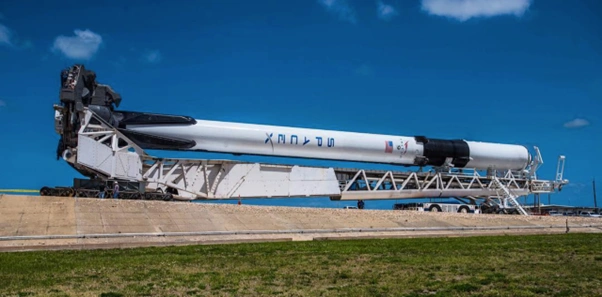
The Falcon 9 rocket has been selected for this mission
Technical Specifications and Infrared Detection Systems
The NEO Surveyor instrument features a telescope with a diameter of 50 centimetres. It utilises detectors that sense two specific infrared wavelengths. These sensors find asteroids by the heat the objects emit.
Most ground-based telescopes rely on visible light to locate space rocks. Dark objects reflect minimal light and often escape detection by these systems. The infrared sensors of NEO Surveyor identify the thermal signatures of these bodies.
The telescope operates in the 4-5.2 micron and 6-10 micron ranges. These channels allow the mission to track objects that approach from the direction of the Sun. Sunlight typically blinds other observatories during such encounters.
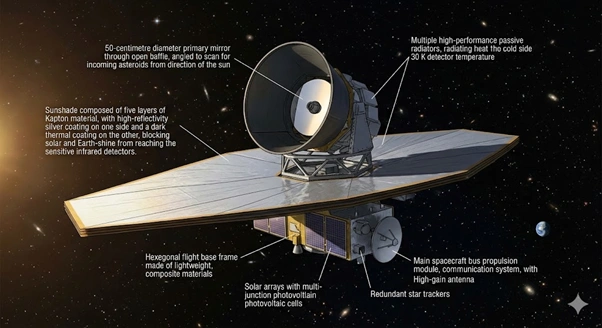
Near-Earth Object (NEO) Surveyor space telescope
The mission goals include:
- Detect two-thirds of the objects larger than 140 metres.
- Identify 90 per cent of these objects within a decade.
- Determine the orbits of asteroids to predict future paths.
- Assess the composition and rotation of threat bodies.
Amy Mainzer serves as the survey director for the NEO Surveyor project. Mainzer stated, “NEO Surveyor is optimised to help us to do one specific thing: enable humanity to find the most hazardous asteroids and comets far enough in advance so we can do something about them.” The project team will use the data to coordinate defence strategies.
Programme Management And Development Expenditures
The development cost for the mission totals $1.2 billion according to agency records. This budget supports the construction and testing of the spacecraft. NASA’s Planetary Missions Programme Office at Marshall Space Flight Centre manages the programme.
The Jet Propulsion Laboratory (JPL) in California leads the technical development. Partners for the project include BAE Systems and the Space Dynamics Laboratory. These entities provide the hardware and the software for the flight system.
Teledyne produces the infrared detectors that the telescope requires. The University of California, Los Angeles (UCLA) provides the science leadership for the survey. This collaboration brings together expertise from the industry and the academic sector.
The mission timeline includes several milestones:
- February 2024: The mission passed the critical design review.
- Spring 2024: Component integration began in Utah.
- September 2027: The scheduled launch date occurs.
- 2028-2033: The primary five-year survey takes place.
The spacecraft will produce 82 gigabits of data every day. The Laboratory for Atmospheric and Space Physics (LASP) will manage the mission operations. The Infrared Processing and Analysis Centre at Caltech will process the results.
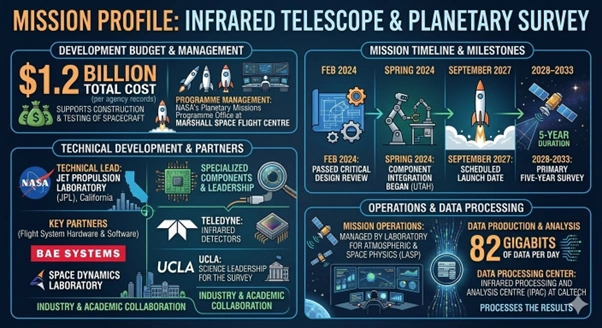
NASA’s mission profile
Data Processing And International Defence Standards
The data processing centre will release the asteroid locations to the scientific community. This transparency allows observers worldwide to perform follow-up tracking. The mission supports the mandate from the United States Congress to secure the planet.
The telescope uses passive cooling to maintain the temperature of the sensors. This method keeps the detectors at 30 Kelvin without the cryogenic fluids. Radiators and sunshades protect the instrument from the heat of the Sun.
The survey will cover 11.56 square degrees of the sky in each frame. This wide field of view increases the rate of discovery for new objects. The mission fills a gap in the current surveillance network.
NASA’s Launch Services Programme at Kennedy Space Centre oversees the SpaceX operations. The Falcon 9 will deliver the telescope to the L1 point directly. This manoeuvre requires a precise burn of the second stage engine.
The mission parameters include:
- Mission duration: Five years for the baseline survey.
- Extended mission: Potential for 10 to 12 years of work.
- Data volume: 82 billion bits per day.
- Target population: 300,000 to 500,000 objects.
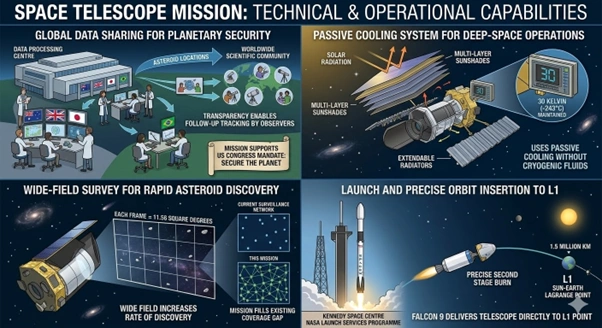
Technical and operational capabilities
Collaboration And System Integration Procedures
The Space Dynamics Laboratory integrates the telescope and the spacecraft bus. Technicians conduct environmental tests to simulate the conditions of space. These tests ensure the hardware survives the vibration of the launch.
The spacecraft bus provides the power and the communication systems. Solar arrays will generate the electricity for the telescope and the transmitters. High-gain antennas will send the images to the Deep Space Network.
The mission build involves several components:
- Instrument enclosure: Protects the telescope from debris.
- Struts: Isolate the telescope to prevent heat transfer.
- Flight base frame: Supports the weight of the assembly.
- Sunshade: Blocks the light from the Sun and the Earth.
The NEO Surveyor project builds on the legacy of the NEOWISE mission. NEOWISE demonstrated the effectiveness of infrared technology for asteroid hunting. The new telescope offers 100 times the sensitivity of the previous system.
Also Read: Common AI Mistakes Small Businesses in Australia Make
Scientists will use the measurements to calculate the diameter of the asteroids. This information determines the energy that an impact would release. The data will inform the design of future deflection missions like DART.
Global Impact And Planetary Security Objectives
The discovery of a threat object provides years of warning for the Earth. This time allows nations to prepare a response to the asteroid. Planetary defence represents a global effort to protect the species.
The NEO Surveyor mission functions as the primary tool for this task. The telescope will find asteroids that currently remain hidden in the glare of the Sun. This capability provides a comprehensive map of the Earth’s neighbourhood.
NASA provides the expertise and the authority for the planetary defence mission. The involvement of SpaceX adds the reliability of a proven launch system.
The mission statistics reveal the scale of the task:
- Estimated NEO population: 25,000 objects over 140 metres.
- Current detection rate: 43 per cent of the target population.
- Future detection rate: 90 per cent with NEO Surveyor.
- Accuracy: Orbits calculated to within several kilometres.
The SpaceX Falcon 9 has completed hundreds of successful launches. This track record ensures the safety of the $1.2 billion investment. The mission will secure the future of the planet by identifying threats early.
The contract with SpaceX marks the final step in the launch preparation. The team in Florida will begin the integration of the fairing and the payload. The countdown for the mission starts as the hardware arrives at the coast.


