
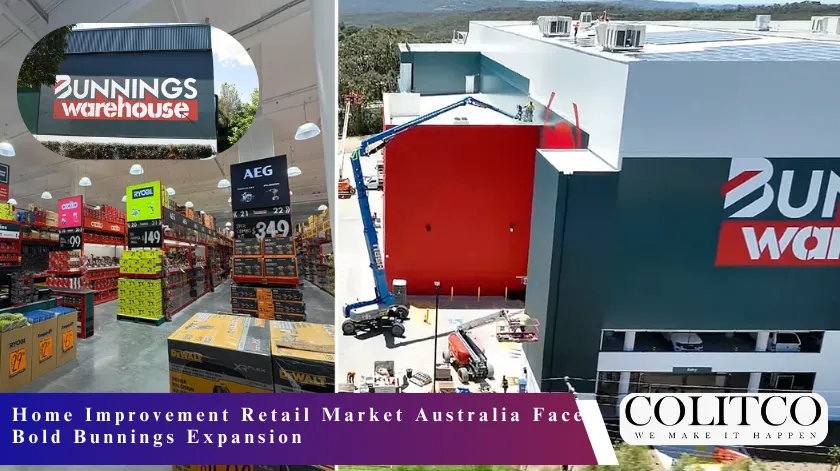
The Australian Home improvement retail market is at a new stage with Bunnings Warehouse shifting out of tools and timber to digital delivery, housing, energy and lifestyle retail. These ubiquitous green sheds are now a diversified retailing powerhouse.
The company is transforming the Australian way of shopping, building and powering their homes. Its plan incorporates convenience, sustainability and affordability.
The analysts indicate that these changes may compel the rivals to reconsider the conventional hardware designs. The change is an indication that hardware chains are turning into full-service home systems.

Bunnings stores have become the anchor of the changing home improvement retail environment in Australia. [The Australian]
Why Is The Home Improvement Retail Market Australia Moving Toward Fast Delivery?
Retail growth has taken convenience as the centre stage. Bunnings has collaborated with Uber Eats to deliver goods to the doorstep quickly. There is a variety of more than 30,000 products that can be ordered by shoppers across the country.
Products include bolts, to lawnmowers. They can deliver within less than 60 minutes. The prices are similar to those in the stores to ensure loyalty. The staged implementation is based on a successful pilot in Melbourne.
This strategy is aimed at the tradies, renovators and the emergency buyers. It puts pure online marketplaces in physical inventory contention. The relocation combines warehouse magnitude with e-lightness.
Flatpack Housing Signals A New Retail Category
Bunnings has ventured into modular housing by collaborating with Elsewhere Pods. The firm currently markets smaller flat-pack homes both online and in stores. Prices start at $26,100 for a 2.7m x 2.4m pod.
A larger studio costs $42,900. These buildings are erected within two days. They are applicable in home offices, retreats or crisis accommodation. The numerous designs also circumvent the conventional building permits, which are under the jurisdiction of the council.
Modulars are expected to expand at an average of 7 per cent. By 2030, the segment would reach up to $18 billion. This move makes hardware retail residential.

Bunnings partners with Elsewhere Pods, selling flatpack homes starting at $26,100 nationwide. [The Australian]
Energy And EV Services Strengthen Long-Term Strategy
Bunnings is also venturing into energy infrastructure and electric mobility. The chain has installed the EV chargers in 14 locations in Australia and New Zealand. Charger models are 22kW, 50kW and 120kW. As customers do their shopping, they recharge.
Solar systems and home batteries are also sold by the retailer. Its Zelora subscription eliminates its high initial expenses. Families instead make regular monthly payments.
Installation and maintenance are combined. This subscription reduces the entry barriers to renewable energy. This is considered by analysts as competition to traditional utilities.
Bunnings Warehouse Vs IKEA Intensifies Furniture Competition
The living room war is on the increase. IKEA has been a leader in the low-cost design. Bunnings is currently aggressively entering the world of décor and furniture. New collections have walnut-appearances starting at $19.
The social media buzz is growing faster. Customers want the convenience of shopping in a single store. They purchase furniture, paint and tools jointly. The rivalry between Bunnings Warehouse and IKEA is enhanced with this tactic.
There is also pressure on such things as discount chains, such as Kmart. Wider ranges would increase the size of the baskets. The homewares push goes beyond hardware to expand brand identity.

The Affordable furniture lines see Bunnings grow to mainstream home decor retail. [SSBCrack News]
Expansion And Profits Confirm Market Dominance
Physical expansion does not deteriorate due to digital developments. Bunnings has established the largest five-storey warehouse in France forest, Australia. It is 101 aisles and various design zones with a total cost of $48 million.
The network currently amounts to 310 nationwide warehouses. Revenue reached $18.97 billion in 2024. Wesfarmers’ parent group has reported a half-year profit of 1.57 billion. The increase in earnings was close to 10 per cent.
These numbers highlight investor confidence. The size of the company makes it stronger in terms of leadership as one of the leading home improvement retailers, right? Analysts are looking forward to more diversification and consistent returns.
Also Read: Bunnings Is Now on Uber Eats, and No, You Still Can’t Order a Snag
FAQs
Q1. What makes Bunnings central to the Home improvement retail market Australia?
A1: Its nationwide scale, delivery services and diversified product strategy drive dominance.
Q2. How does Bunnings Warehouse vs IKEA compare now?
A2: Bunnings adds low-cost furniture, challenging IKEA’s affordable design leadership.
Q3. Are flatpack homes really affordable?
A3: Yes, prices begin at $26,100 with quick two-day assembly.
Q4. What is Zelora’s solar subscription model?
A4: It offers solar and batteries via monthly payments without high upfront costs.


