
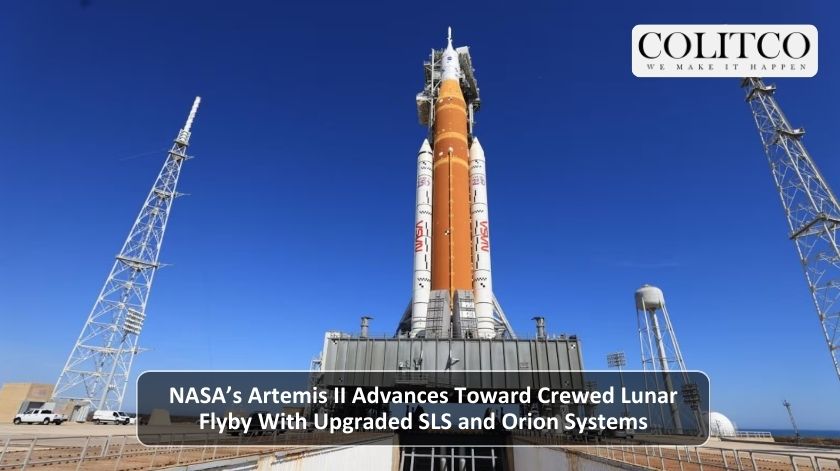
NASA advanced its Artemis campaign as Artemis II hardware reached final integration stages in Florida. The agency prepared the first crewed lunar mission since Apollo, targeting launch no earlier than March 6, 2026. The mission combines the Space Launch System Block 1 rocket and the Orion spacecraft for a ten-day lunar flyby.

Artemis II’s SLS rocket and Orion spacecraft prepare for the first crewed lunar flyby in over 50 years. [Scientific American]
Artemis II: Mission Profile and Flight Objectives
Artemis II will carry four astronauts on a high-energy trajectory around the Moon and back.
The mission will validate deep-space systems under crewed conditions for the first time in this program. NASA is planning the flight as a single launch from Kennedy Space Centre using an integrated stack.

Artemis II crew rehearses operations in Orion during the ten-day lunar flyby mission. [America space]
The spacecraft will complete two Earth orbits before committing to a translunar injection burn. It will then fly a figure-eight path around the Moon and return directly to Earth.
The mission will last about ten days, including reentry and ocean splashdown.
NASA added a proximity operations test early in the mission timeline. After separation, the crew will manoeuvre Orion near the upper stage using a visual target. This rehearsal will prepare astronauts for future docking with planned lunar infrastructure.
Space Launch System Block 1: Core Propulsion and Booster Systems
SLS Block 1 stands about 322 feet tall and uses mixed propulsion technologies.
The rocket integrates a cryogenic core stage with two solid rocket boosters and an upper stage. This configuration supports Artemis I, II, and III missions before later upgrades.

SLS Block 1 core stage with RS-25 engines ready for integration, built using friction-stir welding at Michoud. [NASA]
The core stage uses four RS-25 engines burning liquid hydrogen and liquid oxygen.
Each engine produces more than 500,000 pounds of thrust in vacuum.
Boeing built the core stage at Michoud Assembly Facility using friction-stir welding methods.
Two five-segment solid boosters provide most of the liftoff thrust. Each booster generates about 3.6 million pounds of thrust for roughly two minutes. Northrop Grumman manufactures the booster segments and integrates avionics for early flight control.
Interim Cryogenic Propulsion Stage and In-Space Burns
The Interim Cryogenic Propulsion Stage supports orbital manoeuvres after booster separation. It uses an RL10 engine fueled by liquid hydrogen and liquid oxygen.
United Launch Alliance supplies the modified Delta-derived stage for Artemis II.
The RL10 engine delivers nearly 25,000 pounds of thrust in space. It can restart multiple times, and it proved long-duration capability during Artemis I. For Artemis II, it will shape Earth orbit phasing before Orion continues toward the Moon.
NASA also mounted a target marker on the stage exterior. The crew will use that marker to evaluate handling and navigation performance. This test will strengthen readiness for later lunar rendezvous missions.
Orion Systems: Crew Module and Service Module
Orion includes a crew module, a European Service Module, and a launch abort system.
Lockheed Martin leads spacecraft integration for NASA under the Artemis program.
The spacecraft supports four astronauts for missions lasting up to twenty-one days.
The crew module carries life support hardware and cockpit display systems.
Engineers completed Environmental Control and Life Support System integration for crewed flight. These systems regulate cabin pressure, oxygen levels, and thermal conditions during deep-space travel.
The European Service Module supplies propulsion, power, and consumables in orbit.
The module uses one main engine and multiple auxiliary and reaction control thrusters.
The European Space Agency provides the service module through industrial partners led by Airbus Defence and Space.
Heat Shield, Reentry Updates, and Communications
Orion uses a 16.5-foot ablative heat shield built with Avcoat material. Engineers investigated unexpected char loss during the uncrewed Artemis I reentry. NASA identified gas venting behaviour as the root cause under skip-entry conditions.

Orion’s ablative heat shield protects the spacecraft during Earth reentry; improvements were made after Artemis I. [NASA]
For Artemis II, NASA will adjust the reentry profile to manage thermal loads. The agency will also refine manufacturing controls for future heat shield builds. These steps aim to preserve safety margins while retaining the existing shield.
Artemis II will also test a laser-based optical communications system. The system will transmit data using optical links alongside traditional radio networks. NASA expects significantly higher data rates compared with standard radio frequency systems.
Ground Systems and Launch Infrastructure
NASA will launch Artemis II from Launch Complex 39B at Kennedy Space Centre. Exploration Ground Systems teams upgraded pad hardware following Artemis I lessons. Engineers installed new hydrogen tank systems and improved emergency egress capabilities.
The Mobile Launcher 1 structure supports assembly, fueling, and crew access. It stands about 380 feet tall and weighs more than 11 million pounds. Crawler-transporters move the launcher and rocket stack from the Vehicle Assembly Building to the pad.
During wet dress rehearsals, teams loaded more than 700,000 gallons of propellant.
Technicians verified new hydrogen seals and refined countdown procedures.
These tests increased confidence in fueling stability before the final launch window.
Also Read: Nvidia Backs OpenAI With $30B Equity, Replaces $100B Deal
Program Milestones and Readiness Path
Artemis I launched successfully in November 2022 and provided baseline flight data. NASA later confirmed the heat shield investigation findings in December 2024. The Artemis II core stage arrived at Kennedy in July 2024 for integration.
Teams stacked Orion atop the SLS core stage in October 2025. Engineers then completed system checkouts and prepared for full fueling rehearsals. A second wet dress rehearsal concluded in February 2026.
NASA set a launch opportunity no earlier than March 6, 2026. Program managers will conduct final readiness reviews before committing to flight. If approved, Artemis II will mark the first crewed lunar mission of this generation.
FAQs
- What is Artemis II?
Ans. Artemis II is NASA’s first crewed mission under the Artemis program. It will send four astronauts on a lunar flyby and return them safely to Earth.
- When will Artemis II launch?
Ans. NASA has set a launch opportunity no earlier than March 6, 2026. Final approval depends on readiness reviews and pad preparations.
- What rocket will launch Artemis II?
Ans. Artemis II will launch on the Space Launch System (SLS) Block 1 rocket. The vehicle uses four RS-25 engines and two solid rocket boosters.
- What spacecraft will carry the crew?
Ans. The mission will use the Orion spacecraft. Orion includes a crew module and a European Service Module for propulsion and power.
- How long will the Artemis II mission last?
Ans. The mission is designed to last about ten days. It includes Earth orbits, a lunar flyby, and a direct return trajectory.
- Will Artemis II land on the Moon?
Ans. No, Artemis II will not land on the Moon. It is a flyby mission intended to test systems before future lunar landings.
- What is the purpose of Artemis II?
Ans. The mission will test life support, navigation, propulsion, and communication systems with astronauts on board. It will also rehearse future docking and deep-space operations.
- What improvements were made after Artemis I?
Ans. NASA adjusted Orion’s reentry profile after heat shield findings from Artemis I. Engineers also improved hydrogen fueling systems and pad infrastructure.
- What is the Orion Artemis II Optical Communications System?
Ans. It is a demonstration of laser communications technology. The system aims to achieve higher data rates than traditional radio systems.
- Why is Artemis II important?
Ans. Artemis II marks the first crewed lunar mission in more than 50 years. It lays the groundwork for future Moon landings and long-term lunar exploration.


