
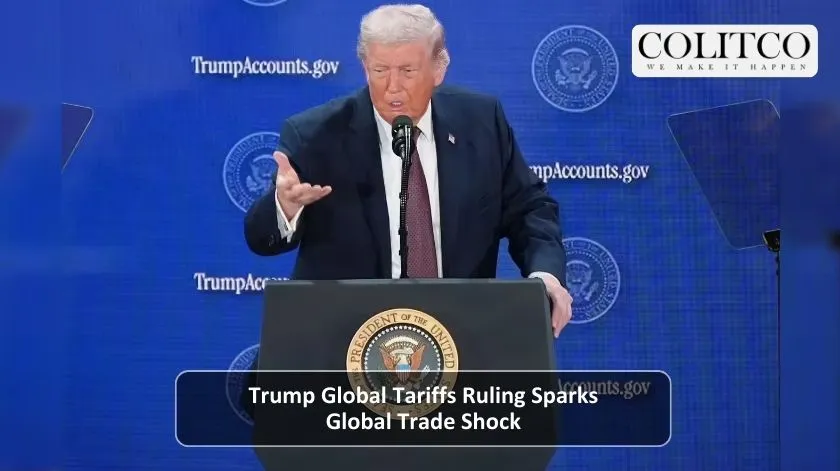
The Trump global tariffs decision shocked markets in countries all over the world and derailed trade planning during the night. The White House was defeated by the US Supreme Court 6-to-3.
According to judges, the president overstepped their powers. They discovered that the crisis statute did not refer to tariffs. That legislation could not support blanket responsibilities. The ruling restricted one-sided commerce.
Risk exposure was reexamined immediately by businesses. Importers paused shipments. The future trades declined steeply. Governments wanted immediate clarification from Washington.

Court decisions and stock market reactions shake the global trading and shipping. [CNBC]
Court Blocks Executive Tariff Powers
A great number of global obligations that were introduced last year were invalidated by the court. Such tariffs were imposed on almost all the trading partners. Over two hundred billion dollars had been raised.
Budget plans were supported by that revenue. The economists cautioned that a trillion-dollar disparity was a possibility. The federal income may be cut off in a hurry by refunds.
The agencies have complicated accounting tasks. Revenue sources have to be redesigned by the policy teams. Shareholders are concerned with fiscal stability.
How Did Trump Respond To The Trade Policy Ruling?
It was shortly after that that President Donald Trump responded. He had attacked a number of justices in public. Then he proclaimed a new imposition. Tuesday will see the start of a new 10 per cent global tariff.
He referred to the 1974 Trade Act in Section 122. Section 301 investigations were also flagged by him. Such investigations may be directed towards certain nations.
Friends hoped to find stability and were granted more uncertainty. Markets were not able to value the lightning pace.

New taxes and legal gambits stress the supply chains and federal budgets. [Business Standard]
Trade Deals And Budgets Face Pressure
Some of the recent trade agreements had pegged tariffs to about 15 per cent or 20 per cent. Those levels were subjected to concessions between countries. Those accords now appear doubtful.
The companies are not able to verify the rates. Certain deals can be renegotiated in the near future. Refund exposure is also determined by officials.
Over a hundred billion can be refunded. It would take months or years to do so. Customs teams are supposed to be work-intensive. Employees of the treasure trove are ready to quarrel.
What Does This Mean For Businesses And Consumers?
Corporations increased the cost in order to compensate for previous taxes. Not many have immediate cutbacks. It is possible to have replacement tariffs. There are increased costs in contracts.
Retailers are more comfortable with margin stability. Electronics sellers maintain a low level of inventory. Importers of furniture postpone high orders.
Consumers are thus exposed to sticky prices. It may not manifest itself in terms of savings. Trust is weak throughout supply chains.

Shoppers, exporters and traders are monitoring prices as the global uncertainty prevails. [Foddie]
Could Legal Challenges Delay The Tariff Refund Process Further?
According to trade lawyers, it will take a long time to litigate in the country. There are thousands of importers who can claim. Any payment should be checked in the courts. That is a task that needs detailed records.
There would be an overload of the administrative systems. Smaller companies are exposed to cash flow pressure. Refunds may arrive slowly.
Certain conflicts might have to be taken to the upper courts. Legal costs may rise sharply. The Trump tariffs ruling by the US Supreme Court has the potential to result in years of litigation.
Investors And Allies Seek Clearer Signals From Washington
International investors want reliable policy messages. Unexpected alterations interfere with contracts and predictions. Exporters experience the fear of a recurring reversal of the law.
The currency markets are responsive to every statement. Shipping routes vary regularly. Plans for capital spending are postponed.
Diplomats demand strict schedules. Yet clarity remains limited. The more general Trump trade policy decision still influences the risk calculations. The volatility in trade can last several months.

Investors seek certainty; sudden policy shifts disrupt contracts and forecasts. [The Economic Times]
What Could Happen Next For Global Trade Policy?
Governments now expect extended negotiations with Washington. Trade ministries are reviewing contingency plans. Exporters seek diversified markets to reduce risk. Some firms may shift production locations.
Others may delay expansion spending. Shipping volumes could fluctuate weekly. Currency volatility may remain elevated. Analysts predict slower cross-border investment.
The Trump global tariffs ruling may influence future presidential powers. Lawmakers could pursue clearer trade legislation. Businesses want predictable rules before committing capital.
Also Read: Global Stocks Slide After Trump Renews Europe Tariff Warnings
FAQs
Q1. What did the court decide?
A1: The court said the president lacked authority for sweeping unilateral tariffs.
Q2. How much revenue was collected?
A2: More than $200 billion has been collected since the start of last year.
Q3. What new tariff was announced?
A3: A 10 per cent global tariff will start on Tuesday.
Q4. Could companies receive refunds?
A4: Yes, refunds exceeding $100 billion may follow lengthy legal and administrative reviews.


