
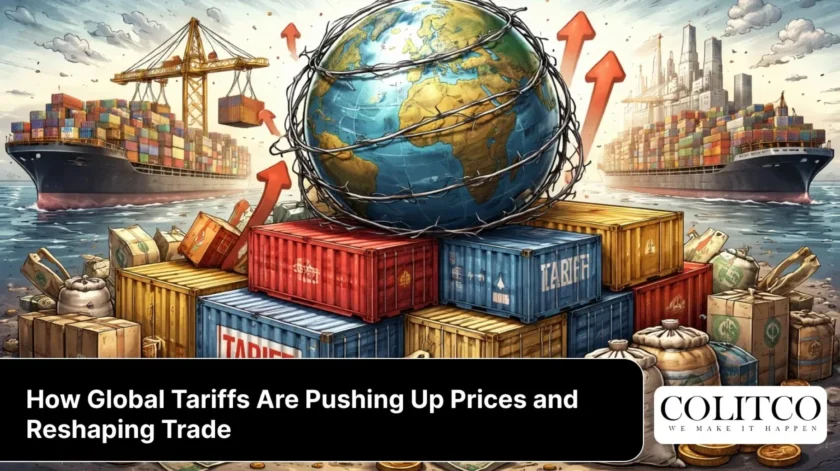
Something shifted in global trade on 21 Feb 2026. US President Donald Trump signed a new executive order reinstating a 10 per cent tariff on goods from every country in the world. The Supreme Court had struck down his earlier tariff regime, ruling it unconstitutional. Trump moved quickly, citing a separate trade law to bring the tariffs back and this time, he says they apply almost immediately.

Figure 1: Global tariffs are reshaping trade flows worldwide, raising costs across supply chains and feeding inflation pressures. [Source: Freepik]
For everyday consumers, that news is more than a headline. Global tariffs and inflation are directly connected. When import taxes rise, prices follow. And the data already shows that is exactly what is happening.
How Global Tariffs and Inflation Are Feeding Each Other?
Tariffs are essentially a tax on imported goods. When the US raises them, someone has to absorb the cost, whether that is foreign exporters, domestic businesses, or consumers. Over the past year, the evidence points firmly toward consumers carrying a significant share.
According to The Budget Lab, core goods prices rose 1.5% during 2025 through November. That compares to just 0.2% over the same period in 2023. Durable goods, appliances, vehicles, and electronics rose 1.6%, against a fall of 1.8% in the prior period. The relationship between inflation and import costs is no longer theoretical. It is showing up in the numbers.
The Real Cost of Higher Import Taxes
Before 2025, the US collected roughly US$7.6 billion a month in tariff revenue, with an average rate of just 2.7%. That baseline has been blown past. By January 2026, the US had collected approximately US$194.8 billion in additional tariff revenue above the pre-2025 average.

Figure 2: US customs duties jumped sharply in 2025, with the effective tariff rate rising well above the 2022–24 average. [Source: The Budget Lab]
The Budget Lab estimates tariffs will raise US$246 billion in annual revenue for FY2026 on a conventional basis. Adjusting for losses in payroll and corporate tax revenues, that figure rises to around US$319 billion. The money is real. So is the cost being passed along the supply chain.
How Tariffs Affect Inflation Through Consumer Prices?
The key question economists are trying to answer is how much of the tariff cost actually reaches consumers. The answer, known as passthrough, is significant. Here is what The Budget Lab found as of November 2025:
- Core goods passthrough rate sits between 31% and 63%
- Durable goods pass-through reaches 96% to 106%, depending on the method used
- Imported core goods prices are 2.1% above the pre-2025 trend
- Imported durable goods prices are 2.9% above the pre-2025 trend
- The economy-wide effective tariff rate reached 11.7% by November 2025

Figure 3: Tariff costs are increasingly passed through to consumers, with durable goods showing near-full price pass-through by late 2025. [Source: The Budget Lab]
In plain terms, nearly the full cost of tariffs on durable goods is landing on consumers. That is how tariffs affect inflation in the most direct way, through the everyday items people buy.
Businesses Rushed to Stockpile
When tariffs were announced, businesses acted fast. Real imports surged 18.1% above trend between December 2024 and March 2025, roughly US$51.1 billion in additional purchases. Companies were front-loading inventory to avoid paying higher costs later.
That strategy bought time. But from April 2025 onward, imports fell. By November 2025, they were running 6.1% below the pre-2025 trend on average. As those pre-tariff stocks deplete, businesses will have no choice but to buy at full tariff-inclusive prices. The pressure on inflation and import costs is likely to build from here.
A Weaker Currency Compounds the Inflation Problem
Standard economic theory suggests tariffs should strengthen a currency. Fewer imports mean less demand for foreign currencies, pushing the domestic currency higher. A stronger dollar would make imports cheaper and take the edge off inflation.

Figure 4: A weaker US dollar since late 2024 has amplified tariff-driven inflation by increasing the cost of imports. [Source: The Budget Lab]
That has not happened. As of January 2026, the US dollar is 6.3% weaker than its December 2024 average. A weaker dollar makes every import more expensive in dollar terms, amplifying rather than softening the effect of global tariffs on inflation. The expected cushion has not arrived, and economists are still debating why.
What the Labour Market Data Shows?
The broader jobs market has stayed relatively steady. Key figures as of early 2026 include:
- Total nonfarm employment grew by 400,000 jobs in the year to January 2026, down from 1.2 million the prior year
- Tariff-sensitive employment fell 0.5% during 2025 through January, about 0.8% below the pre-2025 trend
- Manufacturing industrial output rose 2.0% during 2025 through December
- Manufacturing tariff-exposed employment fell 0.8%, slightly worse than the trend prediction of 0.6%

Figure 5: Employment in tariff-exposed sectors has softened slightly, falling below pre-2025 trend levels despite stable overall job growth. [Source: The Budget Lab]
The labour market picture remains mixed. Analysts note it is still too early to draw firm conclusions on how tariffs affect employment in the longer run.
The Outlook on Global Tariffs and Inflation
Trump’s reinstated 10 per cent global tariffs reopen the pressure valve. If pass-through rates hold, consumer prices will continue to rise across goods. If the dollar stays weak, that pressure compounds. As stockpiles run thin, businesses lose their last defence against the full cost of tariffs.
Global tariffs and inflation are now a live, ongoing story, not a forecast. The data shows prices have moved, trade volumes have shifted, and supply chains have already responded. The question is not whether tariffs affect inflation. It is how much further this runs.
FAQ
Q1. What are global tariffs, and why do they cause inflation?
Ans. Global tariffs are taxes placed on imported goods. When tariff rates rise, the cost of bringing goods into a country increases.
Q2. How much have US tariffs pushed up consumer prices?
Ans. Core goods prices rose 1.5% during 2025 through November, compared to just 0.2% over the same period in 2023. Durable goods rose 1.6%.
Q3. Are foreign exporters absorbing any of the cost?
Ans. There is no clear evidence of foreign producers lowering their export prices in response to US tariffs.
Q4. Why is the US dollar falling when tariffs usually strengthen a currency?
Ans. The US dollar is 6.3% weaker than its December 2024 average, contrary to conventional expectations.


