Mark Zuckerberg faced his toughest audience yet on Wednesday, not Congress, not regulators, but a Los Angeles jury deciding whether he built a machine designed to addict children.
The Meta chief executive took the witness stand at the Los Angeles Superior Court on 18th February 2026, in what has quickly become one of the most closely watched tech trials in American history. The case, brought by a plaintiff identified only as K.G.M., accuses Meta and Google of knowingly engineering their platforms to be harmful to young users’ mental health.
What Happened in Court
The plaintiff, now 20, claims she began using social media as young as age six. Her lawsuit alleges that prolonged exposure to Instagram, YouTube, TikTok, and Snap led to addiction, body dysmorphia, depression, and suicidal thoughts. Both TikTok and Snap settled with her before the trial commenced. That left Meta and Google to face the jury.

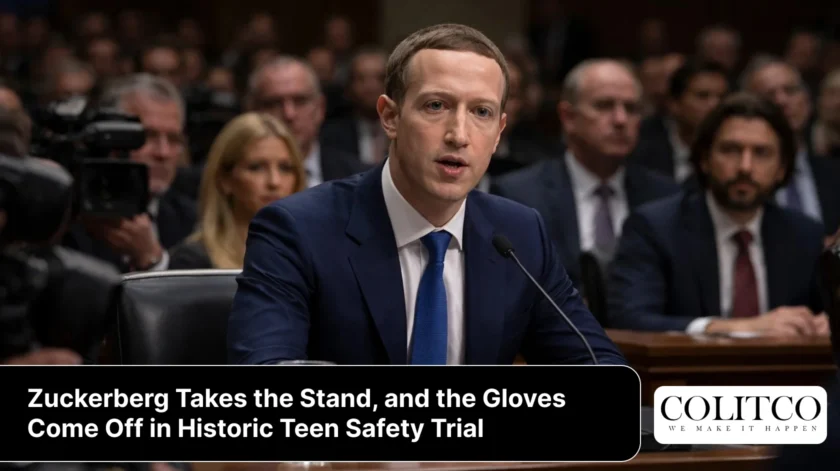
Mark Zuckerberg arrives at LA court for landmark social media addiction trial [New York Post]
Plaintiff’s attorney Mark Lanier wasted no time going on the offensive. In one of the day’s most striking courtroom moments, he had five lawyers unspool a roughly six-metre collage of hundreds of selfies K.G.M. posted to Instagram. Lanier pressed Zuckerberg on whether her account had ever been flagged for excessive use by a child.
Zuckerberg gave no direct answer.
Zuckerberg Pushes Back
The Meta CEO repeatedly denied that the company sought to make its platforms addictive. “I’m focused on building a community that is sustainable,” he told the court. “If you do something that’s not good for people, maybe they’ll spend more time short term, but if they’re not happy with it, they’re not going to use it over time.”
He grew visibly frustrated at several points. “That’s not what I’m saying at all,” he snapped at one stage. “You’re mischaracterising what I’m saying,” he added at another.
Lawyers pressed him on a 2015 internal email thread in which he appeared to flag improving engagement metrics as an urgent company priority. Zuckerberg maintained the comments were aspirational, not directives. Lawyers later presented evidence from Instagram head Adam Mosseri showing internal targets to lift daily user engagement to 40 minutes by 2023 and 46 minutes by 2026.
The Underage Users Question
One of the sharper exchanges of the day centred on underage access. Lanier cited a 2015 internal Meta review estimating that more than four million users under the age of 13 were on Instagram at the time, despite the platform’s minimum age requirement of 13.
Zuckerberg acknowledged that some underage users do exist on the platform, saying children “sometimes lie about their age” during sign-up. The plaintiff’s legal team was unimpressed. “You expect a nine-year-old to read all the fine print?” one lawyer shot back.
What’s at Stake
This trial is not just about one young woman. It serves as a test case for more than 1,600 pending lawsuits, including claims from over 350 families and 250 school districts across the United States. A verdict against Meta and Google could open the door to sweeping damages and force platform-wide design changes to social media apps.
For decades, platforms like Meta have relied on Section 230 of the Communications Decency Act, a 1996 federal law that largely shields internet companies from liability for content posted by their users. Plaintiffs argue the current case is different because it targets deliberate design choices, not user-generated content.
Key features under scrutiny include:
- Infinite scroll
- Auto-play video
- Push notifications
- Beauty filters
- Algorithmic recommendations targeting young users
Meta has denied all allegations, with a spokesperson stating the question before the jury is “whether Instagram was a substantial factor in the plaintiff’s mental health struggles.”
The Courtroom Atmosphere
The atmosphere outside and inside the court has been charged. Bereaved parents, some holding framed photographs of their children who died after encountering harm on social media, have attended proceedings for weeks.
Julianna Arnold, whose 17-year-old daughter died from fentanyl purchased through someone she met on Instagram, watched Zuckerberg testify from outside the courtroom. “We lost our kids,” she said. “But what we can do is inform other parents and families about these harms.”

Meta CEO Mark Zuckerberg testifies at the Los Angeles Superior Court
The judge also threatened contempt proceedings against anyone using Meta’s own Ray-Ban AI glasses to record testimony; members of Zuckerberg’s entourage were photographed wearing the devices as he entered the building.
Also Read: Alcoa Hit with Australia’s Largest Conservation Fine After Six Years of Illegal Forest Clearing
The Broader Picture
Commentators have drawn comparisons to the Big Tobacco litigation of the 1990s, where internal documents eventually proved tobacco companies knew their products were harmful long before the public did. Whether internal Meta communications reveal a similar pattern remains one of the central questions of this trial.
Zuckerberg also revealed he reached out to Apple CEO Tim Cook to discuss the well-being of teens and children, though he offered few details on what came of those conversations.
The trial continues. The plaintiff, K.G.M., is expected to take the stand herself in the coming days, delivering what lawyers describe as the most emotionally significant testimony of the proceedings.