
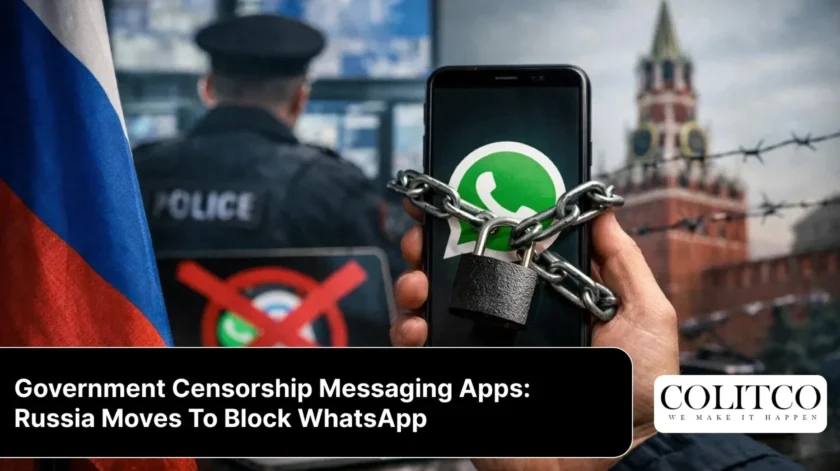
Russia has tried to issue a complete ban on the WhatsApp service of Meta within the country, as the company’s press releases claim. The shift is part of broader government censorship of content in application policies against foreign technology.
The authorities desire to have closer surveillance of local traffic over the internet and encrypted communication networks. WhatsApp reported that the government attempted to interrupt access and limit the services of millions of users.
The platform also vowed to ensure that people remained connected regardless of the pressure. The move comes after previous restrictions on call and data traffic via international applications.
Analysts report that such steps are indications of increased work on digital sovereignty since February 2022. Moscow has been pressuring more and more for local alternatives be provided as it evaluates foreign providers. The conflict has now been turned into a near shutdown move.

WhatsApp logo on smartphones as Russia increases digital restrictions. [Reuters]
Why Has Russia Blocked Government Censorship Messaging Apps Platforms Like WhatsApp?
Russia claims that foreign platforms have to operate according to local laws and data exchange regulations. The Kremlin spokesperson, Dmitry Peskov, added that dialogue is not impossible unless Meta respects the laws of the country.
He threatened to stalemate any agreement in the event of non-compliance. The government also popularises a state-supported messaging app known as MAX.
According to critics, the service may make it possible to surveil and track users. The state media rejects such charges and positions MAX as safe. WhatsApp termed the push as an attempt at directing users to a state-owned surveillance apparatus.
The firm indicated that it would keep doing all it could to sustain relationships. The standoff brings to light the effect of the censorship law on the cross-border messaging application.
How Are Censorship Laws Impact Messaging Apps Globally?
The behaviour of Russia reflects the general tendencies of the regulation of messaging apps in the world. Governments are also demanding adherence to security requests through local data storage.
Social media platforms fight back when these tools jeopardise encryption and privacy. The conflict usually ends with a fine, a throttling or a complete ban. In Russia, WhatsApp has approximately 100 million users, as per reports.
It would rebrand the market as soon as that scale is lost. The other countries are on their toes since the precedent can be propagated. Firms have escalating expenses of meeting competing legal regimes.
Risks are also monitored by investors who make operations politically sensitive. The argument has gone beyond Russia to greater policy debates in the world.

Global networks represent the increased regulatory pressure on messaging services all over the world. [iTnews]
International Reaction To Russia’s Messaging App Crackdown
Such restrictions have raised an alarm among foreign technology groups on the growing restriction of cross border platforms. The advocates of digital rights caution that the block may interfere with freedom of expression.
They are said to undermine trust and security through forced migration to state apps. Other professionals opine that users can use virtual private networks to circumvent controls.
Nonetheless, tools of enforcement are also increasingly becoming advanced. Telegram has not been spared from criticism.
In December, Apple blocked its FaceTime, and the list of impacted services was extended. These steps demonstrate that messaging applications are the core of the geopolitical tension. Companies that depend on cross-border communication may be affected.
Could This Change The Future Of Global Messaging Apps Regulation?
There is an opinion among policy experts that the conflict will hasten the enforcement of tougher global regulations on foreign apps. Others might impose compliance or come up with local alternatives.
That would disperse the previously open internet ecosystem. Local partnerships may be necessary for the survival of companies.
Legal risks will tend to increase,e and compliance teams will expand. Smaller companies would find it difficult to comply with these requirements.
Consumers can end up having fewer choices and a lack of privacy. There is still a lot of commercial interest between governments and tech groups. The result of such might transform the manner in which messaging services are conducted across borders.

The controversies of regulation are growing stronger as governments struggle between control and digital freedom. [European Coatings]
What Comes Next For Users And Messaging Platforms?
WhatsApp claims that it will continue to do its best to ensure accessibility to Russian users. Negotiations may be resumed in case the authorities and Meta strike a compromise.
But there is doubt concerning the enforcement and compliance requirements. Customers might migrate to other tools or encrypted networks.
Companies will check their reliability before investing in platforms. Investors also evaluate the exposure to regulatory shocks. The episode highlights the effects of censorship laws on non-nationwide messaging apps.
It marks an even more challenging time for cross-border digital services. Security and privacy are now at the centre of policy discussion.
Also Read: Meta Australia Teen Accounts Removed As Law Tightens Access
FAQs
Q1: Why did Russia attempt to block WhatsApp?
A1: Russia wants foreign platforms to follow domestic laws and promote its state-backed appMAX.
Q2: How many users could be affected in Russia?
A2: Reports indicate WhatsApp has about 100 million users in the country.
Q3: What is MAX?
A3: MAX is a state-supported messaging app promoted as a local alternative to foreign services.
Q4: Could other countries follow similar restrictions?
A4: Yes, tighter global messaging apps regulation may encourage comparable controls elsewhere.


