

The banking sector stands at a pivotal moment as 2026 could determine which institutions successfully transform into AI-powered organisations. Despite massive investments over the past two years, most US banks have achieved only sporadic tactical wins rather than a strategic transformation through AI in banking strategy 2026.
Figure 1: Illustration of AI-powered financial systems, highlighting how artificial intelligence is increasingly embedded across banking operations. [Source: Freepik]
A Deloitte review of the top 40 US banks reveals predominantly reactive, siloed efforts yielding inconsistent value. Many AI initiatives remain stuck in isolated proofs of concept, marked by weak governance, duplication, and uneven impact across organisations.
AI in Banking Strategy 2026 Requires Unified Vision
AI in banking strategy 2026 implementation faces throttling from brittle and fragmented data foundations. Mounting compliance demands, outdated legacy systems, and internal resistance to change compound these challenges. Most banks have taken a federated and patchy approach to AI, especially generative AI.
Until now, experimentation has lacked an overarching vision across most institutions. Banks still struggle to define what success with AI actually looks like, whether it is efficiency gains, faster innovation, or stronger risk controls. Without unified direction, banks struggle to identify scalable AI opportunities and measure progress against key performance goals.
AI Transformation in Banking Hindered by Governance Gaps
AI transformation in banking requires clear ownership across the AI life cycle, yet accountability remains fragmented or absent at many institutions. Approaches vary widely in how employees can access and use AI tools. Defining which responsibilities sit with central teams versus business units becomes critically important.

Figure 2: Conceptual image of an AI microchip, representing the data and computing foundations required for large-scale AI transformation in banking. [Source: Freepik]
For most banks, a hub-and-spoke model could prove optimal. This model ensures that different business lines’ needs are adequately managed, anchored by a central unit like an AI centre of excellence. The central entity drives quality across the enterprise and upholds AI governance standards while serving as the operational hub.
Bank AI Governance 2026 Focuses on Build Versus Buy Decisions
Bank AI governance 2026 considerations extend to the recurring build versus buy dilemma. Many banks have adopted a hybrid model for traditional AI, like machine learning. They build proprietary models while buying point solutions and platforms for less differentiated needs.
For generative AI, some banks have shifted focus toward an assembly approach. They buy the foundation model layer but build custom proprietary layers around it with data connectors, guardrails, and third-party solutions. Beyond leveraging third-party expertise, this approach reduces time to market and experimentation costs.
Measuring ROI Remains a Critical Challenge for AI in Banking Strategy 2026
As AI in banking strategy 2026 scales, measuring impact becomes critical, yet senior executives find it hard to assess value. Developer productivity is one of the few areas where banks can observe early signs of AI value. Even here, the absence of consistent benchmarks makes it difficult to prove that reported gains translate into real financial outcomes.
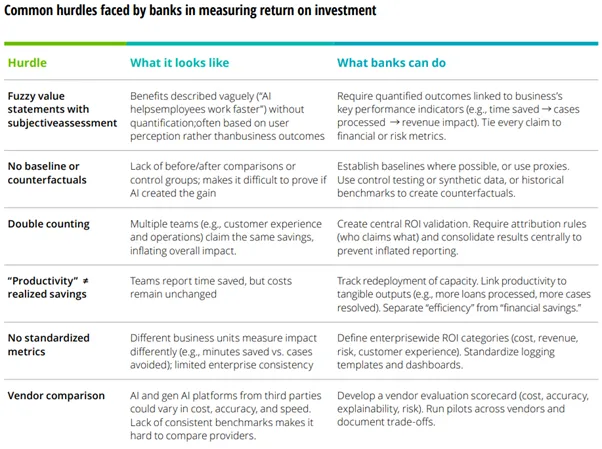
Figure 3: Deloitte analysis outlining common hurdles banks face when measuring return on investment from AI initiatives. [Source: Deloitte]
Only 4 out of 50 banks analysed by Evident in 2025 reported realised ROI from AI use cases. Common hurdles include fuzzy value statements with subjective assessment, no baseline or counterfactuals, double counting, and productivity not equating to realised savings.
AI Transformation in Banking Accelerates With Industry-Specific Models
General large language models are powerful but often limited in addressing banking operations complexity. The real step change comes from models trained on bank-specific data and workflows. For example, Claude for Financial Services emphasises governed research, modelling, and compliance workflows with auditable data use.
Small language models are gaining traction as cheaper, faster, and easier-to-deploy alternatives. Tailored to industry data, these models promise more practical ROI, reducing reactive spend while enabling focused and trustworthy AI transformation in banking adoption.
Agentic AI Represents Critical Frontier for Bank AI Governance 2026
The most critical frontier today is agentic AI, autonomous agents with the ability to take initiative and execute actions. Banks should start embedding compliance into agents themselves, including permissions, auditability, and human checkpoints. They must also prepare foundations for scale: cloud-based infrastructure, orchestration for multi-agent systems, and strong data governance.

Figure 4: Dashboard-style visual showing productivity and performance metrics, reflecting challenges banks face in quantifying AI-driven efficiency gains. [Source: Freepik]
Bank AI governance 2026 requires shifting from a human-at-the-centre model to an AI agent-at-the-centre approach. Humans remain in the loop for consequential decisions and oversight, supported by purposeful change management and organisational redesign where needed.
Industry Outlook: Banking Sector AI Investment Priorities
The banking sector continues channelling substantial capital into AI capabilities despite mixed results to date. As adoption grows, some banks are rethinking infrastructure approaches. Many turn to third-party providers for speed, but unsustainable compute costs demand hybrid AI infrastructure solutions.
Institutions must combine on-premise systems with public, private, and specialised clouds to scale flexibly. This approach safeguards sensitive data while meeting regulatory demands and controlling escalating technology expenses.
What AI in Banking Strategy 2026 Requires Beyond Technology
AI initiatives are unlikely to deliver meaningful results unless banks resolve several structural and organisational issues alongside the technology. These include modernising core infrastructure, migrating to the cloud, and bolstering data architecture and governance. Banks should also embrace a cultural reset where humans and AI collaborate seamlessly.
The approach should boost productivity while preserving accountability, trust, and compliance across the enterprise. Setting vision at the top, backing it with investment, and driving alignment ensures each AI initiative ladders up to a bigger strategic story.
Final Thoughts
The year 2026 could prove pivotal for banks aspiring to become fully AI-powered organisations. AI in banking strategy 2026 must evolve from reactive experimentation to disciplined enterprise-level transformation with clear vision and governance.
Bank AI governance 2026 frameworks will determine which institutions successfully industrialise AI at scale versus those remaining stuck in pilot purgatory. AI transformation in banking demands a unified strategy, measurable outcomes, and cultural alignment where technology and human expertise combine to deliver a sustainable competitive advantage.
FAQs
Q1. What is the main challenge facing AI in banking strategy 2026?
Ans. Most banks have only achieved sporadic tactical wins despite large AI budgets. Initiatives remain stuck in isolated proofs of concept marked by weak governance, duplication, and uneven impact rather than strategic transformation.
Q2. What governance model works best for AI transformation in banking?
Ans. A hub-and-spoke model proves optimal for most banks. This approach features a central AI centre of excellence driving quality and governance standards while serving as an operational hub for adoption across business units.
Q3. How should banks approach build versus buy decisions in Bank AI governance 2026?
Ans. Many banks adopt hybrid approaches, buying foundation model layers while building custom proprietary layers with data connectors and guardrails. This reduces time to market and shifts the cost increase risks to third parties.
Q4. Why do banks struggle to measure ROI from AI in banking strategy 2026?
Ans. Common hurdles include fuzzy value statements, no baseline comparisons, double counting across teams, and productivity gains not translating to realised savings. Only 4 out of 50 banks analysed reported realised ROI.