
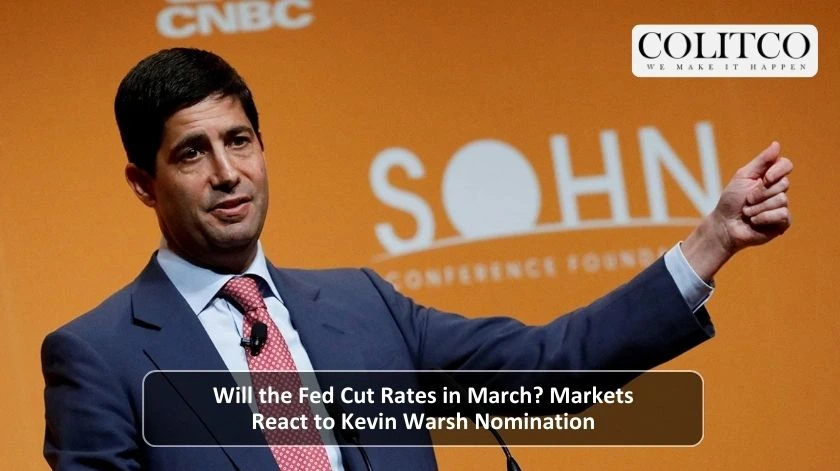
Expectations for a Federal Reserve rate cut in March have shifted as traders reassess monetary policy prospects following Kevin Warsh’s nomination as Fed chair. Betting markets show reduced confidence in aggressive easing, while analysts remain divided over Warsh’s likely policy stance.
Rate Cut Expectations Recalibrated for March
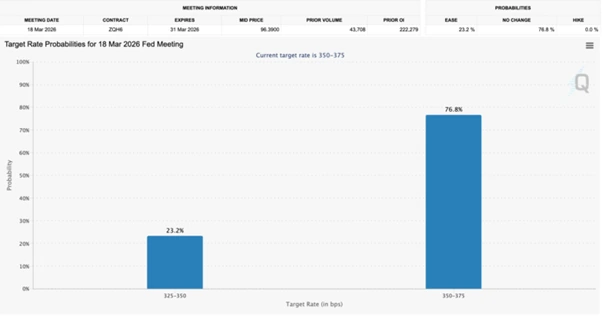
Recent CME FedWatch data indicates that only 17% of traders expect a 25-basis-point cut at the March FOMC meeting. About 82% anticipate rates will remain unchanged, extending the current pause in adjustments.
Source: Cointelegraph
Earlier data showed expectations briefly climbing above 20% after weaker jobless claims and JOLTS figures. However, those projections retreated as markets weighed policy continuity and leadership uncertainty.
Separate CME data previously showed roughly 23% of participants anticipating a March cut. Even then, most forecasts pointed to a modest 25-basis-point move rather than deeper reductions.
Polymarket Signals Shift in 2026 Outlook
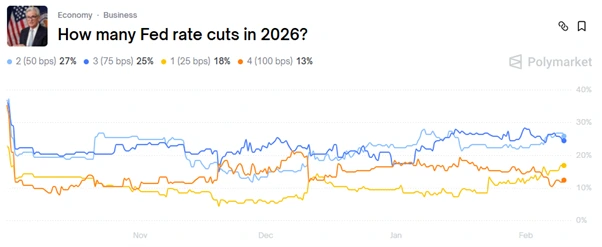
Betting platform Polymarket shows traders now price in two rate cuts this year with a 27% probability. The odds of three cuts stand at 25%, while one and four cuts trail at 18% and 13%.
Source: Polymarket
Before Warsh’s nomination, traders leaned toward three rate cuts as the base scenario. The shift reflects renewed caution about how the next Fed chair might approach monetary policy.
Bitcoin prices have eased from levels above $80,000 since the nomination announcement. Market participants are linking that move to uncertainty around future rate direction.
Warsh’s Record Fuels Debate Over Policy Direction
Kevin Warsh served as a Federal Reserve governor from 2006 to 2011. During that period, he was often described as attentive to inflation risks.
Commentary about his nomination has produced mixed reactions across financial circles. Some analysts consider him hawkish based on past statements about inflation and balance sheet size.
Milk Road Macro wrote on X that confusion surrounds whether Warsh is hawkish or dovish. The post referenced his crisis-era reluctance to cut rates quickly.
At 26:40, Kevin Warsh explains his stance on QE.
He even explains why he resigned over QE back in 2010.
Save this interview with the next Fed Chair. https://t.co/CANAzKnSnD pic.twitter.com/atPFzVpq44
— Milk Road Macro (@MilkRoadMacro) February 9, 2026
The same commentary noted that structural changes, including artificial intelligence and productivity growth, may shape his current thinking. Observers remain divided over whether that signals policy flexibility.
Trump’s Public Support and Market Concerns
President Donald Trump has repeatedly stated that he expects lower interest rates. He said he would not have nominated Warsh if he believed rate cuts were unlikely.
Anthony Pompliano posted on X that Warsh may cut rates aggressively. He added that markets could witness a broad rotation if policy eases.
Kevin Warsh is going to cut interest rates aggressively.
Anyone suggesting otherwise doesn’t understand what is happening.
Make sure you are prepared for what is coming… pic.twitter.com/wWJIXKFNjJ
— Anthony Pompliano 🌪 (@APompliano) February 9, 2026
Other analysts have offered caution. Sam Badawi wrote on X that Warsh’s call for a new Fed–Treasury accord suggests a more nuanced position.
Badawi noted that closer fiscal coordination could influence perceptions of Fed independence. That debate has added another layer to market assessments.
Independence Questions Surface Ahead of May Transition
Warsh must become a Fed governor before assuming the chairmanship in May. Jerome Powell’s term as chair ends then, though his governorship runs longer.
The structure of the Federal Open Market Committee complicates the transition. The committee consists of seven governors and five regional bank presidents.
Some analysts argue that monetary policy decisions rest with the full committee, not solely the chair. Therefore, rate decisions will reflect broader consensus rather than one individual’s view.
Robert Brusca wrote that Warsh has a history aligned with conservative monetary principles. He argued that once confirmed, Warsh would operate independently of political pressure.
Inflation Record and Productivity Debate
Inflation reached above 9% during the recent cycle before moderating toward 3%. Critics of current policy say rates were kept too accommodative for too long.
Warsh has spoken about the role of productivity gains in shaping inflation trends. Supporters of that view argue that technological advances could support growth without fueling prices.
Skeptics counter that productivity improvements must be observed in data before guiding policy shifts. The timing of any rate adjustment may hinge on that evidence.
Fed officials have signaled caution in recent meetings. Statements suggest a wait-and-see approach as inflation remains above target.
Also Read: Novo Resources Advances Wyloo with Multiple Drill-Ready Targets
Crypto Market Reaction to Policy Uncertainty
Crypto markets have responded to evolving rate expectations. Traders generally associate lower rates with increased liquidity and risk appetite.
Last year, Bitcoin rallied to new highs during a period of easing expectations. Current conditions differ as markets adjust to a possible extended pause.
Thomas Perfumo of Kraken described macro signals as mixed in recent commentary. He noted that expectations of rapid liquidity expansion have moderated.
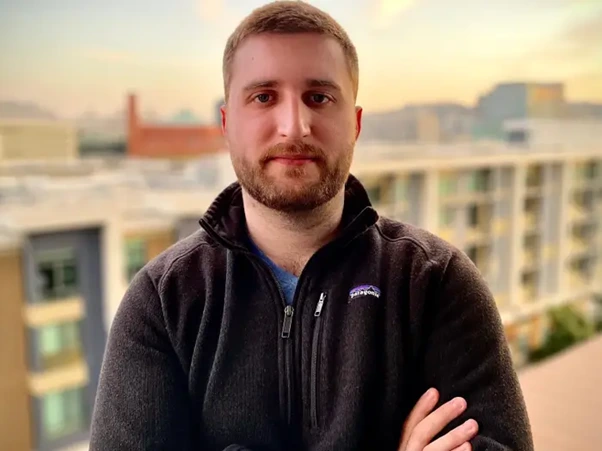
Thomas Perfumo of Kraken on macro trends and crypto market volatility. [Business Insider]
As a result, crypto investors are monitoring economic releases closely. March’s FOMC meeting now carries added focus amid leadership transition discussions.
Rate projections remain fluid as new data emerges. Market participants continue recalibrating positions in response to official statements and public commentary.
For now, the base case points to steady rates in March. Debate over Kevin Warsh’s stance remains central to broader policy expectations in 2026.
FAQs
- What are the current odds of the Fed cutting rates in March 2026?
Ans. Market expectations indicate a relatively low probability, around 17 to 25 percent, that the Federal Reserve will reduce interest rates by 25 basis points at its March meeting. Most traders now anticipate that rates will remain unchanged.
- Why have rate-cut expectations fallen from earlier projections?
Ans. Expectations have moderated due to leadership uncertainty following Kevin Warsh’s nomination as Fed chair and economic data showing resilience in inflation and employment. As a result, many traders now expect a continuation of the current rate pause.
- How could the Fed’s leadership change affect rate decisions?
Ans. Kevin Warsh’s nomination has sparked debate about his likely policy stance. Some view him as hawkish, which could limit early rate cuts, while others believe he may adopt a more flexible approach depending on economic conditions.
- What key data would influence a rate cut decision?
Ans. The Federal Reserve monitors inflation trends, particularly core inflation measures, and labor market strength. Lower inflation closer to the Fed’s target or signs of a weakening job market could increase the likelihood of rate reductions.
- What does market data show about expectations for March?
Ans. Futures and other market tools indicate that most traders expect rates to stay steady at the March meeting, with only a minority betting on a modest quarter-point cut.
- How could a Fed rate cut affect markets such as Bitcoin and other cryptocurrencies?
Ans. Lower interest rates generally encourage higher liquidity and risk-taking, which can support prices for risk assets such as Bitcoin. Conversely, uncertainty or an extended pause in rate cuts can create downward pressure in speculative markets.
- Are analysts united on when the Fed will cut rates?
Ans. No. Analysts and economists are divided, with some expecting rate cuts early in the year and others predicting that rates may remain steady due to persistent inflation and economic strength.
- How many rate cuts might occur in 2026?
Ans. Projections vary. Some traders and analysts see the possibility of one to two rate cuts, while others anticipate a different number depending on economic developments and policy decisions throughout the year.


