

The growth rate of Aldi in Australia is increasing as the German low-cost chain intensifies its affordability message against Coles and Woolworths. The retailer has over 600 stores throughout the country.
However, it has a market share of 10.7% as estimated by the Australian Financial Review. The management considers that more savings will attract the conservative households. Executives are shedding prices and shrinking branded assortments.
Its objective is to achieve lower costs and greater margins. Aldi has also established the first online collaboration with DoorDash. Such a step opens a new digital sales channel.
Aldi Australia’s strategy aims at expanding by efficiency and exclusivity. This can be viewed as a clear interference with established leaders, as seen by investors. The market is monitoring the response rate of the shoppers.

Aldi store exterior emphasising expanding national presence. [Grocery Dive]
Why Is Aldi Expansion In Australia Focusing On Price Cuts?
The retailer is lowering the price of 300 items sold in everyday categories. According to the management, savings should remain transparent and unchanged. Aldi boasts of 16.8 per cent reduced pricing compared to competitors of the same products.
The chain depends on the use of private labels. It has Aldi’s exclusive brands in over 90 per cent of its everyday range. Such products have better profit generation compared to national brands.
Simplicity also decreases the cost of supply. This structure enables the reduction of prices more sharply without reducing returns. Aldi can be the safest option for shoppers who are under pressure due to the cost.
Analysts observe that there is sensitivity in the grocery inflation. As such, price leadership turns out to be a strong attraction.
Range Reductions Reshape The Aldi Supermarket Australia Model
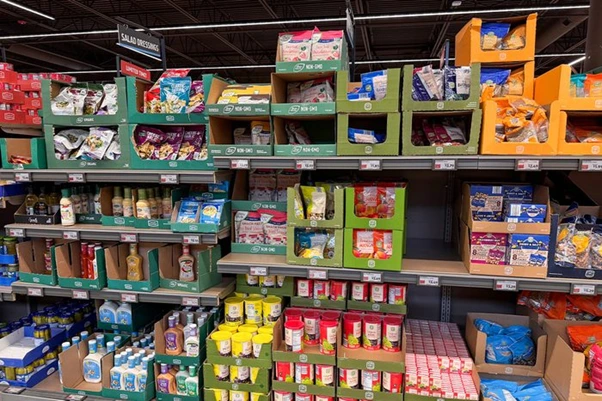
Aldi is lowering the quantity of branded products that it carries. The strategy not only makes shelves easier, but it also accelerates the restocking process. The stores have lean staffing and small-scale designs.
The small range of assortment makes operations predictable. Customers sacrifice diversity in favour of savings. This equation has been successful in Europe and Australia.
Reduced stock-keeping units imply reduced logistics costs. The management claims that simplicity enhances consistency. Some of the shoppers, however, might be missing favourite brands.
The dilemma of value versus choice is still present. Nevertheless, the Aldi supermarket Australia model relies on focus and discipline.

Aldi shelves are filled with image label products. [Reader’s Digest]
Can Coles And Woolworths Defend Their Market Lead?
The powerful structural advantages are maintained by the incumbents. Their chains of stores are larger and more convenient. Product lines are significantly bigger. Aldi stocks between 1,800 products in a store.
The average stock maintained at Coles and Woolworths is around 25,000. Such a distinction favours the one-stop shopping habits.
Analysts advise Aldi to risk losing shoppers who want diversity. It can decrease loyalty in case of the disappearance of favourite brands. The majors also spend a lot on digital services. Comfort is a determining factor for hectic families.
E-Commerce Growth Strengthens The Incumbents
Both chains are experiencing fast online sales. Coles supermarkets expanded the e-commerce sales by 27.9 per cent to 1.3 billion. The e-commerce sales in Woolworths’ Australian supermarket increased by 12.9 per cent to 2.2 billion.
These numbers point to the benefits of scale. Expansive online selections will lead to increased basket sizes. Access is enhanced by home delivery and click-and-collect. Aldi’s collaboration with DoorDash bridges the gap but is premature.
Aldi Australia’s strategy should be equivalent to digital convenience to compete on all fronts. Nevertheless, physical efficiency continues to enable Aldi lower its costs.
The orders for online grocery delivery are being prepared for delivery. [DataWeave]
A Competitive Grocery Battle Intensifies
The industry is currently competing three-way competition. Aldi drives competition in prices and brand exclusivity. Coles and Woolworths are relying on range and technology. Different shoppers are attracted to each of the models.
Discount forms are preferred in times of economic uncertainty. But the majors are the beneficiaries of convenience. Shareholders are not after a fast-paced competition. The share of Aldi could be gradually lifted in the long run in Australia.
Price discipline and continued expansion of the stores will be essential. The following year may change the Australian food shopping habits.
Also Read: Wesfarmers to Close Catch Amid Rising E-Commerce Competition
FAQs
Q1: How many Aldi stores operate in Australia?
A1: Aldi has grown its national store count to more than 600 locations.
Q2: How much cheaper are Aldi prices compared with rivals?
A2: Aldi claims prices are 16.8% cheaper than similar items at Coles and Woolworths.
Q3: How many products does Aldi typically stock?
A3: Aldi stores carry about 1,800 items compared with roughly 25,000 at competitors.
Q4: What is Aldi’s new online strategy?
A4: Aldi partnered with DoorDash to launch its first online grocery delivery service.