
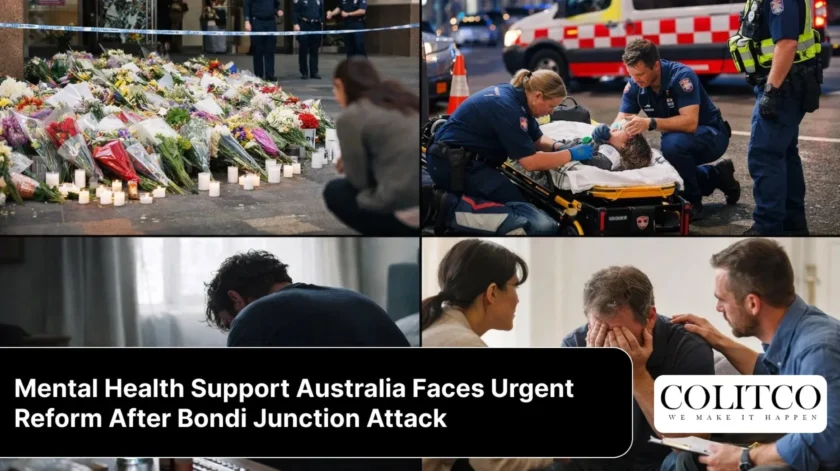
The Bondi Junction attack revealed fundamental flaws in mental health support in Australia that sparked a new round of questioning of the care of schizophrenia. In 2024, the Westfield shopping centre experienced the killing of six individuals and the injury of 10 others.
Joel Cauchi was the attacker who had a history of schizophrenia and was homeless and unmedicated during the attack.
A coronial inquest investigation by a judge, which lasted 837 pages, concluded that warning signs had been missed and that oversight of treatment had been ineffective. The coroner found evidence that there were gaps in psychiatric follow-up and changeover to care that were also contributory.
These results have placed mental health reform in the spotlight of the nation. The tragedy demonstrated how easily vulnerable individuals may fall out of the formal services.

Bouquets of flowers at Westfield Bondi Junction after the deadly stabbing incident. [The Guardian]
Care Failures Highlight Systemic Weaknesses In Schizophrenia Treatment
The report indicated that his psychiatrist prescribed Cauchi medication and released him to a general practitioner in 2020. He then lost frequent contact with the family and public health services.
He later crossed state lines and started sleeping on the streets in Sydney. His psychosis became worse without regular checkups.
Families also expressed concerns, but such warning signs were not taken into definitive action. The coroner indicated that the care that was rendered was one of the reasons that resulted in the unfortunate eventualities.
Researchers claim that schizophrenia needs constant attention and not periodic intervention. Lapses in care are dangerous both to patients and the community.
How Does Untreated Schizophrenia Affect Behaviour And Risk?
Schizophrenia may cause a gross distortion of perception and judgment when not treated. Individuals can be subjected to hallucinations, delusions and intense fear. They can interpret simple occurrences as dangerous.
Acute psychosis may affect the rational thought process and impulse control. Although the majority of the schizophrenic population is not violent, the untreated tend to increase the vulnerability and unpredictability of behaviour.
Medication usually minimises these symptoms and induces risk. Nevertheless, sedation and weight gain are some side effects that make many terminate treatment prematurely. Relapse may happen soon and become rampant.

Mental health experts are demanding earlier intervention and constant attention to patients. [Business Standard]
Family Support And Housing Stability Remain Critical Safeguards
The initial signs of relapse manifestation are often observed by the family and carers. Their observations may be used to take timely actions and avoid a crisis. However, fractionated services often become a challenge for families.
Risk is further increased by a lack of connection to housing and social support. Homelessness enhances the isolation and diminishes the association with clinicians.
Rough sleeping is at all time highs in Australia. There are thousands of severely mentally ill people who lead transient lives, living in cars or in temporary shelters.
There is a low consistency in community outreach to such individuals. Social connections and housing stability are hence critical foundations of recovery.
What Reforms Are Authorities Now Considering Across Australia?
Teresa O Sullivan, a coroner, suggested some structural changes that could stop the recurrence of another Bondi stabbing incident.
She demanded both short and long-term accommodation opportunities that were connected with convenient care. She encouraged more aggressive outreach by psychiatric teams to reach out to people who are homeless.
Clinical associations were requested to revise their recommendations on the deprescribing of antipsychotic drugs. Indefinite monitoring was also recommended in the report for patients who discontinue treatment.
The families ought to be given more explicit counselling on how to tell signs of relapse. More coordination of state health services with federally financed housing programs was also emphasised.

Community health workers promote integrated housing and psychiatric outreach services. [WHO]
Mental Health Support Australia Requires Coordinated Community Investment
According to experts, the mental health budget in Australia is dominated by spending that is hospital-centric. Funding of community services is much less regular. However, home-based care has been proven to do better and decrease crisis admissions.
Experts contend that a proactive approach has to be used instead of a reactionary Emergency response. Electronic surveillance programs and individualised patient models can also be useful in staying in touch.
A mental health national funding venture, like hospital transactions, is being encouraged. The Australians have a growing demand for accessible and efficient care. The Bondi Junction attack has turned out to be a move toward systemic reform and not individual blame.
Also Read: Labour Government Reforms 2026 Drive New Hate Speech Laws After Bondi Attack
FAQs
Q1: What is the focus of the mental health support Australia reforms?
A1: Reforms target continuous monitoring, housing stability, outreach care and improved schizophrenia treatment coordination.
Q2: How many people were affected in the Bondi Junction attack?
A2: Six people died, and ten others were injured in the 2024 incident.
Q3: Why is medication adherence important in schizophrenia care?
A3: Medication reduces hallucinations, delusions and relapse risk, helping maintain stability and safety.
Q4: What solutions are experts recommending?
A4: They recommend housing support, outreach teams, updated prescribing rules and long-term patient tracking.


