
Provaris Energy Ltd (ASX: PV1) (“Provaris” or the “Company”) has taken a significant step toward commercialising its proprietary carbon dioxide transport technology, announcing a partnership with Chinese heavy equipment manufacturer Himile to assess large-scale production capabilities.
The Australian clean energy Company, alongside its development partner Yinson Production, has entered into a Memorandum of Understanding (MOU) with Himile Heavy Equipment Co. Ltd to evaluate the fabrication of specialised liquid CO₂ (LCO₂) tanks at Himile’s manufacturing facility in Rushan, China.
The collaboration marks a crucial transition from design and engineering to industrial-scale manufacturing for Provaris’ innovative compressed gas storage technology.
Strategic Partnership Targets Manufacturing Feasibility
The MOU centres on assessing the commercial viability of producing Provaris’ proprietary LCO₂ tanks, which are designed for Floating Storage and Injection Units (FSIUs) critical to carbon capture and storage operations.
Himile brings substantial credentials to the partnership. Part of the Himile Group established in 1995, the Company commands approximately USD 3 billion in assets and employs more than 30,000 people across its operations in China’s Shandong Province.
The manufacturer has delivered 80% of static equipment and skids for Floating Production Storage and Offloading vessels (FPSOs) developed over the past five years, including more than 25,000 pressure vessels. This track record spans major installations for Floating Liquefied Natural Gas (FLNG) vessels, Floating Production Units (FPUs), and FPSO/FSO projects for global energy and EPC companies.
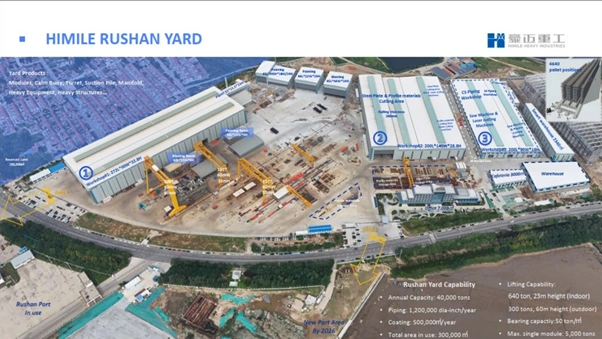
Figure 1: Himile’s Rushan facility features advanced heavy equipment fabrication capabilities and direct deep-water port access [Provaris Energy]
Division of Roles and Responsibilities
The partnership establishes clear responsibilities across the three collaborating parties:
Provaris will develop preliminary designs for robotic fabrication cells, including material selection and laser-welding equipment specifications for installation at Himile’s Rushan facility. The Company will also create a preliminary ‘digital twin’ modelling full automation of the manufacturing process.
Himile will produce preliminary design packages for facility modifications and upgrades at their Rushan site, including installation and commissioning of robotic fabrication cells. The manufacturer will also develop cost estimates for tank fabrication (FOB Rushan) and provide completion timelines for factory upgrades and initial tank deliveries.
Yinson Production will support studies on tank handling from Rushan to selected shipbuilders, including integration of tanks into FSIUs under development during 2026.
A kick-off meeting was held at Himile’s Rushan facility in mid-January 2026, where the scope and division of labour was formalised.
Market Context: Carbon Capture Gains Momentum
The partnership comes amid accelerating global investment in carbon capture, utilisation, and storage (CCUS) infrastructure.
According to the Global CCS Institute, the number of commercial-scale CCS facilities in operation or development reached 628 globally as of 2024, representing a 24% increase from the previous year. The institute projects that achieving net-zero emissions targets will require capturing and storing approximately 1.7 gigatonnes of CO₂ annually by 2030.
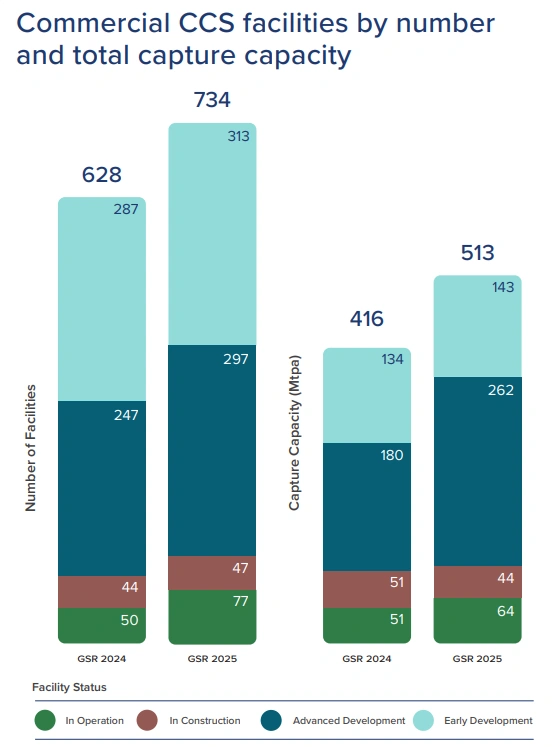
Figure 2: Commercial CCS facilities by number and total capture capacity [GLOBAL STATUS OF CCS 2025]
Maritime transport of captured CO₂ has emerged as a critical enabler for CCUS value chains, particularly for industrial emitters located far from suitable geological storage sites. The International Energy Agency identifies ship-based CO₂ transport as essential for connecting dispersed capture sites to centralised storage facilities, especially in regions like Europe and Asia Pacific.
Provaris’ LCO₂ carrier technology addresses a key bottleneck in the carbon transport chain by enabling large-volume, cost-effective maritime transport of liquefied carbon dioxide.
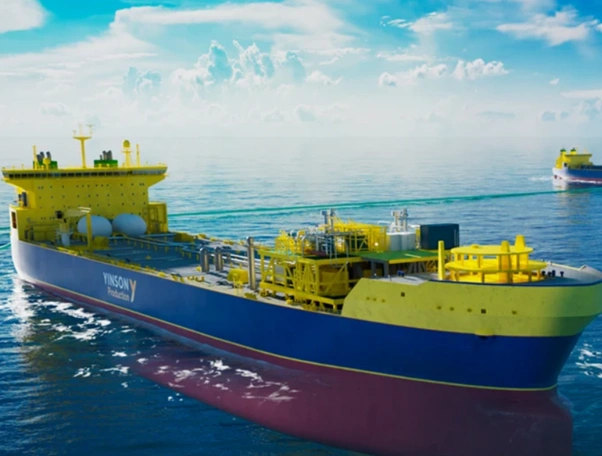
Figure 3: Illustration of an FSIU in the foreground, receiving cargo from an LCO2 carrier in the background [Provaris Energy]
Technical Innovation Through Automation
The collaboration with Himile focuses heavily on advanced manufacturing techniques, particularly robotics and laser welding, to achieve the precision required for large-scale pressure vessel production.
Provaris Chief Technical Officer Per Roed emphasised the importance of Himile’s capabilities: “We are excited to advance the collaboration with Himile on the next phase of the LCO₂ tank development given their expertise and extensive track record. Following our visit to their modern facility and the processes implemented at their Rushan facility, we are confident that Himile can deliver a high-quality, cost-effective tank to meet the expected growth in maritime and offshore LCO₂ markets.”

Figure 4: Per Roed, Chief Technical Officer,Newbuilds, Tankers, LNG, Ports, Operations [Provaris Energy]
Roed noted that the tanks under development will be significantly larger than those currently available commercially, offering cost advantages for Yinson Production’s FSIU projects and potential customers for carriers and storage applications.
Yinson Production’s Chief Technical Officer Lars Gunnar Vogt highlighted the strategic importance of the partnership: “This MOU is an important step in translating advanced tank design into scalable, industrialised fabrication. Working with Provaris and Himile allows us to assess not just technical feasibility, but also manufacturability, cost, and delivery timelines – factors that are critical as we develop FSIU concepts for carbon capture and storage value chains.”
Parallel Development Programs Continue
The manufacturing feasibility study runs in parallel to Provaris’ ongoing Front-End Engineering Design (FEED) and class approval process for the LCO₂ tanks.
The Company submitted final Phase 1 deliverables to Yinson Production in January 2026, with Phase 2 work now underway. The FEED program includes a class approval process with classification society DNV, targeted for completion by mid-2026.
The dual-track approach ensures that tank design, regulatory approval, and manufacturing capabilities progress simultaneously, potentially accelerating time to market.
Strategic Location Advantages
Himile’s Rushan facility offers several logistical advantages for large-scale tank production. The site features:
- Annual capacity of 40,000 tonnes
- Painting capacity of 1,200,000 square metres annually
- Coating capacity of 100,000 cubic metres per year
- Total area of 300,000 square metres
- Maximum single module weight of 3,000 tonnes
- Direct deep-water port access with lifting capability of 640 tonnes and 24-metre height
The deep-water port access is particularly significant, enabling direct loading of completed tanks onto vessels for transport to shipbuilders or integration sites.
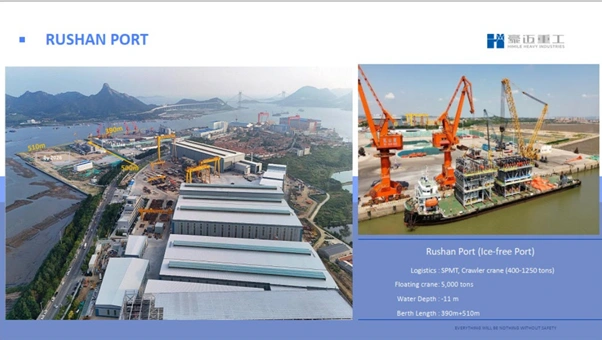
Figure 5: Rushan Port provides ice-free deep-water access with advanced lifting and logistics capabilities [Provaris Energy]
Industry Executive Perspectives
Himile’s President for Himile Heavy Industries, Zongkui Han, expressed enthusiasm for the partnership: “We are delighted to partner with Provaris and Yinson Production on the fabrication of H₂ and LCO₂ tanks – a venture with broad future prospects that is highly aligned with the prevailing policies for carbon capture and hydrogen energy. We are fully committed to leveraging our rich experience in heavy equipment fabrication to contribute to the success of the project.”
The reference to hydrogen tanks suggests potential broader applications for the robotic fabrication capabilities being developed, aligning with Provaris’ dual focus on both hydrogen and CO₂ transport technologies.
Investor Outlook
Provaris continues to position itself at the intersection of two major energy transition trends: green hydrogen production and carbon capture and storage.
The Company’s approach of developing proprietary storage and transport technology, combined with strategic partnerships for manufacturing and project development, creates a differentiated value proposition in the emerging clean energy infrastructure sector.
As of 2nd February 2026, Provaris Energy Ltd (ASX: PV1) shares were trading at $0.012, within a 52-week range of $0.008 – $0.027. The Company maintains a market capitalisation of approximately $10.77 million.
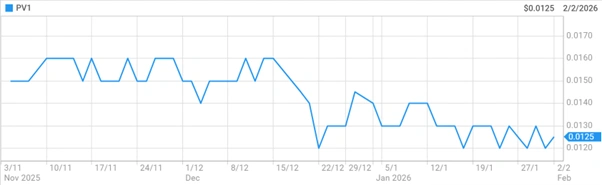
Figure 6: PV1 Price Chart [ASX]
The partnership with Himile represents a significant de-risking milestone, transitioning the LCO₂ tank technology from concept and design phases toward industrial-scale production. Successful completion of the feasibility assessment could position Provaris to capture early-mover advantages in the nascent maritime CO₂ transport sector.
Key near-term catalysts for investors include:
- Completion of DNV class approval (targeted mid-2026)
- Results from Himile manufacturing feasibility study
- Progress on Yinson Production FSIU projects
- Potential customer announcements for LCO₂ carriers or storage
With global CCUS investment accelerating and regulatory frameworks increasingly favouring carbon transport infrastructure, Provaris’ technology development timeline appears well-aligned with market demand trajectories.
The Company’s systematic approach to technology maturation, strategic partnerships, and regulatory compliance positions it as a potential enabler of large-scale carbon transport networks essential to meeting international climate commitments.


