
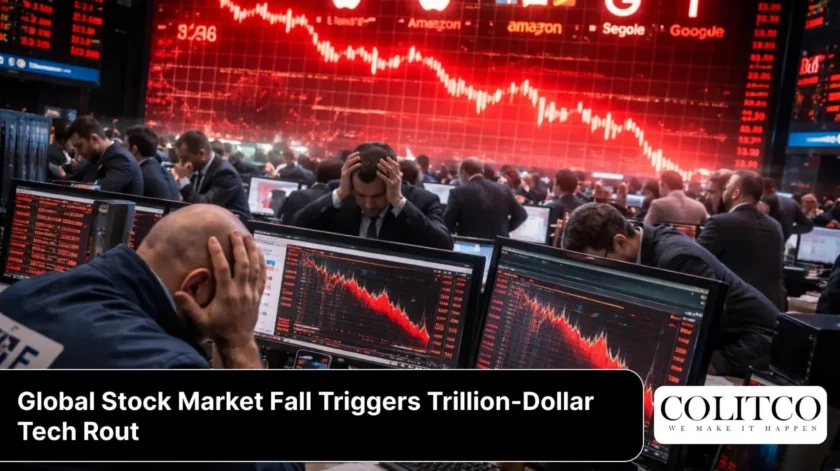
The stock market decline across the globe accelerated this week following an AI-driven shock that wiped hundreds of billions of equities and credit markets around Silicon Valley and across the globe as investors respond to the fear of a potential AI-driven transition to eclipse existing software business models and destabilise the revenue streams.
Stocks, bonds and loans that are associated with technology firms lost colossal sums in just two days, and software stocks managed by iShares ETF have fallen nearly a trillion dollars over the last seven days.
The shrink, according to traders, was abnormally rapid and widespread, cutting across big and small corporations, indicating a structural issue, as opposed to the standard profit-taking.

Traders monitor screens as technological stocks plunge in a global stock market crash. [WSJ]
Why Is The Global Stock Market Fall Accelerating?
The slide took off when AI start-up Anthropic published a legal-oriented tool of automation that analyses contracts and documents, a small launch in itself but sufficient to put investors already nervous about automation taking over white-collar jobs and enterprise software requirements on edge.
According to market strategists, the response is a sign that people are moving off bubble worries and onto worries about actual disruption risks, and investors now reflect the eventualities of AI leaders beating out incumbents before it happens.
With the ongoing deterioration of the AI fear market crash story, investors were moving out of growth names and into safer economic sectors quickly, escalating volatility in the world indexes.
Software Stocks Lead Losses Across Markets
Software shares were the epicentre of the sell-off as valuations contracted at a very high pace, and long-standing confidence regarding ongoing subscription revenues was doubted by analysts evaluating AI-based competition.
There was intense selling pressure even on companies that were regarded as defensive, including large cloud and enterprise platforms, even though they were not losing money.
The sell-off spread to debt markets, with over $17.7 billion of loans in US tech companies falling to levels of distress trading in the last four weeks, highlighting how the downturn has since extended past the equities.
Investors claimed that the pace of repricing demonstrates how fast confidence can turn over when technology changes threaten the model of core revenues.

Software and cloud firms note deep falls as sales are broadening. [Communications Today]
How Are Global Investors Reacting To AI Fear Market Crash?
The fall in the global stock markets is no longer in the hands of Wall Street, since the London Stock Exchange Group, Tata Consultancy Services and Infosys have already fallen due to the fear that the AI replacement will strike the outsourcing and data services.
The US weakness found in Asian and European standards, as it represented anxiety on a global scale. Portfolio managers said that they reduced exposure to technology and increased cash or moved to commodities, banks and utilities.
Most people claimed that they want to know the businesses in front of rebuilding positions and thus, hope is not prevailing.
Credit Markets And Big Tech Show Strain
The stress is already showing cracks among the perceived beneficiaries of AI, and Alphabet committed to more capital investment in artificial intelligence, and the revenue expectations of Arm Holdings fell short of expectations, both leading to after-hours falls.
Lenders and other private equity groups associated with software companies came under pressure when the cost of loans went down.
Microsoft disclosed 15 million paying customers of its Copilot application, a tiny percentage of its overall customer base, which makes it harder to believe that it will be able to monetise its offering in the near future.
Such indicators reinforced the belief that technology stocks decline because of the AI fear and not just because of pure speculative buying.

World markets go down as investors re-examine incomes and AI expenses. [The Economic Times]
What Comes Next For Markets And Technology Leaders?
Analysts believe that volatility will be here to stay as markets re-evaluate which companies will become winners or losers in the AI era, and some believe that the sell-off is a good reset button.
And others predict that there may be more downside to come should the earnings not meet expectations. It may be more favourable to the companies that would incorporate AI in a way that would not endanger their margins, but less powerful ones might not cope with it.
At this point in time, the fear market crash is a prevailing theme that is informing sentiment, and the stock market crash across the world is still challenging investor confidence in most parts of the world.
Also Read: Stock Market Crash Warning Signs Emerge As Gold Surges And Tech Valuations Stretch In 2026
FAQs
Q1: What caused the global stock market fall?
A1: Rapid AI disruption fears triggered heavy selling in software and tech shares worldwide.
Q2: Why do tech stocks fall due to AI fear?
A2: Investors worry AI tools may replace services and shrink traditional software revenues.
Q3: Is the AI fear market crash limited to the US?
A3: No, losses spread across Europe and Asia with similar tech exposure.
Q4: Could markets stabilise soon?
A4: Stability depends on earnings clarity and proof that AI investments deliver returns.


