

Microsoft Corporation reported Microsoft Q2 earnings results on 28 January 2026 that exceeded Wall Street expectations across key metrics. The Company announced revenue of US$81.3 billion for the quarter ended 31 December 2025. This represented a growth of 17 per cent compared to the corresponding period last year.

Figure 1: Microsoft CEO Satya Nadella speaking during a public discussion as the Company reports strong Q2 earnings growth driven by cloud and AI expansion. [Source: Yahoo Finance]
Microsoft Q2 earnings delivered operating income of US$38.3 billion, increasing 21 per cent year-over-year. Microsoft Cloud revenue crossed the US$50 billion milestone for the first time. CEO Satya Nadella stated that Microsoft has built an AI business larger than some of its biggest franchises.
Strong Performance Across Revenue Metrics
Microsoft quarterly profit performance exceeded analyst expectations despite market concerns. Net income on a GAAP basis reached US$38.5 billion, representing 60 per cent growth. Diluted earnings per share came in at US$5.16, surpassing the US$3.92 that Wall Street anticipated.
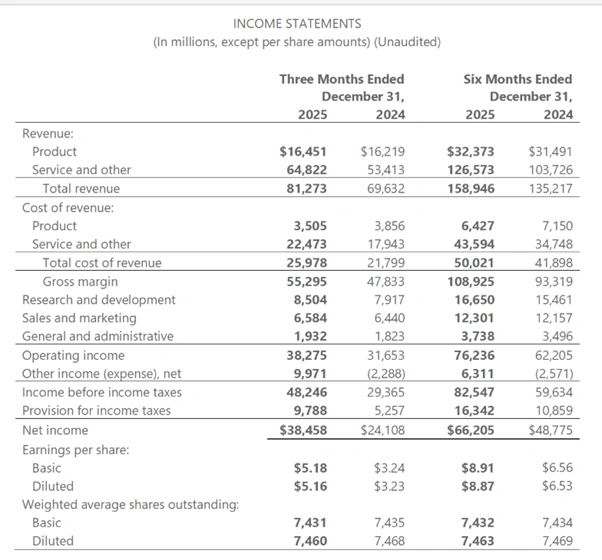
Figure 2: Microsoft income statement for the three and six months ended December 31, 2025, showing strong revenue, operating income and net income growth. [Source: Microsoft Investor Relations]
Microsoft Q2 2026 revenue growth reflected strong demand across the Company’s product portfolio. CFO Amy Hood highlighted that Microsoft exceeded expectations across revenue, operating income and earnings per share. The Company returned US$12.7 billion to shareholders through dividends and share repurchases, marking a 32 per cent increase.
Non-GAAP net income totalled US$30.9 billion after excluding OpenAI investment impacts. This represented 23 per cent growth on an adjusted basis. The adjusted diluted earnings per share of US$4.14 increased 24 per cent year-over-year.
Microsoft Cloud Reaches Historic Milestone
Microsoft Q2 earnings demonstrated the strength of cloud services across customer segments. Microsoft Cloud revenue reached US$51.5 billion, surpassing analyst estimates of US$51.2 billion. This compares to US$40.9 billion in the same quarter last year.
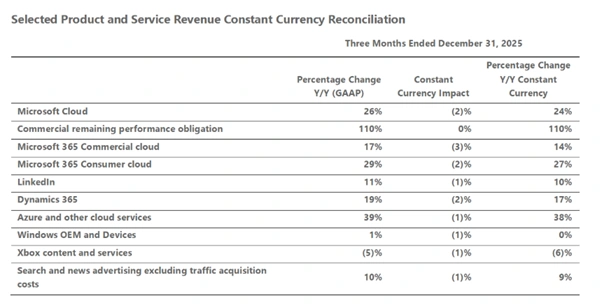
Figure 3: Selected Microsoft product and service revenue growth in constant currency, highlighting strong performance in cloud, Azure and Microsoft 365 segments. [Source: Microsoft Investor Relations]
Commercial remaining performance obligation increased 110 per cent to US$625 billion. Approximately 45 per cent of this total comes from OpenAI commitments. This metric helps Wall Street gauge overall AI demand across Microsoft’s customer base.
Microsoft quarterly profit benefited from expansion across multiple cloud product lines. Azure and other cloud services revenue increased 39 per cent year-over-year. Microsoft 365 Commercial cloud revenue grew 17 per cent during the quarter.
Business Segments Deliver Mixed Results
Microsoft Q2 2026 revenue growth varied across the Company’s three main business segments. Revenue in Productivity and Business Processes reached US$34.1 billion, increasing 16 per cent. Wall Street had anticipated US$33.6 billion for this division.
Microsoft 365 Consumer cloud revenue jumped 29 per cent compared to the prior year. LinkedIn revenue increased 11 per cent during the quarter. Dynamics 365 revenue grew 19 per cent, demonstrating continued enterprise software adoption.
Intelligent Cloud business generated US$32.9 billion in revenue, representing 29 per cent growth. This exceeded analyst estimates of US$32.2 billion. More Personal Computing revenue declined 3 per cent to US$14.3 billion.
AI Capacity Constraints Impact Revenue Potential
Microsoft Q2 earnings highlighted ongoing challenges in meeting AI customer demand. The Company continues facing AI capacity constraints where customer demand outpaces Microsoft’s ability to supply services. This creates an artificial cap on potential revenue growth.

Figure 4: Microsoft corporate branding displayed at Company headquarters, reflecting its global technology and cloud services footprint. [Source: Office Apps]
Microsoft responded by significantly increasing capital expenditures to expand infrastructure. Spending reached US$37.5 billion during the quarter, up from US$22.6 billion in Q2 2025. These investments aim to address capacity limitations and support future growth.
Nadella emphasised that Microsoft remains in the early phases of AI diffusion. He noted the Company is pushing the frontier across its entire AI stack. This approach aims to drive new value for customers and partners.
Segment Performance Shows Varying Growth Trajectories
Microsoft quarterly profit contribution varied significantly across product categories. Windows OEM and Devices revenue increased just 1 per cent during the quarter. Xbox content and services revenue decreased 5 per cent year-over-year.
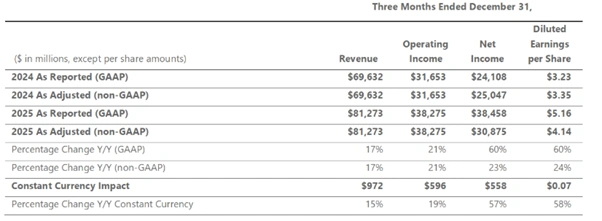
Figure 5: Financial performance reconciliation showing GAAP and non-GAAP revenue, operating income and earnings growth for Microsoft Q2 FY26. [Source: Microsoft Investor Relations]
Search and news advertising revenue, excluding traffic acquisition costs, grew 10 per cent. This demonstrated continued strength in Microsoft’s advertising business. The More Personal Computing segment generated US$14.3 billion, meeting analyst expectations.
Microsoft Q2 2026 revenue growth in constant currency terms showed 15 per cent overall increase. This adjustment removes foreign currency fluctuations to show underlying business performance. Operating income grew 19 per cent in constant currency.
Share Price Declines Despite Earnings Beat
Microsoft Q2 earnings triggered a negative market reaction with shares falling more than 4 per cent. The stock closed at US$481.63 before declining to US$455.35 in after-hours trading. This represented a 5.46 per cent overnight decrease.
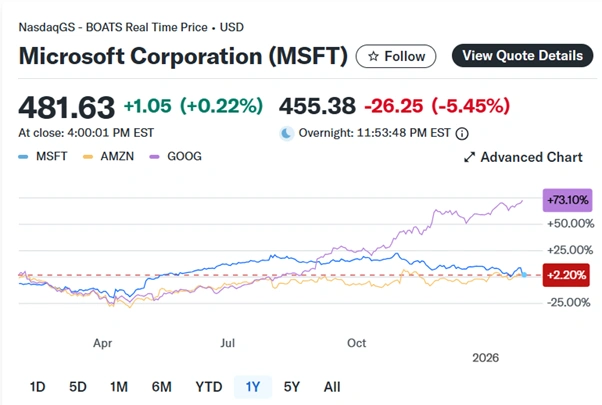
Figure 6: Microsoft share price performance showing a post-earnings decline despite beating analyst expectations on revenue and earnings. [Source: Yahoo Finance]
The decline occurred despite beating both top and bottom line expectations. Investors continue raising concerns about massive AI industry spending levels. Microsoft’s stock price increased just 7 per cent over the past 12 months.
This performance slightly outpaced cloud rival Amazon, which rose 2 per cent during the same period. Google’s stock surged 69 per cent over 12 months, largely tied to its Gemini 3 model debut.
OpenAI Investment Creates Accounting Impact
Microsoft quarterly profit calculations included significant impacts from OpenAI investments. GAAP net income included a US$7.6 billion gain from these investments during Q2 2026. The prior year quarter showed a US$939 million loss.
Microsoft provided non-GAAP figures to aid investor understanding of operational performance. Management considers these adjusted measures alongside GAAP results when evaluating business performance. The Company believes this additional insight helps clarify trends affecting the business.
The OpenAI investment gains increased diluted earnings per share by US$1.02 on a GAAP basis. Excluding this impact provides comparability with prior periods and underlying business trends.
Forward Guidance And Strategic Outlook
Microsoft Q2 2026 revenue growth positions the Company for continued expansion across cloud services. Microsoft will provide forward-looking guidance during its earnings conference call. The Company maintains significant research and development investments to empower customers.
Hood emphasised strong demand for Microsoft’s portfolio of services. The Company delivers hundreds of products, services and enhancements each quarter. These releases stem from years of significant R&D investments.
Microsoft Q2 earnings demonstrated execution on the Company’s cloud and AI strategy. The results reflect momentum in stories showcasing how technology shapes industries and drives customer success.
About Microsoft Corporation
Microsoft Corporation creates platforms and tools powered by AI to deliver innovative solutions. The Company meets evolving customer needs through cloud-based services and software products. Microsoft maintains a mission to empower every person and organisation to achieve more.
The technology company commits to making AI available broadly and responsibly. Microsoft operates across productivity software, cloud infrastructure, gaming and personal computing segments. The Company is headquartered in Redmond, Washington, and trades on Nasdaq under the ticker MSFT.
FAQ
Q1. What were Microsoft Q2 earnings results for revenue?
Ans. Microsoft reported revenue of US$81.3 billion for Q2 2026, representing 17 per cent growth year-over-year and beating analyst estimates.
Q2. How much did Microsoft Cloud revenue reach?
Ans. Microsoft Cloud revenue crossed US$50 billion for the first time, reaching US$51.5 billion during the quarter ended 31 December 2025.
Q3. Why did Microsoft stock fall despite beating earnings?
Ans. Microsoft shares declined more than 4 per cent as investors raised concerns about massive AI industry spending despite strong results.
Q4. What is Microsoft spending on AI infrastructure?
Ans. Microsoft capital expenditures reached US$37.5 billion in Q2, up from US$22.6 billion in the prior year quarter.


