

Chinese-language money laundering networks moved an estimated $16.1 billion in illicit cryptocurrency during 2025, according to new findings from blockchain analytics firm Chainalysis, highlighting the growing scale and sophistication of crypto-enabled financial crime.
Blockchain analytics firms say Chinese-language money laundering networks processed $16.1 billion in illicit cryptocurrency during 2025.
The activity was spread across six major service categories, forming a loosely connected but highly effective ecosystem that allows criminal funds to be received, layered, and redistributed with increasing efficiency. While crypto crime overall has fluctuated in recent years, Chainalysis says these Chinese-language networks remain among the most consistent and industrialised operators in the space.
The findings point to a maturing underground economy that increasingly mirrors legitimate financial services, complete with brokers, escrow-like intermediaries, and specialised laundering tools.
A Networked System, Not Isolated Actors
Chainalysis describes Chinese-language money laundering networks, often referred to as CMLNs, as coordinated service providers rather than single criminal entities. These networks typically operate through Chinese-language platforms, including messaging apps and online marketplaces, connecting brokers, over-the-counter traders, and infrastructure providers.
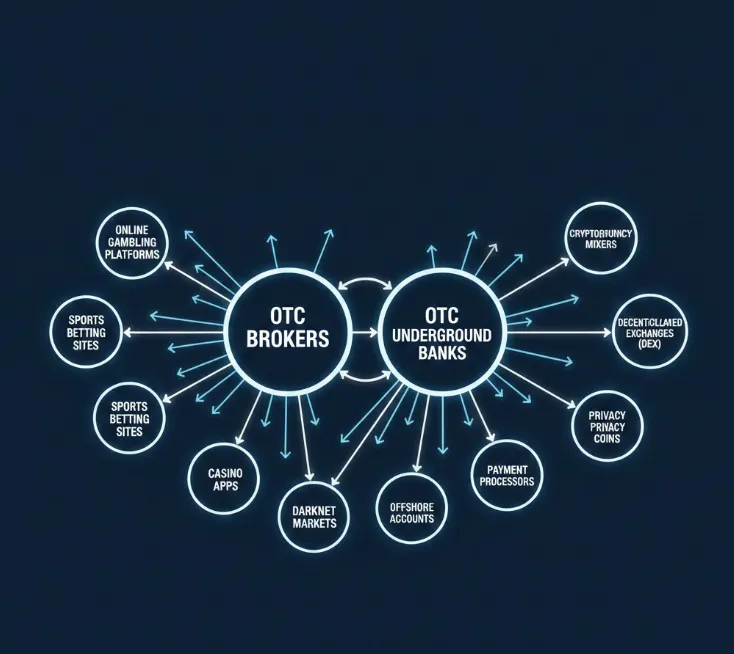
Chinese-language laundering networks operate as interconnected service providers rather than isolated criminal groups.
Rather than handling funds end-to-end, participants specialise in different stages of the laundering process. Some focus on intake, others on obfuscation, and others on cashing out or reinvesting funds through semi-legitimate channels. This division of labour allows the networks to scale quickly and adapt when individual services are disrupted.
According to Chainalysis, the same wallets and service providers frequently reappear across unrelated investigations, suggesting that a relatively small number of facilitators underpin a large share of illicit crypto flows.
$16.1B in Inflows Across Six Service Types
In total, Chainalysis estimates that CMLNs processed $16.1 billion in illicit inflows during 2025, with funds passing through six main categories of services.
These include over-the-counter (OTC) brokers, underground banking services, online gambling platforms, mixing and obfuscation tools, payment processors, and other intermediary services that blur the line between licit and illicit activity.
Rather than relying heavily on privacy coins or decentralised protocols alone, many of these networks continue to use mainstream blockchains and widely adopted tokens, taking advantage of liquidity and ease of transfer before layering transactions to make tracing more difficult.
The reliance on common infrastructure presents both challenges and opportunities for law enforcement, as high transaction volumes can mask illicit activity while also leaving extensive on-chain footprints.
Industry Attention Highlights the Scale of the Problem
The scale of the activity has not gone unnoticed within the crypto research community. Analysts discussing the report on X pointed to Chainalysis data showing that Chinese-language laundering networks handled roughly $16.1 billion in illicit crypto during 2025 across six major service categories, reinforcing concerns about how embedded these operations have become within the broader digital asset economy.
⛓️ Chinese-Language Money Laundering Networks Processed $16.1B in Illicit Crypto: Chainalysis
Chainalysis says Chinese-language money laundering networks (CMLNs) processed $16.1B in inflows during 2025 across six #major service types. #crypto
— CryptOpus (@ImCryptOpus) January 27, 2026
While the social media commentary largely echoed the report’s findings, it underscored a broader industry concern: that laundering services are no longer fringe operations, but an integral layer of the global crypto transaction landscape.
Over-the-Counter Brokers Remain Central
One of the most significant conduits identified by Chainalysis remains over-the-counter crypto brokers, particularly those operating informally or outside regulated exchanges. These brokers often facilitate large trades for clients seeking to avoid know-your-customer checks or transaction monitoring.
In many cases, funds are received in one jurisdiction and settled in another, with brokers using a combination of crypto transfers and traditional banking relationships. This hybrid structure allows illicit funds to be converted, split, or recombined with relative ease.
Chainalysis notes that OTC brokers frequently serve as repeat counterparties for scam operators, ransomware groups, and illicit online marketplaces, making them a critical choke point for enforcement efforts.
Online Gambling Platforms as Laundering Hubs
Another major service category involves online gambling and betting platforms, many of which operate in regulatory grey areas or target users in jurisdictions where such services are restricted.
Illicit funds are deposited, wagered minimally, and withdrawn as purported “winnings,” effectively laundering proceeds while generating a transactional cover story. Chainalysis says this method remains popular due to its simplicity and the high transaction volumes typical of gambling platforms.
Some platforms appear to function primarily as laundering vehicles rather than genuine gaming services, with limited user engagement beyond fund movement.
Obfuscation Tools and Layering Techniques
While mixers and privacy-enhancing services accounted for a smaller share of total inflows compared to OTC brokers, they remain an important part of the laundering process. These tools are often used after initial aggregation, rather than as entry points.
Chainalysis observed increased use of rapid wallet hopping, cross-chain bridges, and nested services to add layers of complexity. Rather than relying on a single obfuscation method, networks combine multiple techniques to frustrate tracing efforts.
This layered approach reflects a shift away from reliance on any single tool that could be sanctioned or shut down.
Links to Scams and Fraud Activity
The report also highlights strong links between Chinese-language laundering networks and large-scale scam operations, including investment fraud, romance scams, and phishing campaigns.
Funds from victims are often funnelled through the same laundering infrastructure, regardless of the original scam type. This reuse of services allows networks to operate at scale while maintaining operational separation from front-facing scam activity.
Chainalysis says this pattern complicates attribution but strengthens the case for targeting service providers rather than individual scam wallets.
Enforcement Pressure and Persistent Adaptation
Despite increased regulatory scrutiny and law enforcement cooperation, Chainalysis notes that CMLNs have shown a consistent ability to adapt. When one service is disrupted, alternatives quickly emerge, often operated by the same facilitators under different branding.
Crackdowns on exchanges and mixers have shifted behaviour, but not eliminated demand for laundering services. Instead, networks have diversified their methods, spreading activity across multiple platforms to reduce exposure.
This resilience suggests that enforcement alone may not be sufficient without broader structural changes, including improved international coordination and tighter oversight of high-risk service categories.
Also Read: UK Inflation Surge Sends Pound To 4-Year High As Dollar Weakens Globally
A Persistent Challenge for the Crypto Ecosystem
Chainalysis concludes that Chinese-language money laundering networks represent one of the most entrenched challenges facing the crypto ecosystem, not because of their technical sophistication alone, but because of their integration into everyday crypto infrastructure.
The $16.1 billion figure underscores how illicit finance continues to coexist with legitimate activity on the same rails. As crypto adoption expands, the firm warns that addressing professionalised laundering services will remain central to reducing overall crypto-related crime.
For regulators, exchanges, and analytics firms alike, the findings serve as a reminder that the battle against illicit finance is increasingly about networks and services, not just individual bad actors.


