
Australia has selected Greg Moriarty, a seasoned defence and intelligence official, as its next ambassador to the United States. The appointment signals Canberra’s intent to deepen strategic ties with Washington at a time of heightened regional tension and shifting global power dynamics.
Prime Minister Anthony Albanese confirmed the nomination describing Moriarty as “uniquely qualified” to navigate the complex relationship between the two allies.
Who Is Greg Moriarty?
Moriarty brings decades of experience in national security and diplomacy. He previously served as secretary of the Department of Defence from 2017 to 2024, overseeing major capability upgrades and the AUKUS security pact negotiations.
Before that role, he held senior positions in the Office of National Intelligence and the Department of Foreign Affairs and Trade. His background spans intelligence assessment, defence policy, and strategic planning.
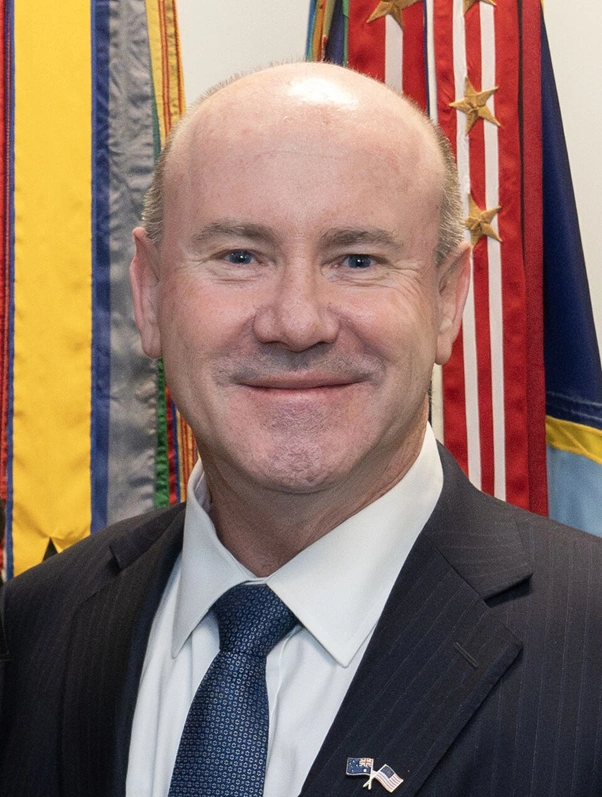
Greg Moriarty brings extensive defence and intelligence experience to the US ambassadorship [Wikipedia]
“Greg has been at the centre of Australia’s most important security decisions,” Albanese said during the announcement in Canberra.
Moriarty replaces Kevin Rudd, the former prime minister who served as ambassador since 2023. Rudd’s tenure was marked by efforts to strengthen economic and climate cooperation between Canberra and Washington.
Why This Appointment Matters Now
The timing reflects Australia’s growing focus on defence and regional stability. Relations with China remain strained despite recent diplomatic thaw efforts. The South China Sea, Taiwan Strait, and Pacific influence remain flashpoints.
Moriarty’s defence expertise positions him to advance AUKUS, the trilateral security arrangement with the US and UK announced in 2021. The pact centres on nuclear-powered submarine technology transfer and advanced defence capabilities.
“This is about ensuring Australia has the strongest possible representation in Washington during a critical period,” said Defence Minister Richard Marles.
Key priorities for Moriarty will likely include:
- AUKUS implementation – Managing the complex submarine program and technology sharing agreements
- Regional security – Coordinating responses to Chinese military expansion and North Korean threats
- Economic integration – Strengthening trade ties and critical minerals cooperation
- Climate and technology – Advancing clean energy partnerships and innovation collaboration
Reaction from Washington and Beyond
The US State Department welcomed the appointment. A spokesperson noted Moriarty’s “deep understanding of Indo-Pacific security challenges and long record of US-Australia cooperation.”
Australian opposition leader Peter Dutton praised the choice, calling Moriarty “a safe pair of hands” who understands the alliance’s strategic importance.
However, some analysts question whether a defence-focused ambassador might overshadow economic and cultural dimensions of the relationship.
“The appointment reflects where Australia’s priorities lie,” said Professor Rory Medcalf from the Australian National University. “Defence and security are front and centre, but we can’t neglect trade, education, and people-to-people links.”
Regional partners have also taken notice. Japan and South Korea, key US allies in the Indo-Pacific, view the appointment as confirmation of Australia’s commitment to collective security arrangements.
The Road Ahead for Australia-US Diplomatic Relations
Moriarty assumes the post as both nations navigate significant domestic and international pressures. The US faces a presidential election later this year that could shift foreign policy directions. Australia balances economic dependence on China with security alignment to America.
The ambassador will work closely with Foreign Minister Penny Wong and Defence Minister Marles to coordinate policy. His first major test may come during the next AUKUS ministerial meetings, where submarine timelines and cost-sharing arrangements require resolution.
The Australia-US alliance faces new tests amid regional security challenges [Freepik]
Trade remains another critical area. Australia seeks greater access to US markets for agricultural products and critical minerals. American firms want clearer pathways for investment in Australian infrastructure and energy projects.
Climate cooperation could expand under Moriarty’s watch. Both nations have committed to net-zero emissions targets and see opportunities in renewable energy technology, hydrogen development, and carbon capture innovation.
What Makes This Diplomatic Role Unique
The US ambassadorship is Australia’s most strategically important diplomatic posting. Washington serves as the gateway to American political power, military planning, and economic influence.
Unlike other envoy roles, the US ambassador must manage relationships across Congress, the Pentagon, intelligence agencies, and state governments. The position requires balancing public diplomacy with behind-the-scenes negotiation.
Moriarty’s intelligence background gives him credibility with US security establishments. His defence experience means he speaks the same language as Pentagon officials and military commanders.
“He won’t need a learning curve,” said Allan Gyngell, former head of the Office of National Intelligence. “He already knows the players and understands how decisions get made.”
Challenges and Opportunities Ahead
Moriarty inherits an alliance in strong shape but facing new pressures. China’s military build-up continues. North Korea’s nuclear program remains unresolved. Climate change threatens Pacific island nations that both countries aim to support.
Technology competition adds another layer. Australia wants access to American artificial intelligence, quantum computing, and space capabilities. Washington seeks Australian rare earth minerals and research partnerships.
The ambassador must also manage expectations. AUKUS submarine delivery timelines stretch into the 2030s and 2040s. Cost estimates keep rising. Public support remains fragile if benefits seem distant or unclear.
“Greg will need to show tangible progress on shared priorities,” said Jennifer Parker from the University of New South Wales. “Patience only goes so far when you’re asking for multi-billion dollar commitments.”
Cultural and educational exchanges offer lower-profile wins. Tens of thousands of Australian students study in America each year. Business partnerships span technology, agriculture, and services. These connections underpin the official relationship.
Historical Context of Australia-US Ambassadors
Australia has sent distinguished representatives to Washington for decades. Former foreign ministers, defence chiefs, and political leaders have held the role during critical periods.
Kim Beazley served during the post-9/11 era, strengthening security cooperation after the 2001 terrorist attacks. Joe Hockey navigated trade tensions during his 2016-2020 tenure. Arthur Sinodinos worked to preserve bipartisan support for the alliance amid American political polarisation.
Each brought different strengths. Moriarty’s profile fits the current strategic environment, where defence and intelligence dominate bilateral discussions.
His appointment also reflects growing professionalisation of Australia’s diplomatic service. Career officials increasingly fill senior posts once reserved for political appointees or high-profile figures.
Also Read: UK Pharmacies at Breaking Point as Painkiller Shortage Deepens
Looking Forward
Greg Moriarty takes up his new role at a pivotal moment for Australia’s place in the world. The US alliance remains the cornerstone of Australian security policy, but managing it grows more complex as great power competition intensifies.
His success will depend on building trust across Washington’s political spectrum, delivering results on AUKUS and other priorities, and maintaining public support for deeper engagement with America.
The appointment sends a clear message: Australia views the US relationship through a predominantly security lens and wants someone who can operate effectively in that space.
Whether that approach proves sufficient in an era of multifaceted challenges remains to be seen.


