

Intel Corporation (NASDAQ: INTC) faced a sharp market reaction as the Intel stock drop reached 17.03 percent, highlighting why Intel stock is plunging in January 2026. Shares fell to US$45.07, wiping around US$31 billion in market value in one session. The fall marked the Company’s steepest daily decline since August 2024.
Figure 1: Intel Corporation logo, representing the semiconductor Company at the centre of the recent Intel stock drop. [TradingView]
The Intel stock drop came despite a fourth-quarter earnings beat. Intel reported US$13.7 billion in revenue, above the US$13.4 billion consensus. Non-GAAP earnings reached US$0.15 per share, nearly double expectations. Investors instead focused on weak first-quarter guidance.
Why Intel Stock Drop Stunned Wall Street Despite Earnings Beat?
The Intel stock drop accelerated after management guided first-quarter 2026 revenue between US$11.7 billion and US$12.7 billion, below expectations. Adjusted earnings were forecast near breakeven versus estimates of US$0.05 to US$0.06 per share. Markets reacted to forward risk, not past results.
The Intel turnaround strategy had fuelled optimism through 2025, with shares rising 84 per cent. Restructuring efforts, government backing and interest from SoftBank and Nvidia lifted sentiment. That confidence faded as guidance reset expectations.
The Company had briefly traded at a four-year high. Bernstein analyst Stacy Rasgon said the stock had taken on “meme-like” characteristics. The outlook failed to meet elevated expectations.
Capacity Limits Cap Near-term Upside
Supply constraints played a central role in the Why Intel stock is plunging in January 2026. Demand for data centre processors linked to artificial intelligence remains strong, yet Intel’s factories are running near capacity.
Chief Financial Officer David Zinsner said available supply will hit its lowest point in the first quarter of 2026. Improvements are expected from the second quarter as efficiency lifts. Analysts from Jefferies and Oppenheimer expect constraints to ease by mid-2026.

Figure 2: David Zinsner, Chief Financial Officer of Intel Corporation, who commented on supply constraints and near-term capacity pressures. [Intel Newsroom]
The Intel turnaround strategy faces execution pressure. Bernstein analysts said Intel misjudged the server cycle. Supply shortages stem from internal manufacturing limits rather than external disruptions.
Chief Executive Officer Lip Bu Tan said yields remain below required levels. While the 18A process transition stays on track, production efficiency lags.

Figure 3: Lip Bu Tan, Chief Executive Officer of Intel Corporation, leading the Company’s turnaround and manufacturing efficiency strategy. [Intel Newsroom]
What Global Memory Costs Mean for Intel Stock Drop Recovery?
Rising global memory prices add pressure following the Intel stock drop. Intel’s Client Computing Group recorded a 7 per cent sales decline in the fourth quarter as laptop prices increased.
Panther Lake AI PC chips mark a technical milestone. However, inconsistent supply and yield challenges may delay impact. The Intel turnaround strategy is unlikely to gain momentum until the second half of 2026.
HSBC analyst Frank Lee said Intel remains a complex turnaround. Customer announcements for the 14A process are expected in late 2026 or early 2027. Revenue impact would follow years later.

Figure 4: Frank Lee, technology analyst at HSBC, who described Intel’s turnaround as complex and long-term. [LinkedIn]
Long-Term Recovery Timeline Tests Investor Patience
The Intel stock drop revealed a huge disconnect between recent hype and near-term reality. After years sitting out the artificial intelligence boom that made Nvidia the world’s most valuable Company, Intel finally enjoys a demand surge. High-profile investments sent shares soaring in recent months. Three big catalysts helped send Intel shares to four-year highs earlier in January 2026.
Wall Street showed growing optimism over demand for traditional computing chips from artificial intelligence data centres. The release of Panther Lake chips made with the latest 18A manufacturing process added momentum. TD Cowen analysts said the rally had been largely driven by the dream rather than near term reality or fundamentals.
Share Price
Intel shares closed at US$45.07 per share on 24 January 2026, down US$9.25 or 17.03 per cent. The stock traded between US$17.67 and US$54.60 per share over the past 52 weeks. Market capitalisation stands at approximately US$186.41 billion.
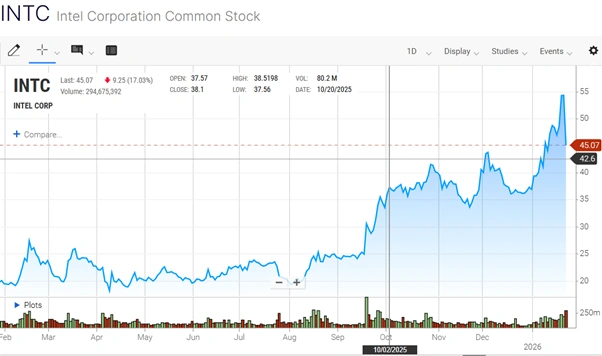
Figure 5: One-year share price chart of Intel Corporation, showing the sharp decline to US$45.07 per share on 24 January 2026. [Nasdaq]
Final Thoughts
The Intel stock drop reflects a market reassessment of execution risk rather than confidence in the Company’s long-term relevance. Demand across data centres and artificial intelligence workloads remains visible. However, near-term supply limits and margin pressure continue to shape investor caution.
The Intel turnaround strategy now enters a critical delivery phase. Cost discipline, yield improvement and capacity utilisation will determine whether momentum can return. Until operational proof replaces expectation, market confidence is likely to remain measured rather than reactive.
Also Read: Australian Open Kia Arena Ignites Drama At Australian Open 2026
FAQ
Q1. Why did the Intel stock drop despite an earnings beat?
Ans. Weak first-quarter 2026 guidance overshadowed strong fourth-quarter results.
Q2. How much value did the Intel stock drop erase?
Ans. The Intel stock drop wiped about US$31 billion in market value.
Q3. What risks affect the Intel turnaround strategy?
Ans. Supply constraints and manufacturing yields remain key challenges.
Q4. When could Intel announce new manufacturing customers?
Ans. Customer announcements are expected in late 2026 or early 2027.


