

Cryptocurrency markets showed greater resilience during 2025 as traders adapted to sharp Bitcoin price movements, growing stablecoin usage, and rising institutional involvement, while broader market sentiment improved heading into early 2026 following renewed confidence across digital asset trading.
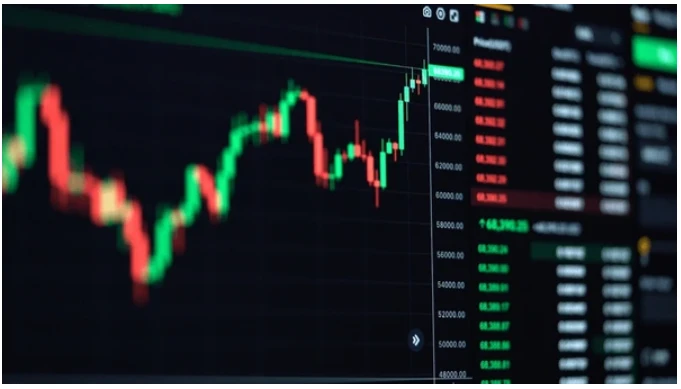
Bitcoin trades through sharp price swings as crypto confidence strengthens across global markets. 9Source: shutterstock)
A year shaped by volatility and global uncertainty
The global financial environment in 2025 was shaped by rising geopolitical tension and expanding trade disputes. The United States imposed new tariffs that triggered immediate retaliation from several countries. These developments introduced uncertainty across financial markets.

Global markets saw rising crypto confidence in 2025 despite tariffs, geopolitical risk, and shifting monetary policy. (Source: freepik)
Despite this, many traditional assets recorded strong performance. The Dow Jones Industrial Average gained 8.7 percent year to date. Gold posted gains exceeding 50 percent over the same period.
Under normal conditions, such economic stress would reduce risk appetite in cryptocurrency markets. Instead, trading activity remained steady throughout the year. Bitcoin moved within a wide range, yet market participation stayed consistent.
Bitcoin surged above $109,000 around the US presidential inauguration in January. That rise was brief, followed by a rapid decline. However, the price soon regained ground and moved back above $100,000.
By April, Bitcoin fell to $75,000. Prices later recovered and climbed to an October high above $126,000. These sharp movements defined the year, yet traders continued to remain active.
Altcoins and Bitcoin move through sharp market cycles
Altcoins followed similar patterns of price instability during 2025. Ripple recorded its highest monthly close in January. Within a single day, it lost 20 percent of those gains.
Major tokens such as Ethereum, Avalanche, Cardano, Polkadot, and Shiba Inu declined between 17 percent and 34 percent during the same period. These losses reflected broader pressure across the market.
Bitcoin also experienced its largest monthly drop since 2022. This downturn coincided with a high-profile exchange security breach, which increased caution among traders.
Part of the pullback was tied to profit-taking after earlier price rallies. Global economic pressure and delays in US monetary easing also reduced risk appetite across digital assets.
Stablecoins record steady growth during market weakness
While cryptocurrency prices moved lower, stablecoins followed a different trend. The combined market capitalisation of major cryptocurrencies declined by 18.6 percent during this period.
At the same time, stablecoins reached a record market value of $226.1 billion. USDC led this growth, adding $16.1 billion in market capitalisation.
This shift showed that traders were not leaving the crypto market. Instead, they moved capital into assets designed to maintain price stability during uncertain conditions.
During this period, Ripple briefly outperformed Bitcoin. Ethereum and Solana recorded deeper declines of 45.3 percent and 34.1 percent, while stablecoins continued to attract inflows.
Exness senior financial markets strategist Quoc Dat Tong said traders were changing how they approached risk. He said the market was moving away from heavy dependence on a few major cryptocurrencies.
Traders expand strategies beyond the ‘Big Four’
For many years, cryptocurrency trading focused on Bitcoin, Ethereum, Solana, and Ripple. These four assets dominated most portfolios and trading activity.
In 2025, a shift began to take shape. Traders moved into stablecoin-based contracts and smaller digital assets. This was not driven by speculation alone.
The goal was to build portfolios that could better manage volatility. Traders sought to reduce exposure to large price swings without leaving the crypto market.
This shift increased demand for advanced trading platforms. High-speed execution, stable pricing, and reliable order processing became more important than ever.
Exness invested in pricing technology and execution systems designed to support this new trading environment. These tools allowed traders to manage positions with greater precision.
Market confidence improves as sentiment turns positive
Early 2026 brought a change in market sentiment. The Crypto Fear and Greed Index moved into the greed zone for the first time since October 2025.
The index rose to 61 from 48 in one day. This change reflected improving trader confidence across the crypto market.
The shift followed Bitcoin’s price stabilisation near $97,704. Reduced volatility also helped restore confidence after the October liquidation event that removed $19 billion from the market.
Improved derivatives market liquidity also supported this recovery. Funding rates returned to more balanced levels, lowering the risk of forced liquidations.
Long-term Bitcoin holders also reduced selling pressure. On-chain data showed stronger holding patterns, which helped support price stability.
Institutional investment reshapes Bitcoin’s supply
Bitcoin’s next market phase is increasingly driven by institutional activity. Ark Invest said Bitcoin has entered a period of greater maturity.
Since 2024, spot Bitcoin exchange-traded funds have attracted more than $50 billion in net inflows. These funds allow institutions to gain exposure without holding Bitcoin directly.
BlackRock and Fidelity funds have accounted for much of this demand. Their purchases have tightened supply and increased market liquidity.
Ark Invest analyst David Puell said ETFs and digital asset treasury companies now hold about 12 percent of Bitcoin’s total supply. This level of absorption exceeded earlier expectations.
Long-term holders have also become more active during price rallies. Early investors have taken profits during high price levels, creating a balance between selling and institutional buying.
Also Read: AFT Pharmaceuticals Accelerates Global Expansion and R&D Pipeline in December Quarter Update
Lower volatility signals a shift in market structure
Bitcoin volatility has declined compared with previous cycles. Large price drops during bull markets have become less severe.
Since the 2022 market bottom, Bitcoin has not recorded a drawdown larger than 36 percent. In earlier cycles, declines of 50 percent were common.
This change has attracted more risk-aware investors. Many now allocate capital with a focus on long-term exposure rather than short-term speculation.
Ark Invest continues to project strong long-term valuations for Bitcoin through 2030. Its models are based on digital gold demand and institutional adoption.
At the same time, stablecoins are taking on a larger role in global crypto usage. This change reflects the evolving structure of digital asset markets as they move into a more measured trading environment.