

The global scramble for critical minerals is intensifying. While lithium and rare earths dominate headlines, another strategic metal is quietly emerging as essential to future technologies.
Niobium demand is forecast to surge from 79.68 kilotonnes in 2025 to 83.19 kilotonnes by 2026. That’s a compound annual growth rate of 9.92%, driven by applications spanning high-strength steel to next-generation battery systems.
For Australian investors, the question isn’t whether niobium matters. It’s which niobium mining companies stock the ASX offers, and which are positioned to capitalise on this growth.
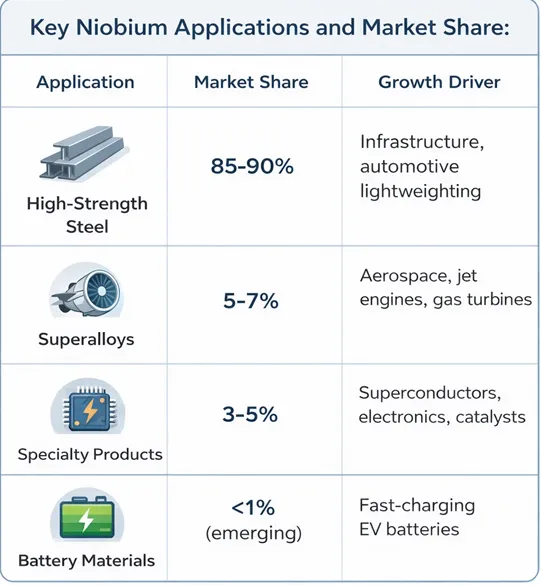
Niobium consumption by end-use application.
The Niobium Value Proposition for 2026
Niobium sits on the critical minerals list for a reason. This refractory metal strengthens steel, enabling lighter yet stronger infrastructure, automotive components, and aerospace applications. Just 0.03% niobium addition can double steel’s strength.
But traditional uses are only part of the story.
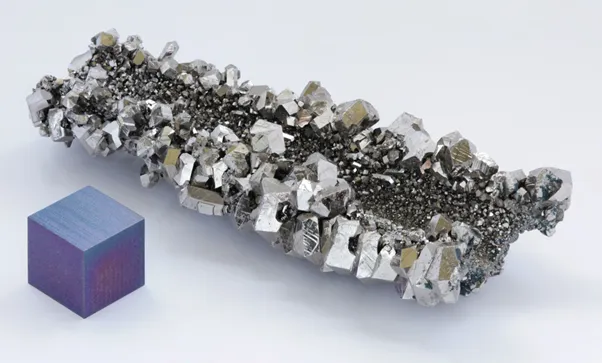
Pure niobium crystals displaying characteristic metallic lustre. [Wikipedia]
CBMM and Toshiba’s collaboration on niobium-based battery anodes promises charging times slashed to under 10 minutes. Quantum computing applications are emerging. Defence systems increasingly rely on niobium alloys for extreme-temperature performance.
The catch? Over 90% of global niobium production comes from Brazil, with CBMM controlling roughly 80% of supply. China dominates downstream processing.
Geopolitical tensions and supply chain vulnerabilities are pushing governments and manufacturers to seek alternative sources. Australian companies with exposure to niobium assets outside Chinese control are drawing attention.
Market Dynamics Shaping 2026
Several factors are converging to create a favourable environment for niobium miners:
Battery Technology Breakthroughs
Electric vehicle manufacturers are testing niobium-doped lithium-ion batteries. Results show faster charging, longer lifecycles, and improved safety compared to conventional chemistries. Commercial rollout could begin within 18 to 24 months.
Infrastructure Spending
Global infrastructure investment is accelerating. The United States alone has committed over USD 1 trillion to infrastructure modernisation. High-strength, low-alloy steels containing niobium are specified for bridges, pipelines, and structural applications.
Defence Procurement Military budgets are rising across Western democracies. Niobium’s role in jet engines, missile systems, and naval applications makes it strategically important. Secure supply chains outside adversarial control are prioritised.
Price Trajectory Ferroniobium prices have steadily climbed from historical lows. While volatility persists, the structural demand story suggests sustained higher pricing through 2026 and beyond.
Australian Companies with Niobium Exposure
While Australia isn’t traditionally known for niobium production, several ASX-listed companies have secured assets with significant niobium potential.
St George Mining (ASX: SGQ)
St George Mining acquired 100% ownership of the Araxá Rare Earths and Niobium Project in February 2025. Located in Minas Gerais, Brazil, the project sits directly adjacent to CBMM’s world-leading niobium operations.
The current Mineral Resource Estimate comprises 41.2 million tonnes at 0.68% Nb₂O₅, alongside substantial rare earth mineralisation. Importantly, drilling continues to intersect high-grade zones, with recent results including 73.6 metres at 1.04% Nb₂O₅.
Mineralisation remains open in all directions. The project benefits from established infrastructure, including road access, power, and a skilled local workforce familiar with niobium mining and processing.
St George is operating three diamond drill rigs around the clock at Araxá. The Company has received government backing through Brazil’s MagBras Initiative, which aims to establish domestic critical minerals supply chains.
Assay results continue to demonstrate thick, high-grade mineralisation from surface. With CBMM providing a proven processing and offtake pathway, Araxá represents one of the more advanced niobium development opportunities globally.
As of early January 2026, St George Mining trades at approximately A$0.041 per share, with a market capitalisation around A$104 million.
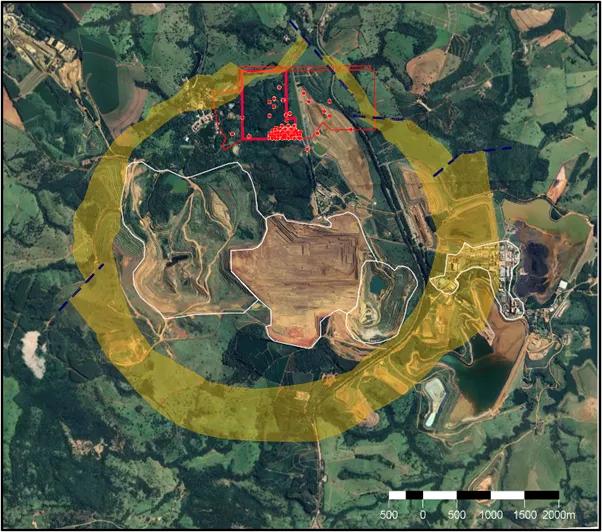
The Araxá Project’s strategic location adjacent to the world’s leading niobium mine [St George Mining]
Other Notable Players
The niobium space in Australia remains relatively concentrated. Most ASX companies with critical minerals exposure focus on lithium, rare earths, or graphite. Pure-play niobium developers are scarce.
Several companies have identified niobium anomalies during broader exploration programs. However, most remain at early-stage reconnaissance. Investors seeking exposure to niobium production growth may need to look beyond Australian-domiciled companies or consider diversified critical minerals developers.
Globally, companies like Niobec (owned by IAMGOLD) in Canada and NioCorp Developments in the United States are advancing niobium projects. These provide alternative exposure for investors comfortable with international markets.
Investment Considerations for 2026
Niobium mining stocks carry distinct risk and opportunity profiles compared to other battery metals or bulk commodities.
- Supply Concentration Risk: CBMM’s market dominance means pricing power rests with a single producer. New entrants face challenges competing on cost unless they can demonstrate strategic value through geography or downstream integration.
- Long Development Timelines: Niobium projects require specialised metallurgy and processing. Permitting, financing, and construction timelines often extend beyond five years from discovery to production.
- Market Size: The niobium market is smaller than copper, nickel, or lithium. While growth rates are attractive, absolute tonnage remains modest. Large-scale producers may struggle to justify capital deployment without diversified revenue streams.
- Strategic Premium: Companies with niobium assets in stable jurisdictions and relationships with end-users may command valuation premiums. Offtake agreements with automakers, steel mills, or defence contractors derisk projects materially.
Demand Drivers Intensifying Through 2026
Multiple trends support the case for niobium demand acceleration:
- EV Adoption Rates: Global electric vehicle sales exceeded 14 million units in 2024. If niobium-enhanced batteries achieve commercial validation, even a 10% penetration rate would require thousands of additional tonnes annually.
- High-Strength Steel Standards: Building codes and engineering specifications increasingly mandate advanced high-strength steels for safety and sustainability. Niobium content in these alloys ranges from 0.02% to 0.1%, but volumes are substantial given steel’s scale.
- Gas Pipeline Expansion: Liquefied natural gas infrastructure buildout requires pipeline-grade steel with specific niobium content for corrosion resistance and weldability in extreme conditions.
- Aerospace Recovery: Commercial aviation is rebounding from pandemic lows. Jet engine orders are rising, with niobium-based superalloys essential for turbine components operating above 1,000°C.
Who Mines Niobium Today?
CBMM’s operations in Araxá, Brazil, account for approximately 80% of global niobium supply. The company produces ferroniobium and niobium oxide from its carbonatite ore body.
Niobec, owned by IAMGOLD, operates a mine in Quebec, Canada, contributing roughly 10% of global output. Anglo American previously owned this asset before divestment.
Smaller producers in Russia and elsewhere supply niche markets or strategic stockpiles. However, Western supply chains are actively seeking to reduce dependence on Russian sources.
Currently, no Australian-based company operates a producing niobium mine. St George Mining’s Araxá Project, if developed, would establish Australia’s first significant exposure to niobium production, albeit through a Brazilian asset.
What Is Niobium Worth?
Niobium pricing is opaque compared to exchange-traded metals. Ferroniobium (FeNb) trades are typically negotiated bilaterally between producers and consumers.
As of late 2025, ferroniobium prices ranged between USD 45 and USD 50 per kilogram of contained niobium. Historical prices fluctuated between USD 35 and USD 55 per kilogram over the past decade.
Pure niobium metal commands significantly higher prices, often exceeding USD 60 per kilogram, but volumes are minimal compared to ferroniobium.
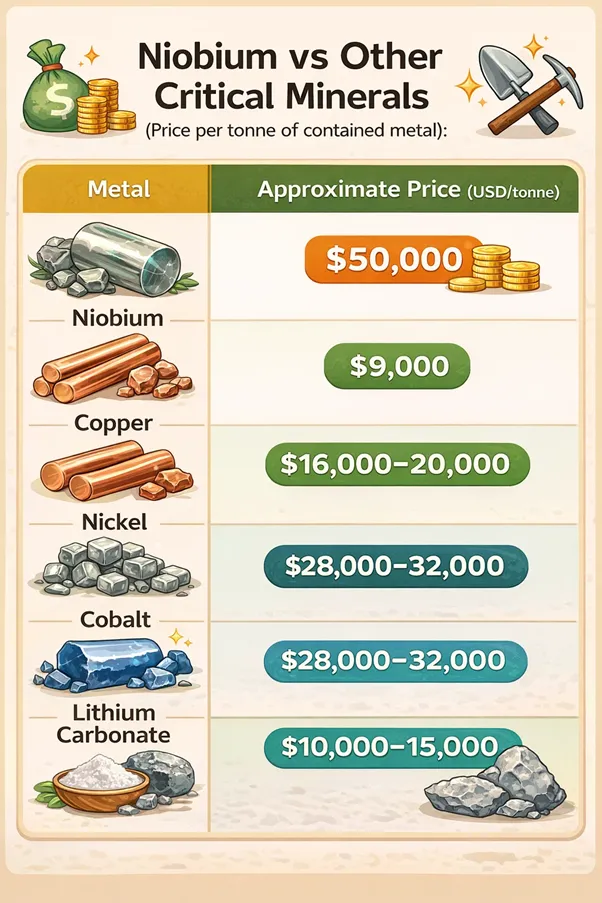
Price comparison showing niobium’s premium to base metals
For context, a tonne of contained niobium at USD 50 per kilogram equals USD 50,000. This compares favourably to copper at approximately USD 9,000 per tonne or nickel at USD 16,000 to USD 20,000 per tonne.
Project economics depend heavily on ore grades, processing costs, and capital intensity. High-grade carbonatite deposits like those at Araxá benefit from simpler metallurgy and economies of scale compared to lower-grade occurrences.
Is Niobium More Expensive Than Gold?
No. Gold trades around USD 80,000 per kilogram as of January 2026. Niobium ferroniobium prices approximate USD 50 per kilogram of contained metal.
However, this comparison is somewhat misleading. Gold is a monetary metal and a store of value. Niobium is an industrial commodity consumed in manufacturing.
Pure niobium metal costs more than ferroniobium but remains far cheaper than gold on a per-kilogram basis. The confusion may arise from small-lot specialty pricing for research-grade materials.
The Outlook for Niobium Demand
Market forecasts consistently point toward sustained niobium demand growth through 2030 and beyond. According to industry analysis, the market is expanding, driven by infrastructure, automotive, and aerospace applications. Several factors underpin this optimism:
- Urbanisation in Developing Economies: Infrastructure buildout in India, Southeast Asia, and Africa requires vast quantities of high-performance steel.
- Decarbonisation Mandates: Lightweighting vehicles to improve fuel efficiency and reduce emissions drives advanced high-strength steel adoption. Niobium is essential to achieving the required properties.
- Energy Storage Evolution: Beyond lithium-ion, researchers are exploring sodium-ion, solid-state, and other chemistries. Niobium’s versatility positions it for multiple next-generation technologies.
- Superconducting Applications: Niobium-titanium and niobium-tin alloys dominate superconducting magnet production for MRI machines, particle accelerators, and fusion reactor research.
Supply responses remain constrained. CBMM can incrementally expand production, but large-scale greenfield projects require years to develop. This supply-demand imbalance favours existing producers and near-term developers.
Final Thoughts
Niobium isn’t grabbing headlines the way lithium did in 2021 or rare earths in 2023. That may be precisely why savvy investors are paying attention now.
The fundamentals are compelling. Demand is rising across multiple end-use sectors. Supply is concentrated and geopolitically exposed. Prices have stabilised after years of volatility.
For Australian investors, direct exposure options are limited but growing. St George Mining’s Araxá Project represents the most advanced opportunity to participate in niobium’s growth story through an ASX-listed vehicle.
Whether niobium becomes the next critical minerals success story depends on execution. Projects must advance through permitting, secure financing, and reach production. But for companies that successfully navigate these hurdles, the rewards could be substantial.
2026 may prove a pivotal year for niobium. The companies moving decisively now could define the sector for decades.
Also Read: US Treasury Taps Australia and India to Break China’s Grip on Critical Minerals
Frequently Asked Questions
Q: Who mines niobium in Australia?
A: Currently, no niobium mines operate within Australian territory. However, ASX-listed St George Mining owns the Araxá Niobium and Rare Earths Project in Brazil, providing Australian investors with exposure to niobium production potential.
Q: What companies mine niobium globally?
A: CBMM in Brazil dominates global production with approximately 80% market share. IAMGOLD’s Niobec operation in Canada supplies around 10%. Smaller producers exist in Russia, with emerging projects in the United States and elsewhere at various development stages.
Q: Who is the largest producer of niobium?
A: CBMM (Companhia Brasileira de Metalurgia e Mineração) is the world’s largest niobium producer by a significant margin. The Brazilian company has operated its Araxá mine for over 60 years and supplies roughly four-fifths of global ferroniobium demand.
Q: How much is a tonne of niobium worth?
A: At current ferroniobium prices around USD 50 per kilogram of contained niobium, a tonne of pure niobium would be worth approximately USD 50,000. However, niobium is typically sold as ferroniobium alloy rather than pure metal.
Q: Is niobium in demand?
A: Yes, demand for niobium is growing steadily, forecast to increase from 117.45 kilotonnes in 2025 to 188.47 kilotonnes by 2030. Applications in high-strength steel, batteries, aerospace, and defence are driving consumption higher.
Q: Is niobium more expensive than gold?
A: No, niobium is significantly cheaper than gold. Ferroniobium trades around USD 50 per kilogram, while gold trades near USD 80,000 per kilogram. Niobium is an industrial metal, whereas gold serves as a monetary asset and store of value.