

The Sunshine State has joined an exclusive club that most residents never wanted membership in.
Queensland’s mean dwelling price has breached the $1 million barrier for the first time, according to the latest data from the Australian Bureau of Statistics. The milestone was reached in the September quarter of 2025, with prices climbing 3.5 per cent to hit $1,005,600.
This makes Queensland only the second state after New South Wales to record a seven-figure average price for Australia’s residential dwellings.
Record Surge Defies National Slowdown
The $33,900 quarterly jump caught many analysts off guard.
While national dwelling values rose more modestly by 2.7 per cent to reach $11.9 trillion, Queensland’s growth rate outpaced every state except Western Australia and the Northern Territory. Dr Mish Tan, ABS head of finance statistics, confirmed the shift represents an $91,400 increase compared to the same period in 2024.
“Queensland is the second state after New South Wales with a mean dwelling price of over $1 million,” Dr Tan stated in the official release.
The rapid escalation follows Queensland overtaking the Australian Capital Territory as the nation’s second-most expensive property market back in March 2025. At that time, the Queensland mean dwelling price stood at just $944,700.
Within six months, that figure jumped another $60,900.
Brisbane Leads Suburban Surge Into Million-Dollar Territory
The transformation extends far beyond state-level statistics.
Research from Cotality reveals that 38 Brisbane suburbs entered the million-dollar median value bracket over the past year alone. The capital city recorded more new entrants than any other Australian city, pushing its total to 205 suburbs with seven-figure price tags.
Regional Queensland hasn’t been spared either. The Gold Coast, Sunshine Coast, and previously affordable areas like Toowoomba now host 141 markets with median values exceeding $1 million.
- Capalaba
- Boondall
- Keperra
- Oxley
- Springwood
- Murrumba Downs
- Nerang
- Pelican Waters
- East Toowoomba
These suburbs all crossed the threshold in 2025, according to the analysis covering 4,844 property markets nationwide.
Even more remote locations have felt the pressure. Castle Hill in Townsville and Cannon Valley near Airlie Beach now feature median prices above the million-dollar mark.
Migration Pressures Meet Supply Constraints
The price explosion didn’t occur in a vacuum.
Queensland’s population growth has been supercharged by both interstate and overseas migration. While national net overseas migration fell to 315,924 people in the year to March 2025, down 36 per cent from the previous year, internal migration patterns tell a different story.
Australians continue fleeing Sydney and Melbourne in search of Queensland’s more affordable lifestyle and warmer climate.
The state added approximately one new dwelling for every three new residents during the first quarter of 2025, according to housing supply data. That ratio falls well short of the average household size of 2.5 people, creating a structural mismatch between demand and supply.
Victoria came closest to balance with one new home per 2.1 residents. Queensland and Western Australia, despite their rapid growth, built far too little to accommodate incoming population.
Regional centres like Hervey Bay, Cairns, and Townsville have seen consistent demand from retirees and younger families alike. Brisbane continues attracting overseas migrants and students, boosting both rental and ownership markets.
Affordability Crisis Deepens for First-Time Buyers
The million-dollar milestone carries significant implications beyond symbolic value.
Cotality economist Kaytlin Ezzy noted that a household earning the average income of $106,000 would need to dedicate more than 50 per cent of pre-tax earnings to service a loan on a million-dollar property with a 20 per cent deposit.
Three out of four key affordability metrics have now hit record highs in Australia:
- Price-to-income ratio
- Years required to save a deposit
- Share of income needed for rent
The only metric showing modest improvement is the portion of income required to service a new mortgage, which dropped slightly to 45 per cent following three Reserve Bank interest rate cuts since February 2025.
“For first home buyers, the metrics are pretty disappointing,” said Eliza Owen, Cotality’s head of research. “There’s this real disparity between where incomes are and where property prices are that show a kind of structural shift in who can access the market.”
Canstar estimates Queenslanders now need to earn approximately $100,000 more per year to afford a typical home compared to pre-pandemic levels.
NSW Maintains Top Spot Despite Queensland’s Rapid Ascent
New South Wales remains Australia’s most expensive property market by a comfortable margin.
The state’s mean dwelling price reached $1,295,900 in the September quarter, maintaining a roughly $290,000 premium over Queensland. However, Queensland’s 3.5 per cent quarterly growth rate suggests that gap could narrow if current trends persist.
The Australian Capital Territory, previously Australia’s second-most expensive jurisdiction, now sits in third place with a mean price of $968,100.
At the opposite end, the Northern Territory maintains the lowest mean price at $564,100, though even this increased by 5.3 per cent or $28,400 during the September quarter.
Western Australia recorded the largest dollar increase of any state, with prices rising $40,800 or 4.5 per cent. This growth reflects Perth’s transformation from an overlooked market to one surpassing Melbourne’s median dwelling value for the first time in over a decade.
Total National Housing Wealth Hits $11.9 Trillion
Australia’s residential property market continues breaking records across multiple metrics.
The total value of the nation’s residential dwellings increased by $317.0 billion during the September quarter to reach $11.9 trillion. Households own $11.46 trillion of this wealth, with the remainder held by investors and institutions.
The number of residential dwellings rose by 53,800 to 11,410,700 nationally. The national mean price jumped $23,000 to $1,045,400 during the quarter, marking continued upward momentum despite affordability concerns.
All states and territories recorded dwelling value increases, with New South Wales (+2.4 per cent), Queensland (+4.0 per cent), and Western Australia (+4.9 per cent) leading the charge.
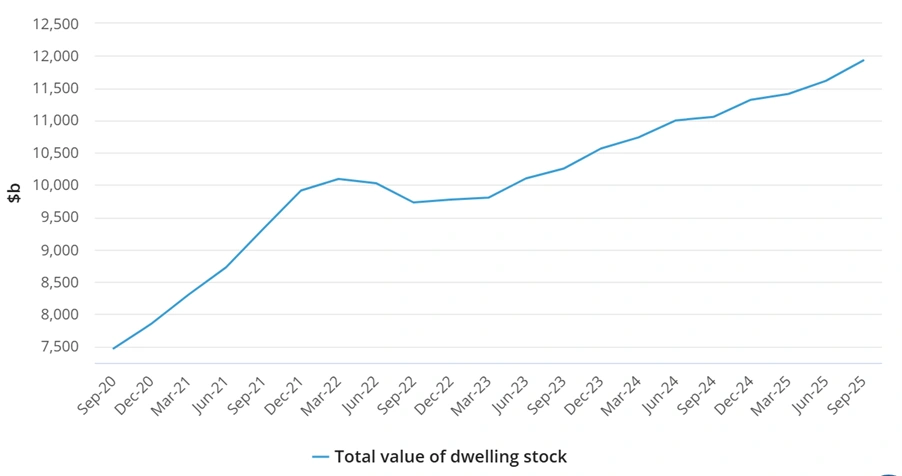
Total value of dwelling stock, Australia
Future Outlook: Growth Expected Despite Headwinds
Market forecasters anticipate continued price increases across 2025 and beyond.
A Reuters poll of 17 real estate analysts conducted between May and June 2025 projected national home prices would rise 4.0 per cent in 2025. Annual increases of 5.0 per cent are forecast for both 2026 and 2027.
Brisbane, Adelaide, and Perth are expected to lead capital city growth with gains around 5.0 per cent in 2025. Sydney and Melbourne face more moderate expectations of approximately 3.5 per cent growth.
The National Housing Supply and Affordability Council projects that gross new housing supply will remain subdued through early 2027, averaging around 183,000 dwellings annually. Over the five-year Housing Accord period, total output is expected to reach 938,000 dwellings, falling short of the 1.2 million target by approximately 262,000 units.
Queensland, New South Wales, Tasmania, and the Northern Territory are projected to show the weakest target attainment rates.
Building approvals data offers some positive signals. ABS figures show approvals rose 17.80 per cent year-on-year in the first half of 2025, with 96,198 dwellings approved between January and June.
Whether this translates to actual construction remains uncertain given ongoing material shortages and labour constraints in the construction industry.
Social Housing Waitlist Hits Crisis Levels
The affordability squeeze extends beyond home ownership into rental markets.
Queensland’s social housing register grew by 4.1 per cent in the March quarter 2025 to reach 52,031 people. The waitlist has expanded consistently despite government initiatives aimed at increasing supply.
Rental vacancy rates across Queensland sit at just 0.9 per cent statewide, with some regions recording rates as low as 0.1 per cent. This represents well below the 3.0 per cent level considered healthy for balanced rental markets.
Young people face particularly acute challenges. According to the 2021 Census, 4,833 young people aged between 12 and 24 were homeless in Queensland on census night, accounting for 22 per cent of the state’s total homeless population.
The Queensland Council of Social Service’s 2022 Rental Affordability Snapshot showed zero affordable housing options available to students living in share-house accommodation and receiving Youth Allowance.
Olympic Development Adds Fuel to Fire
Infrastructure investment ahead of the Brisbane 2032 Olympic Games continues driving large-scale development.
Major transport upgrades, hospital expansions, and new schools are directly impacting housing demand and property values. Regional centres like Hervey Bay have also seen healthcare expansions and tourism-focused developments supporting long-term population growth.
These projects boost local employment while making communities more attractive to buyers and investors. However, they also contribute to near-term demand pressures in an already constrained market.
Also Read: Greens Attack Labor’s AI Strategy as Government Dodges Dedicated Regulation
FAQs
Q: What is the current average dwelling price in Queensland?
A: Queensland’s mean dwelling price reached $1,005,600 in the September quarter 2025, marking the first time it has exceeded $1 million.
Q: How does Queensland’s dwelling price compare to other Australian states?
A: Queensland now has the second-highest mean dwelling price in Australia, behind only New South Wales ($1,295,900). It surpassed the ACT ($968,100) to claim this position.
Q: Why have Queensland property prices risen so dramatically?
A: The surge is driven by multiple factors including strong interstate and overseas migration, limited housing supply, infrastructure development ahead of the 2032 Brisbane Olympics, and relatively better affordability compared to Sydney and Melbourne.
Q: How affordable is Queensland housing for first-time buyers?
A: A household earning the average income of $106,000 would need to dedicate over 50 per cent of pre-tax earnings to service a million-dollar property loan with a 20 per cent deposit, making home ownership increasingly unattainable for many.
Q: What is Australia’s national mean dwelling price?
A: Australia’s national mean dwelling price stands at $1,045,400 as of the September quarter 2025, with the total value of residential dwellings reaching $11.9 trillion.


